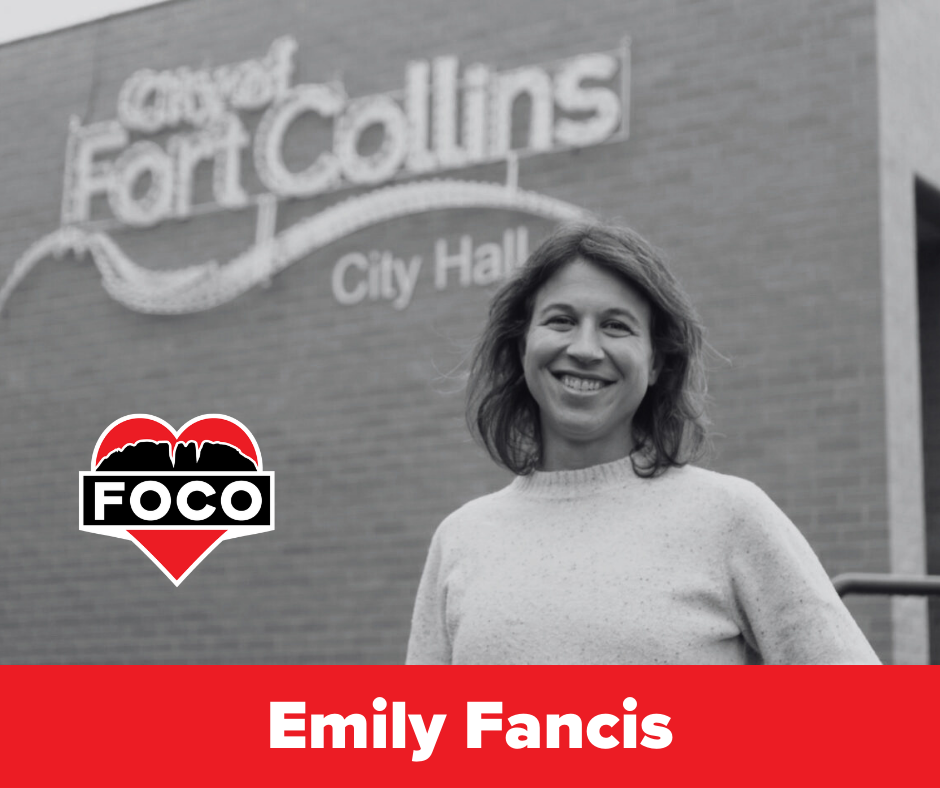

Emily Francis is the Mayor of the City of Fort Collins, where she focuses on affordability, equity, and values-driven leadership. Born and raised in Fort Collins, she attended Laurel Elementary, Lesher Middle School, and Fort Collins High School before earning her degree from Colorado State University and a master’s in public health from Portland State University. Before entering public service, Emily worked in nonprofit leadership, including community organizing with mobile home park residents and senior nutrition programs. She was first elected to City Council in 2019 and became Fort Collins’ first millennial mayor in 2025.
Cities across the country are wrestling with affordability, rapid growth, and maintaining their identity. As communities expand and housing prices rise, leaders face difficult decisions about density, economic development, and who gets to stay. How can a growing city preserve its soul while ensuring people from all income levels can call it home?
According to Emily Francis, Mayor of the City of Fort Collins, meaningful change begins with values-driven leadership and a deep commitment to affordability. Drawing from her lived experience growing up housing insecure and her work in nonprofit community organizing, she believes cities must intentionally bend the trajectory of rising costs through smart infill development, thoughtful job attraction, and policies that allow workers to live where they serve. For her, protecting community identity means protecting access.
On this episode of The Love FoCo Show, Jeff Faust welcomes Emily Francis for a conversation about leadership, affordability, and the evolving identity of Fort Collins. Emily shares her journey from nonprofit work to city hall, discusses the hidden cost of public service, and explains why authenticity and values-based decisions guide her approach as mayor.
Narrator: This is the Love FoCo Show.
Emily Francis: It's really hard when people are really upset with you to want to try and, okay, well, how are we gonna do this? You know, mate. And it's like, no, at the end of the day, I'm showing up because this is what I said I wanted to do, and this is how I said I was gonna lead. And so it's just, like, repeatedly coming back to that.
Narrator: Welcome to the Love FoCo Show. Our podcast highlights the incredible people who make Fort Collins the place we're proud to call home. Each week, your host, Jeff Faust, sits down with local leaders, community champions, and changemakers to share their stories, what they love about our city, and how they're helping it thrive. So whether you're out on the trail, at a brewery, or walking through Old Town, thanks for tuning in.
Jeff Faust: Hey, everyone. Jeff Faust here, your host for the Love FoCo Show. Thanks for tuning in. And today, you are gonna love my most recent conversation with Mayor Emily Francis, our newest mayor in Fort Collins. I'm a millennial.
She's a millennial. I think you're going to love this conversation. I know I did. She talks a lot about her upbringing and journey to council member and mayor. The price and cost of leadership that sometimes I think is hidden, and what it means to continually show up to make values-based and values-driven decisions.
It was a great conversation, and I'm so excited to share with it share you with it, today. Well, Emily, thank you so much for sitting down with me for the Love FoCo Show. Welcome to the podcast.
Emily Francis: Thank you for having me.
Jeff Faust: You are the second no. Third mayor that I've had the privilege of interviewing, but the current mayor, of course, of Fort Collins. And, man, I know your schedule is probably way busier than mine. And so thank you so much for sitting down and spending some time with me.
Emily Francis: Happy to make time. Yep.
Jeff Faust: I I watched your campaign from afar, and, you know, the interwebs can tell me a lot about a person to this point, passions, desires, things they're hoping for for our city. I I totally wanna talk about all that stuff. I'd love for you to just riff on our city for a while and talk about your hopes and dreams. But I wanna start this conversation the way I start every conversation in this podcast and just kind of talk about your Fort Collins origin story. So many people are moving here.
It seems like there are still natives around and but they're being diluted.
Emily Francis: They're out there.
Jeff Faust: I'm definitely a transplant in from from Kansas City, but I don't think I ever want to leave. But tell us about your origin story. Were you born and raised here? Like, what was that like? And Yeah.
And just fill us in on on some of the story behind the story.
Emily Francis: Sure. My origin story starts at Poudre Valley Hospital
Jeff Faust: Love it.
Emily Francis: Where I was born, which is now UC Health. Yes. So no more Poudre Valley Hospital. But, yeah, I was born and raised here in Fort Collins. I feel like when you're from Fort Collins, you always have to say what schools you go to.
That's, like, a pre work.
Jeff Faust: I was, like, already thinking now. Like, what's your track?
Emily Francis: Yeah. Laurel, Lesher, Fort Collins High School. Sweet. It was great. Yeah.
So and, you know, I actually grew up for a stint in what is now the city's Natural Resource Building. Really? So when I was a kid, I lived there. It's on this old farm, and the city bought it, then we had to move out of it. So our city attorney now was that was one of her…
Jeff Faust: They call eminent domain on that?
Emily Francis: No. They just they just bought it. But the city attorney, that was one of the projects she works on. So I always had to give her a hard time about Yeah. Buying the house that I
Jeff Faust: Yeah.
Emily Francis: I lived in. But it was a great area. You know? Grew up next to what is now a bunch of the natural areas. At the time, it was an old sugar beet farm, and so there's a ton of sugar beet on on the grounds, and you could go play
Jeff Faust: in it. It was like I've learned this is a big part of our agricultural history. Yes. Which I did I mean, I would have had I grew up in Iowa, moved from Kansas City, grew up in Iowa. And, you know, it's just corn, soybeans, hogs.
And Mhmm. But, like, when we moved out here, it's just different weather. The soil's different. Yeah. And then I think a couple years into living here, they built the sugar beet, at least what I call the sugar beet park.
Mhmm. You know, just right off Lemay. Yeah. Yeah. And I remembered, like, digging into that.
I was like, why is this an icon? And then I I got lost in a trail of of history and research and all kinds of things.
Emily Francis: Yeah. I mean, when I was a kid, there was mounds of sugar beet sugar. Really? And you could and it was, white, and you just went and played in it. And, like
Jeff Faust: That's…
Emily Francis: I mean, that was, a thing over by where I lived. And so, yeah, there is a long history with that. And I had the opportunity. I lived next to the bike path, and I lived it wasn't a natural at the time. Now it is.
But I moved around a lot in Fort Collins, and, you know, that was, a big part of my story. And my campaign was talking about affordability because my story in Fort Collins was growing up pretty low income and relying on Fort Collins and residents and how there was, like, such a good community to take care of each other. Yeah. And so, you know, when I graduated from high school, didn't go to college right away. I went and worked in Steamboat as a ski boat for a few winters.
Jeff Faust: That feels very Colorado.
Emily Francis: It was very Colorado. Yeah. I lived in Alaska for a summer Yeah. Working in Denali, which is a town of three hotels.
Jeff Faust: Yeah.
Emily Francis: Then I lived in Seattle, and I ended up moving back and graduating from CSU.
Jeff Faust: Okay.
Emily Francis: And then I moved to Oregon to get a master's in public health. Okay. Lived out there for a while, and then I came back. I have five sisters. Five of us all six of us were living outside of Colorado, and all of us moved back.
Jeff Faust: It has a way… Of bringing you back.
Emily Francis: It does. Now they're all traders. They live in non four counts. They live in Denver, Buena Vista, Breckenridge, and Aurora. So but now we're all back in The States.
I moved around back around that time, and, I just started working for nonprofits. I worked for Volunteers of America. I worked in, senior nutrition programs and did a lot of, like, making sure seniors had access to healthy lunches and meals that were homebound. Then I worked at the Family Center, La Familia, and I did a lot of community organizing with mobile home parks. And then that's really how I got into local government and ran for city council.
So, now I've been I always think I've been back for, like, four years, and I think it's been twelve years.
Jeff Faust: Yeah. So Yeah. Well, it's funny because COVID happened in there somewhere. So, like, everybody's, like, equally
Emily Francis: At the same Yeah. Those those three years all
Jeff Faust: of the years. Yes. Thanks for sharing that. I I have I find myself getting curious about a number of things that you said. I'd I'd love to to talk about your education journey a little bit.
But before we do that, talk to me a little bit about growing up and what you're I think you said kind of a more of a low-income area or or family setting. That's interesting because I I don't I think when people, especially outsiders, like, drive into Fort Collins or they spend the week here, they just say, man, this place is killer. It's so nice. Mhmm. Everything is nice.
The amenities are nice. But that's not the full picture of Fort Collins. I mean, there there are all kinds of people who are living paycheck to paycheck, who are struggling to make ends meet. Fill fill in that story a little bit for me, and just kind of what types of things you experience. How when you say you relied on the city of Fort Collins, what does that mean?
And then maybe how did that shape the leader that you are today? Because I I find that a lot of those stories from our childhood or upbringing, they have a way of leaving an imprint on us that that kind of starts to just work its way out in our adult life as well. So could you fill in the gaps on that a little bit?
Emily Francis: Yeah, we grew up low-income. And so for us, we bounce around housing a lot, very housing insecure. Sometimes just like staying at a family friend's house for the summer, not having a home of our own. And when I say Fort Collins raised me, I mean, yes, we relied on services, whether it be the food bank or, other things to make our make sure we had enough food and and housing, but also just, the community. My mom started this she put an ad in the Colorado one that was called, like, the babysitters club.
And what they did was it was a group of moms who had kids, and they just took turns cooking dinner for, one night. So you would pick, like, Monday and I take Tuesday, and you take Wednesday, and then you'd just go drop their food off. So you're, like, only having to cook one night. Right? And some of those people and those moms and kids that were in that that club, I'm still friends with today.
They're my mom's best friends. But by putting an ad in the Coloradoan, like, it was, like, they need help. She needed help, and it was this community that came together. Yeah. And then when it came up that we needed, like, a place to stay, we had options, and we had other people we could rely on.
And so it's like, yeah, the organizations fill those gaps, but the community that I grew up and still have today is largely based on helping each other raise families together.
Jeff Faust: I I love that. I mean, there's just a sense of ingenuity. And I I think, like, my mom was a single mom for a number of years, and the stories that she tells about, like, what kind of grit that takes, what kind of outside the box thinking it takes, definitely the reliance on others, but also sometimes the the poverty of relationships. I I think my mom talks about that a lot of, like, she's just grinding her nine to five, sometimes her nine to nine, and then trying to figure out what to do with us kids on on the tail end of that. But it really is that community aspect makes a huge difference.
I I'm curious, jumping ahead a little bit, then I want I wanna get back to education too. But how do you continue to create space for that in, like, a growing city? Because I think it's easy. I I mean, maybe. Anyway, I'm not a mayor.
You'll have to tell me. But, like, in a town of 20 or 30,000, be like, this is our culture. This is our identity. This is who we are. It it almost feels easier to maintain that when the numbers are smaller.
When the city expands, not just geographically, but also numerically and all like, how do you maintain culture in that growing atmosphere? It has to be a challenge.
Emily Francis: Yeah. I mean, I it's a great question because, as you pointed out earlier, Fort Collins has great amenities. We have nice streets. We have great parks. We have natural areas.
The city is beautiful. You know? Sometimes you forget until you go to another city, and you're like, oh, wow. Fort Collins does have great municipal services. And I think part of the thing is we as we are becoming more and more unaffordable, which is a lot of people talk about how difficult it is to live here and how they just can't make ends meet.
I think what happens is is that the people who are moving in are more affluent, and that culture and that community aspect change in a different way. Now I think probably later we'll talk about, like, what I see as mayor and what I wanna do, but part of that is, like, the affordability piece is so important to me. One, because I I grew up in it, and I know that there are residents, many residents that experience these insecurities. And two, it's because, you know, when when we lose that when we lose those people, we're losing part of that community and the identity that made Fort Collins so great. And cities change.
We're gonna change no matter what. To me, it's thinking about, well, how do we wanna change, And who do we wanna become? I wanna live in Four Combs that has a wide range of incomes and people because that's where community comes from, and that's where better thinking comes from, and better relationships and dialogue come from. And so I think it's not so much about the number of people necessarily. I think it's about who's living here and who can afford to live here is going to shape who our community is.
Jeff Faust: Yeah. It's it's interesting to me because they've been, like, going way back now. Yeah. Before I was here, Although you experienced the sugar beet craze, but, like, the farming community, inherent in the farming community is one of Reliance. Like, we're in this together.
I'll lean on you. You'll lean on me. My grandparents were both farmers. And if one of them was gone, like, their neighbor would come and take care of their agriculture, whatever it was, you know, their their animals. And I I have to think that the more affluent you are, the less you have a need to rely on one another.
You can either pay for things to be done or or it's just not that same kind of, like, our arms are locked together out of survival.
Emily Francis: Mhmm.
Jeff Faust: So it's like, that's a really interesting thing to consider, especially if you drive around the city and, you know, with the affordability that so many people are one financial emergency away from really hard decisions.
Emily Francis: Mhmm.
Jeff Faust: And continuing to create space for that that community is is gonna be super important.
Emily Francis: Well, I think it's what made Fort Collins identity. I mean, we're talking about, like, our ag heritage here in Fort Collins and let's carry that through. We've typically been a blue collar town, and, you know, I think it's just there's something about Fort Collins that really has continued that. But, you know, now we're talking about that identity changing and what we want that identity to be. And we're getting more away from our ag background just because of advances in technology and also more things being grown on the East Side of the state.
You know, it's like, well, what does Fort Collins wanna become? If we're not gonna have an ag identity, what is our identity going to be?
Jeff Faust: Mhmm. Yeah. When we're, you know, yeah, was just thinking, like, means the CSU guys, we need to get them to wear that orange more often. Yeah. And go to New Belgium and drink that Aggie beer more often.
Emily Francis: Well, I mean, CSU is still an ag school, you know. Big time. And we have huge ag programs. It's just, what do we do with that now?
Jeff Faust: It's different. Yeah. Super interesting. Okay. So let's get back into just kind of, you know, childhood up through education.
You said Laurel, Lesher.
Emily Francis: Mhmm.
Jeff Faust: And then what did you say? Fort Collins High. Mhmm. And then, like, a gap exploratory year or, you know, probably met different Or maybe a few.
Wow. That's yeah. Yeah. Yeah. Denali sounds incredible, by the way.
Yeah. And so, you know, those times in our lives shape us in really unique ways. I'm curious that that time, early adulthood, lifetime for you, skiing, going to Alaska. What are some of the things that you felt like drew you back here? Like, maybe things you remembered, things you needed to let go of, or things that you began to cherish more once you had some of that distance.
What was like happening in your heart and in your mind during those years? That's a very personal question.
Emily Francis: No, no, was like, back to like 20, 21 year old Emily. I actually went to Fort Lewis for my first year of college and my younger sister and I were freshmen at the same time. And my Fort Lewis, you start off with the class of 900 and by first semester it's 300. And I love my sister, but we are very different. I am more of an introvert, more studious.
She is very outgoing. And it was rather difficult to be at a college in a small class with her. And I I was fine. I didn't need to stay at Fort Lewis. So she ended up staying and graduating for Fort Lewis, and I came up to CSU, to finish my studies.
And I think, you know, I love Colorado. I've moved away numerous times and I always come back. I think there's something that I just so heartily identify with Colorado. And so when I decided to come back to CSU, was a natural fit. Obviously, I left again.
But I think it's it's really you know, it's challenging growing up in this town. And it's a great town, and you wanna, like, move away, but then you always wanna come back. But it's so as you said, it's so important to get out and experience other things. And I didn't wanna be a person who just stayed in their hometown. And so I've tried to leave multiple times so that keep ending up in my hometown.
And I think that says something about Fort Collins. Yeah. Yeah.
Jeff Faust: It's interesting because I, so I'm married and I have three kids. They're middle school at Timnath Middle High, and then I have one still in elementary school as well. We moved from Kansas City, which was a much more diverse metropolitan in a lot of different ways, socioeconomically, but also just racially and ethnically. And we've moved here and there's still diversity. I I think the narrative when I moved here was there's not as much diversity.
And the longer I lived here, the more I realized. You just have to be, like, really good at learning your city and meeting people and getting out. But my wife and I have had this conversation many times. Like, it's still, like, incredible, and we are going to pay money to make our kids leave. Like, I don't know what that's gonna look like yet.
They're too young. I don't have to make all those decisions yet. But I'm we're, like, stashing money away now so that if they wanna do a gap year, if they wanna do Peace Corps, they wanna go to a mission trip, they wanna, you know, like, get educated somewhere else. Like, we are ready to pony up for that. Mhmm.
Because I think, like, we do want worldview to be shaped by the world, not just by one local community. And then kind of the hope is, like, yeah, they'll remember how amazing it is and maybe maybe come back to Larimer County. It's Probably. You said you spent some time in Oregon. Mhmm.
What did you study there? And and, what was what was that time of your life like?
Emily Francis: Well, I went to Portland State University to study public health. And so I lived in Oregon for a few years, and I moved to California for a year. I ran this farm to school program where I take kids on field trips on farms. And that was during that time when everyone was trying to get fresh foods into schools. Yes.
So I did a lot of that. And then I moved back to Oregon and I became a bread baker as you do in Portland.
Jeff Faust: Really? Yeah. That feels very Portland.
Emily Francis: It was a very sourdough, wood fiber, house milled Yep. Local organic grains. Yes. You have to have all the things in there. Love it.
So I was I didn't do anything with my public health degree for a while. I'm just was a bread baker
Jeff Faust: Yeah.
Emily Francis: For a few years. And it was great. I mean, I love public health. Like, how did you get into that?
Jeff Faust: I mean, were you just, like, sipping coffee one day and you, like, had the most amazing piece of toast? You're like, I have to like, how do you jump in to making sourdough and, like, making a living off of it?
Emily Francis: Well, I was I came back from California, and I was just kinda, like, not didn't really know what I wanted to do. And I was new in the field of public health, so it was kinda hard to get hired. But I worked in the restaurant industry for, you know, ten or twelve years. Oh, okay. I was working at a coffee shop, and they had a bakery.
And, you know, one day I was just like, can I do that? Yeah. And so then, I don't know, I started baking and then I became the head baker.
Jeff Faust: Now the question is, you kept that a lot? Like, do you still make sourdough for yourself today?
Emily Francis: Yeah, I do.
Jeff Faust: You have like the little, I mean, because my wife did this for a while. I'm fascinated. Uh-huh. That jar breathes. It is.
Emily Francis: It’s like an organism. She feeds it, It's like an animal.
Jeff Faust: I have to go and, like, I have to feed, you know? Yeah. Uh-huh. What is happening? What has happened to our kitchen?
You know? But it's it's amazing.
Emily Francis: Yeah. It's like the new dog. You know? You're like, I gotta go home and feed a starter. Yeah.
Yeah.
Jeff Faust: How do you split that starter off and and share it with others? Or is this just an Emily
Emily Francis: You know, it's kinda
Jeff Faust: like a Recipe.
Emily Francis: A misunderstanding about how sourdough works where, like, really just sharing starters that somebody doesn't have to do the work of making
Jeff Faust: a starter.
Emily Francis: But there's nothing special. Like, if you get a starter
Jeff Faust: from just It's
Emily Francis: just what's in your air makes the starter.
Jeff Faust: So, yeah. Oh, I love it. Well, that's a fun fact for for everyone to listen to about, you know, mayor Emily. She's she's a sour sourdough starter and baker.
Emily Francis: Yep. Love it. Mhmm.
Jeff Faust: Okay. So let's just fast forward just a little bit in the journey, because you're you're mayor now. Yep. First millennial mayor, I would imagine. Yep.
Just because the nature of how generations generations work. And you you know, before you were elected mayor, you were on the council. You you sat in a chair. And so how did you go from Baker Emily to like local government, serving the city, leaving the charge? What was that journey like?
And how do you find yourself where you're
Emily Francis: at today? I think I had a very atypical journey where I did not ever work on a campaign volunteer. I had never been involved in local politics at Any politics at all.
Jeff Faust: Yep.
Emily Francis: But when I was working at the family center, I worked with Mobile Home Park residents on like, how do they wanna improve their quality of life. And they really wanted to focus on preservation and protection of mobile home parks because redevelopment of mobile home parks was, like, really big possibility. And then when you're living in a mobile home, there's nowhere really to move your home. And so you just lose your investment, and they can't afford to live anywhere else. And mobile homes are, like, such lovely communities that there are these, like, little mini cities and neighborhoods, and people love living there, and they know their neighbors.
And so they're really concerned about it. So my job was basically to help them explore policy level options on how do you preserve and protect mobile home parks. And so what I did was I worked with elected leaders, so at the city and county and PSD, and then I connected them to residents who probably came from somewhere where interacting with your local government or any government was dangerous, who probably language wasn't English, their first language. And what I did was just, like, work with them on how to talk to elected officials and talk to elected officials on how to work with people who come from a different country. And it was really awesome.
I learned so much. Yeah. You know, we had these panels where it would just be someone from the city and county and school board, and community members could ask questions, and somebody could answer it. Because often someone's like, hey. What about this?
And you're like, oh, that's not me. That's someone else. And then you have to go find that other person. Yeah. But just having all everyone there, it was awesome.
It was like, everyone could learn about who does what and what the issues were. And then and then elected leaders could really hear from community members directly about what their issues were. And so that's why I kinda got involved with knowing elected leaders. And at the time, you know, the city kept talking about how we're world-class world class city that used to be full class tagline. Yeah.
And it just irritated me so much. I worked with residents who did not think this city was world class. They did not get world That's a nice tagline,
Jeff Faust: but how is that impacting my life? Yeah, they don't have world class service.
Emily Francis: They don't have world class treatment. And it bothered me so much. And at the time, council was mainly retired men. There was one woman on council. And I just, I don't know, I just went to city hall and filed paper to run for city council.
Jeff Faust: And when was this? Okay.
Emily Francis: 2019. Yeah. And now there's a I
Jeff Faust: mean, like, I've been amazed at how many strong female leaders are in our city. Yeah. Yeah. I mean, and tons and tons.
Emily Francis: Yeah. I mean, I I was fortunate to be elected to the first majority female council we've had and first millennial to be elected. I was 34 when I got elected. I had no idea what I was doing. But I knocked, like, a lot of I think I knocked 15 I'm
Jeff Faust: very honest. Disclosure.
Emily Francis: I did. I I mean, I just I just knew that there was not representation for people like me
Jeff Faust: Yes.
Emily Francis: Up there. And that decisions and what council was talking about was not the things I was caring about
Jeff Faust: Yeah.
Emily Francis: Which was things like affordability and housing and transit, being able to stay in Fort Collins. And these were things council wasn't really talking about at the time.
Jeff Faust: I'm so moved by that because I I I think people find their way in so many different avenues. Know, sometimes it's sometimes it's relationships. Sometimes it's, you you know, just the culture they've been in. They've always seen, you know, they've always been around doctors and lawyers. They're gonna be a doctor and lawyer.
It's just, another part of the culture, the family system Mhmm. Even. But I hear passion, from your drive and and even some discontentedment of, like, hey. Like, there is a disconnect from the people that I'm I'm trying to demonstrate hospitality to, trying to be a liaison from them to the city and and back and forth. And I'm not seeing, all these decisions with, like, the entire community in mind.
Yep. I love that. I love that because I I do think that that that creates a different kind of motivation, a different kind of drive and and passion to see change, and that's exciting.
Emily Francis: Yeah. I mean I mean,
Jeff Faust: I'm excited listening to Well, I don't know. Yeah.
Emily Francis: People always ask me, why did you run? I was like, I don't I had a minor fluke that day where I was like, this is how I'm gonna solve this. Yeah. Yeah. You know?
And and so, yeah, I mean, I came on a council. At that time, there was no onboarding for council. You just, like, showed up. You just show up. You got elected.
I think two weeks later, you're sworn in, and it was, like, a very, like, contentious who's gonna be mayor pro tem. And it was, like, I didn't know how to make motions. I didn't know how to be on the like, nothing. Right? And so there's no training for it and just throw
Jeff Faust: it right in. All the rules about making a motion. Who's gonna second? Are we both?
Emily Francis: Yeah. Mhmm.
Jeff Faust: Oh, I've yeah. I've I've messed that up plenty of times. My selling boards that I've been on and things. And you just, yeah, you kinda stumble your way forward. So so served there for five, six years.
Emily Francis: Well, I had to get reelected. So, so I was
Jeff Faust: Tell us a little bit about because I'm not sure everybody knows. I mean, I I think I'm I'm learning right now. So you get elected to city council.
Emily Francis: Uh-huh.
Jeff Faust: Full disclosure. I mean, you're a millennial, maybe you'll know this reference. My early exposure to how council works was from Leslie Knope on Parks and Rec.
Emily Francis: Yes. Number one. Yeah. Like,
Jeff Faust: teach me a a little bit about this. So how when you get elected, how long does that seat last?
Emily Francis: If you're a city council member, four years.
Jeff Faust: Okay. And mayor's two. Right?
Emily Francis: Mayor's Mayor's two years. Yep. Yeah. Okay. Council, you can serve two consecutive terms, and mayor, you can serve three consecutive terms.
Jeff Faust: K.
Emily Francis: So consecutive's the key part because you can take a break and
Jeff Faust: come back if you
Emily Francis: want, which some members have have taken a break and come Yes.
Jeff Faust: You got elected or election dated, like Leslie Knope, did you, like, rent out a giant facility and throw a party? No. You'll have to go back and watch the episode. I don't know if you're a big proxy, but I was just watching this. I can't remember what season.
Season four, season five, whatever she runs. She gets elected or does she, and then there's the recount. She you know? Yep. And I looked at the room where she was celebrating in some small town in Indiana.
Was like, there's no way a city council member is renting this whole facility and doing, a ball drop and open bar and all this stuff for, this one chair. But sure enough. Love They gotta make TV, though. They gotta make TV.
Emily Francis: I love it. Yeah. No. That is not what happened. No.
So, yeah, so I was elected in 2019, and that's when Wayne Troxel was mayor, and he served two years. And then Jenny Arndt came on as mayor. And so when she came on, every two years, also elect a new mayor pro tem. And so mayor pro tem, like a fancy way of saying vice mayor, where you kind of have two roles. One is to fill in with the mayor, when she's out of town or they're out of town.
And the other is, like, you're a representative of council because you're elected by council. So you're elected by council to kinda represent them. The mayor represents the city. Mayor pro tem represents council. And so every leadership meeting, we're there together.
And Jenny's representing the city, and I'm here saying this is what council wants. Things like scheduling, what's on the calendar, what are we talking about, things like that. So I was elected as mayor pro tem in 2021.
Jeff Faust: Okay.
Emily Francis: And then during that time, we moved the election from April
Jeff Faust: to November. I mean, that's lot of Oh, yeah. That's a lot of, like, behind the scenes exposure.
Emily Francis: A 100%. Yeah. Yeah. To what the mayor does and what what it's like. Yeah.
So we moved the election from April to November because we wanted to increase voter turnout in municipal elections. So that extended everyone's term for seven months.
Jeff Faust: Okay.
Emily Francis: And then I was reelected again in 2023 and reelected as mayor pro tem again in 2023. Yeah.
Jeff Faust: Yeah.
Emily Francis: Then two years later, I ran for mayor.
Jeff Faust: Yeah. So what happened there? Because what's interesting is some sometimes, not always. Yeah. But sometimes people get a picture of, like, what this could be, and they're like, well, I'm not doing that.
Emily Francis: Mhmm.
Jeff Faust: Right? Like, I've seen too much or I've seen what this really is. It's no longer an idealized version of what I thought this could be, but, like, I've actually seen it. Mhmm. Plenty of people would say, no thanks.
Yeah. And you said, no. I'll take, like, another step in. So what was still the same kind of discontentedness of, like, I need I I wanna see this this role represent the whole city, or or, like, how were things shifting for you that made you think, no. I'm gonna throw my name in the in the ring for this.
Emily Francis: Good question. I thought about it a lot because it's very I mean, I have to have a full time job when I'm there. So it's a lot of work. And just thinking about my personal life and what I wanna do, it's not the easiest thing to get a job after being there. So you gotta have to
Jeff Faust: think about, like And, again, I'm sure all of our listeners know that. So so you just said you you have a full time job. Yeah. And this is not that 20,000, you know, member city. This is a a real city.
Emily Francis: Yeah.
Jeff Faust: Over a 100,000 people. We've got a big school, there's a lot of major employers, a lot of challenges, affordability. I mean, real issues you're trying to solve, and you're doing that while you have a full time job. And this is probably one or two jobs on top of a very public figure. Yeah.
Yeah. That's that's hard. It is. I've worked. You go to Steamboat and ski still?
Get away.
Emily Francis: And No. I do run a lot.
Jeff Faust: But other than that other than
Emily Francis: that, No. I switch from skiing and running. But, you know, I think mean, I've worked the entire time on Beenau Council. And, currently, this new council is the first time we've had a primarily working council. Everyone, I think except for one person, has full time jobs or at least part time jobs.
Usually, that's not the case, you know, because used to, when I first got on council, I made $10,000 a year. And, you know, so that's why a lot of retired people were running anything on city council because they could, you know, it made sense. Then
Jeff Faust: So your average person already, like, there's no way that you could do that. No.
Emily Francis: So then we, the residents voted to increase council pay.
Jeff Faust: Yep.
Emily Francis: And it's based on the area median income. So now as mayor, I make 70% of area median income, which is, I don't know, $65,000 Yeah. But that's not enough. Still I could qualify for affordable housing. Yeah.
You know, so I do have a full time job.
Jeff Faust: Yeah. This is why I love interviews like this and I love learning more about our city And I want interviews like this to spread around because it really is a sacrifice. Mhmm. And people think like, oh, mayor. Like, oh, man.
Like, no. I don't think they get it. They don't get it. It is it's it is servant leadership. Like, there is a cost to leading, and it and it very rarely pays for itself financially.
Like, it there is a big cost to that. Mhmm. So I just want I mean, thank you for paying that price. You know what mean? That it is not yeah.
It's something that likely weighs on you, I I would imagine, and pulls you in a lot of different directions. And so, yeah, I just appreciate that.
Emily Francis: Yeah. I think, you know, because I wanna do a good job as being mayor, and every mayor has to define what that looks like for them. But you wanna put the time and the effort and the respect into the position. And I still have to pay my mortgage. So, you know, there is, it there is, like, working through this, and it's what what does Fort Collins want from its elected leadership, and how do they wanna be represented, I think, a question we're gonna talk about as we grow, as our city grows, because the expectation of elected leadership continues to grow.
And the, like, what we do and what our responsibility is and what impact we can have continues to grow, which is good. But also, we have to remember that these are volunteer positions and that these have now some pay. But at the end of the day, like, people have to work usually. Yeah. Yeah.
Yep. And so I can't be at every single event Yep. Because I I'm at my day job.
Jeff Faust: Oh, it's impossible.
Emily Francis: Yeah. But people tie so much to the mayor showing up. Right? And they want you to be there, and I understand, and I want to be there. They want their council member to show up.
Right? And it's so important to see there's so much tied to your elected officials showing up, and it means something 100% true. And, also, like, how do we work with that when we also want council members who represent us up on the dais to be there? That's, like, such a trade off that we're gonna have to work through as we move forward.
Jeff Faust: Well, not only if you show up, but also how you show up. Mhmm. Because it's public figure. Yeah. And so not everyone knows.
Like, maybe you've had, like, a super hard week at work or multiple weeks at work. And it it's already really hard for you to go to the event. And, if you don't meet their expectations, I mean, it's just, the way that human nature works. And, you know, you could show up just having a bummer of a day. And if that leaks out in body language or person about whatever it is, people can still be disappointed.
I mean Oh, yeah. This is, like, welcome to leadership. This is part of part of the gig. But, hopefully, empathy for your office and your position grows, and people can begin to understand that. But, yeah, I just think it's a good thing to share.
This is a full time job, but you have another full time job.
Emily Francis: I do. Yes. I'm also a huge introvert. And so Yeah. You know, people expect mayors to be gregarious and show up and know everyone and talk to everyone.
And that's not my style. I do so much better in small groups. Large events are not my jam. Like, I won't go. But when people expect the mayor to show up and be this person, not me, right?
I'm a big introvert. And so, you know, I think it's really working and building those relationships so that people know, like, who you are and what you're for. So they're not relying on your public persona. Right? Because at the end of the day, when I go home, that persona comes off.
That's and it's hard living in those two different lives sometimes. And, you know, I think the more you can be yourself and the more authentic you can be, the more people identify with that.
Jeff Faust: That's huge. And and I feel like that's something our generation has always loved Mhmm. And championed. But the integration of public and private self Mhmm. And the more that those can be congruent.
Mhmm. I mean, what it saves you energy. Mhmm. You're not always you know? But but I think it's I you know, authenticity is contagious, and I think it's attractive.
Like, people want to they wanna lean into that. Mhmm. They wanna experience that more and more.
Emily Francis: Well, that's what I leaned into with my my oral campaign. You know? And, like, what I remember when I was thinking about running, and my partner was like, you cannot run your campaign the same way you did last time because campaigns are so hard. Right?
And they put so much stress on somebody and you have to, like, have to, in quotations, do all these things if you want to win. And he was like, I want you to run your campaign in the way you wanna run your campaign. And that's what I did. I just really leaned into being my awkward, authentic self, primarily through social media, and just talking about issues that were important to me. But in a way that, like, the way I dress, the way I presented, the way I showed up was, like, authentically who I was.
And I think that people really liked that or identified with it. And so I think that also has set me up in a way where I can come into this office and not pretend like I have to be someone else that I presented during the campaign, that I can just walk into the office and be authentically me because that's what people voted for. Yep.
Jeff Faust: I I'm I'm curious. I just switching gears a little bit off of your particular campaign of being elected to just the larger election as a whole. In our city, this I'm just gonna pop quiz you so it's okay. You can just pass.
Jeff Faust: You can just say pass. Uh-huh. Do you have any, like like, a frame of reference for how many people voted in the election?
Emily Francis: This year, think we're up to 48%. Okay.
Jeff Faust: Yeah. So that that feels I mean, on one hand, like, usually, it's below 50, but, like, also for a city mayoral, like, that feels high
Emily Francis: Yeah.
Jeff Faust: Off compared to, like, probably a lot of other cities. Is that is that right to assume that? I think
Emily Francis: when I first ran, it was, like, 32%. Percent. Okay. 30 something percent. Yes.
Well, yeah.
Jeff Faust: A little more ownership, a little more interest, and Yeah. Sort of trending in the right direction.
Emily Francis: Yeah. We also had some big things on the ballot that people are really passionate about Yeah. Which helps drives voter turnout. Mhmm. Moving it to November drives voter turnout.
Jeff Faust: Yeah. Mhmm. Yeah. Just because they're is it just because they're used to voting in the fall?
Emily Francis: Yeah. Because when you get one in April, then it's people are always like Yeah.
Jeff Faust: They get the thing in the mail.
Emily Francis: Like, oh
Jeff Faust: my gosh. I gotta read Exactly. 20 statues and figure out what it was. Yes. I get that.
I get that. Oh, sweet. Well, that was a long way to get us to I I I really appreciate you sharing that part of your story with me. I I'm curious. I I found myself thinking about this question.
Maybe it's a weird way to pose this question, which is fine. You can reword it in your own mind. But if you were to think about, like, the DNA or, the soul of our city, you know, like, the nature of who we are, how would you begin to describe that? And and what about that do you really love? Like, what have you fallen in love with when it comes to kind of the soul and the DNA of our city?
Emily Francis: Well, I think when I think about Collins, you know, yes, we have great amenities. Our natural areas was very forward thinking. We have beautiful parks. We have all these things. Right?
But to me, what I love about Fort Collins is the people that make up Fort Collins, which is why I'm, like, so passionate about making sure that people can afford to live here. Because, like, the people that Fort Collins attracts who are able to live here, you know, and want to live here, it's just, to me, makes Fort what it is. And so I think the DNA of Fort Collins is people who come here and say, is the town I want to be in. And I think since I've grown up here, you know, for a long time, it was like that kind of fed on each other and, like, more people identified with Fort Collins and that, like, grew this, like, community that I identify with as Fort Collins. However, as we become more and more unaffordable, that, to me, is, like, what we're losing, that I see less of.
And I think it's because we're funneling who can stay and who can live here. And so, I mean, there are so many things about the amenities of Fort Collins that I love in the city of Fort Collins, especially being, like, a a big runner and a big outdoors person, a big bike lanes.
Jeff Faust: You go to another city. Yeah. I mean, I I went back to visit my family. They're still in the Midwest. And, they either don't have bike lanes Mhmm.
Or you will still get run over if you are in one because they're, like, 12 inches wide. Yeah. Like, who can bike? Our bike lanes here are they're first class. They are.
You can kick your feet back
Emily Francis: and really enjoy. I mean,
Jeff Faust: platinum level. They are platinum level. We're by community. You are a group one boarding at that point. Yes.
You're you're right. Those those amenities, I mean, they're they're only gonna mean so much to a certain section of people if we can, unfortunately. So let's talk about affordability a little bit. I I would love to talk about this. I I'm an employer.
It is really hard to the phrase that I that I learned when I did leadership Fort Collins was talent acquisition. Like, finding people from outside is he can bring it. This is a challenge, especially if you're not moving from a coast Yeah. Where you just have a bunch of, you know, like, net worth wrapped up in a house or an asset. But coming from the Midwest to the front range was challenging.
How do you look at that? Not only in short term, but this city will outlive your, your position as mayor. And so how do you navigate some short term goals around affordability, but also, like, with the long term kind of game in in mind?
Emily Francis: Mhmm. Well, I think, you know, and I'm very fortunate that the other council members also feel affordability is the number one issue in Fort Collins. We had our first round of our priority setting last weekend, and we'll have our second round this Saturday. And I don't think I've ever been part of a council that was so concentrated and focused and dedicated to talking about affordability. And affordability from the part that, yes, we need more housing, and we need more housing that's affordable to more people.
But we also need to make it affordable for businesses to open and locate and stay here. And we also need to attract jobs. That we do not have enough jobs that pay a livable wage to stay in Fort Collins. And the amount of people that are commuting into our city is extremely high. You know, I think we're almost at I think we're at 48,000 people commute into Fort Collins.
Jeff Faust: Really? Yeah. I didn't know that. 48,000 Yes. Commuting in. I mean, I that's, there there was always talk about, like, housing prices Mhmm.
On a trajectory towards, a Boulder type of experience. I have to imagine those numbers are maybe not quite to Boulder, but, you know, there's gotta be more people that commute into Boulder, can't afford their drive drive home somewhere else. But I I have to imagine that's on pace to to follow that too if we don't interrupt that somehow.
Emily Francis: Yeah. I mean, we we the thing is is when people if we don't want growth in Fort Collins, it's it just won't happen within our city limit, but it's gonna happen on the other side of by 25. Yeah. And then people are gonna drive in.
Jeff Faust: Just gonna go somewhere else. Right?
Emily Francis: Yeah. We're gonna have the tax leakage out to those communities. And so and then, you know, when we talk about our environmental goals, vehicles miles traveled and building emissions are the top two things that are contributing to our greenhouse gases. So if we really want to focus on our climate goals, we have got to reduce vehicle miles traveled, and that is a big part of people commuting in. So, you know, with affordability, we we just have to be able to make some progress in this area where we are saying we actually do really want people who work in our community to live in our community.
And from a public health perspective, you know, when you have police officers and teachers that live in your community, you have better safety outcomes, you have better education outcomes, You know, you have more people that are invested in your community and are giving back. Because if you think about, oh, if I drive into Fort Collins and I work here, well, you're not volunteering here. You're not spending your time here. You're going to your your other town that you live in.
Jeff Faust: There's less ownership, less investment in the fabric of the community.
Emily Francis: So you lose community. You lose you're decreasing your education outcomes, your safety outcomes. If you're a police officer and you drive in work in Fort Collins, where is your heart tied to? Yeah. You know?
It's not saying you you're not dedicated to serving Fort Collins, but you have better outcomes when you live there.
Jeff Faust: Well, it's good for the I mean, you know, I I interviewed chief, a couple months ago. We talked about how it's nice for me and my fa to, like, see the police officer car Yeah. Right down the street. Like, know that guy lives there.
Emily Francis: Right.
Jeff Faust: He doesn't know me yet, but if I run into a pinch, I'm gonna, like, knock on that guy's door. Yeah. Yeah. It it does add some kind of even safety, ownership investment in the community. But you're right when some of our civil servants can't live here, that is that's tragic.
I I this is my thing with, like, teachers. Like, when teachers can't afford to live in the cities where they teach, I I think teachers get into the profession because they just genuinely care, they wanna give back. But you want those people in your city.
Emily Francis: Yeah.
Jeff Faust: You know, not just in your schools, but in your city.
Emily Francis: Oh, a 100%. And I and I think when, you know, we think about long term affordability, like, what why long term you know? Yes. We wanna address immediate right now. The issue is it just takes so long to change the ship of where we're going.
And, you know, councils, like, what are we going to do quickly? What are we going to do that can help us set us on the right trajectory? Because, you know, when we think about this long term, this is you know, we're going to see things like we have a decrease in sales tax for the city of Fort Collins, which means we cut $15,000,000 from the budget mid year. We're gonna have to cut an additional $15,000,000 this year. So with sales tax decreasing, how are we gonna pay for the nice amenities in Fort Collins?
That's one thing. And, when you have sales tax leakage, which is, you know, it's not staying in the community that's being kind of out, that's a problem for providing municipal services. I think the other thing is so, one, we're gonna have decrease in municipal services if we don't address people being able to live here. The second is what PSD is talking about. We're we're talking about school closures.
Jeff Faust: You got that email.
Emily Francis: 500 kids less again this That's real. And those those schools are community hubs for people. They're just not where kids go to learn. They are community hubs. And when we close schools in neighborhoods, I mean, that has a detrimental effect on the neighborhood because now you have this building that was where people were coming together.
And now what's gonna happen to it? How do we have this? Where are kids gonna go? Where are communities gonna gather? Where do families?
I mean, schools are just so much more than teaching. And so when you think about the long term impact of this, this is what not being affordable means. And these are just two examples of what can happen. And then, you know, we also talk about talent. So people being able to hire an income move here.
City of Fort Collins has issues hiring people because it's too expensive for entry level jobs. We have other employers that are like, we offer jobs, and people can't afford to live in the city. You know? So they're not getting people. So it just has this effect, this ripple effect where it's just gonna keep going, which is why for the health of our city, we have to be able to address affordability.
Jeff Faust: That's, I mean, this is why we thank our public servants because these are really complex problems. They're they're hard to solve. When you look at the landscape of our city, where do you begin with that? There's only so much green space left. And if you throw in transportation in there too, I mean, more we spread out, the harder it is to do public transit in a really efficient and effective way.
Do you talk about building up? Mhmm. Is that I mean, how are you beginning to think about solutions to some of those?
Emily Francis: So I think for the building side of things, the greenfield development is really where we're gonna see things happen, and that's mainly in the Northeast part of town.
Jeff Faust: Mhmm.
Emily Francis: They have a different water district, which makes it extremely difficult and more expensive to build out there. So we have to think about creative solutions because city the city of Fort Collins water utility isn't out there. And so that's a barrier just to for affordability. And then when you think about in infill, this is really where we can make more of an impact. However, in Fort Collins, there's not agreement about infill density.
And so that's, a really hard community conversation. We've been through it a couple times, and, you know, it's really thinking about, well, what do we want as Fort Collins? Because we're gonna change either way. Yeah. Nothing's gonna stay the same.
Even if we never let anyone else in Fort Collins. Fort Collins will change. It's just what do we want it to change into? For me, infill development is something we're gonna have to do if we wanna talk about affordability. And is it that everything becomes cheaper?
Not necessarily. But the thing is is we can change the trajectory of where we're going right now. Right now, we're just, on this upward path of things getting more and more expensive. We can bend that curve if we choose to. Are we ever gonna come down?
Probably not. You know? And that's just something we have to think about. But that's where we are also really wanna focus on attracting good employers so that we're able to have more jobs that pay livable wages. Because we just have a huge gap right now
Jeff Faust: Yeah.
Emily Francis: In service and high paying jobs, not a lot in the middle.
Jeff Faust: And I one of the things I've learned over the last year doing interviews like this is that in previous decades, major influxes came when some of those employers planted themselves here. Now someone just told me a story about I mean, it's it's a different city, but it's Northern Colorado, like Kodak Mhmm. In Windsor. Like, the old photography. Like, I I didn't even know.
I mean, it's been a while since I had heard that just because everything's so digital now and everyone's got, you know, camera on their phone. But they were talking about the influx of jobs and families that moved to Windsor because of Kodak. Yep. You know, you drive down Harmony and just the Tech Road there, just so many, and then Woodward expanding and growing. When someone lands in your city like that, it has a way of not just impacting the, the person they hire, but restaurants and schools like you had mentioned, and really a whole family unit if you can get that above average paying job that helps you land here and and build a life.
Emily Francis: Yeah. It it does make a difference. And, you know, I think the city is we are talking about moving towards some sort of attraction. Fort Collins typically has not done business attraction. We haven't really needed to.
Yeah. But then we didn't for a long time.
Jeff Faust: Had excellent world class amenities. Exactly.
Emily Francis: But now we're so expensive, and it's so difficult to build here that people are going elsewhere. It's cheaper to go to Loveland or Timnath, Windsor, you know, go to Greeley and they'll pay you to move there, basically. So, you know, Fort Collins does have to think about, well, if we wanna remain competitive, we're gonna have to think about some sort of attraction. And And a lot of that can be thoughtful and done in a way that's Fort Collins. We can think about, well, with things like when Woodward expanded, we really thought about, well, how many jobs are you bringing people in or how many people are you gonna hire locally?
And so we have done kind of an approach where we work with you based on how many people you actually hire locally instead of bringing people in. Right? Because we wanna create jobs where people who are here. It doesn't mean we're saying no to people who wanna move here. But we don't wanna just import people and just compound the problem.
So there are thoughtful ways that we can talk about how we're doing business attraction.
Jeff Faust: Yeah. Well, that's super interesting to me. I'm I'm excited to, like, keep watching and keep learning Mhmm. The way you guys are are trying to tackle some of those. Still talking about employment, still talking about affordability, but switching sectors a little bit because I'm a nonprofit leader.
Mhmm. And nonprofit, you know, there's a ton of nonprofits in Fort I've been amazed at how many nonprofits, and many of them are are doing well because this community is wildly generous, and so many people have skin in the game. They want they want the community to remain great. And so they, I think it's fantastic the amount of volunteerism, but also the amount of, like, financial generosity people display to the nonprofits. But as the city grows and changes, the complexities get added, that nonprofit sector needs to be able to continue to to thrive here too.
And I'm sure you know this. I'm not sure. I would imagine everyone can assume this, but nonprofit affordability is also quite challenging. I mean, you know, it's it there's still money going in and money money going out, but the affordability of even those nonprofit leaders, salaries, wages, benefits, things like that, that's quite a bit of challenge. But there's gotta be a great balance between, like, the corporate entities that are that are hiring lots of in the nonprofit agencies that are supporting the entire community as a whole.
Mhmm. That one's just near and dear to my heart because that's the sector I'm in. And, it's also something that I've just loved about our city and just learning so much about that. I I'm curious as you are in now this role, not not only just the council role, but the role that you currently have as mayor, how do you see kind of that nonprofit sector and the city or the nonprofit sector and the for profit sector kind of working together, currently or or ways you hope that they would work together more in the future?
Emily Francis: I'm yeah. I mean, I we need all of them together, you know, because all of them fill a different different place in the city. I worked for nonprofits for years, and they have such a value to our community. They can be able to be so responsive and be able to fill in voids that, you know, the government or the private sector can't do.
I think for the future of Fort Collins, I think we have to get a little bit smarter about how we're how nonprofits are working together because there is such a, so much competitiveness between nonprofits for funding and for donor dollars. And, you know, at some point, there's gonna be a limit to those dollars, especially, like, if we're seeing economic downturns. And then what happens to that? So I think the better we can get
Jeff Faust: That's really funny because if economic downturns happen, there's less financial generosity taking place, but likely a greater need.
Emily Francis: Right. But if nonprofits were say, streamline nonprofits or they're better working together, would they be operating on such razor razor thin margins that they couldn't weather storms, economic ups and downs like that? Right? And so, you know, I used to work for a nonprofit leader, and she always said, as a nonprofit, it should be your job to work yourself out of a job. That that is the day that, you know, you truly succeeded when there is no longer a need for
Jeff Faust: you. Mhmm.
Emily Francis: And I just think we have to work towards that of, like, what if there what if we're working towards this place where we didn't need all these nonprofits or we didn't need you know, and I I always worked in human services, so it's different probably than your nonprofit. But, you know, working yourself out of this that, like, do we can we get to a place? Probably not. But can we get to a place where we have reduced need? And that's where I think we're trying to go.
But I think there's always going to be a place for those nonprofits. But we have to get better at working together on these issues because right now it feels very siloed. Siloed. Yeah. And if we really want to address some of these big issues or just these conversations and complex things we're working on for Collins, those three sectors have to come together better.
Jeff Faust: Yeah. Yep. Just a couple I mean, maybe maybe one last Sure. One last question. As you navigate, you know, two two jobs, being a public and and just all the different things that we've talked about, How how would you maybe define success for your role and and particularly as mayor, but also just as a as a female leader in our community trying to kind of create ways for us to advance and thrive as a community.
How are you gonna look back at the end of this tenure and be like, man, I I feel great about this or or that. Or how how might you define success? How are you kind of working towards towards that?
Emily Francis: Well, it's a great question.
Jeff Faust: Thank you. I I ask questions for a…
Emily Francis: I still don't have an answer to this.
Jeff Faust: Yeah. Which is which is fair. Yeah. This is fair.
Emily Francis: You know?
Jeff Faust: I mean, you're like two weeks into a job, I get it.
Emily Francis: Yeah. I was I mean, I was just talking to my therapist about this the other day. I've just been like, you know, with counsel, got to a place where there's so many different ways and so many expectations about what is being a good council member mean, or what does a good mayor mean? And it's different to everyone, right? How often do you answer my email?
How often do you call me back? How quickly? All these things. How much do you show up? Do you go to this thing?
For me
Jeff Faust: You went to their thing, but you didn't go to my thing.
Emily Francis: Right, right. Or you didn't answer my email or you didn't, you know. There's just so many expectations that you have to, for me, really internally look at what does it mean to me? What can I do at the end to be like, did that well? And for a council member, you know, it was really just going back to my values of like, why did I run?
And what did I want to bring into this? And this to me was representing people who don't have the privilege to show up at city hall, who want to elect someone because they ran on values of things like affordability and equity and representation, that they feel like that's my person and I know at city hall they're gonna represent me and I don't have to show up. Right? And that's what I wanted to do. I wanted to represent so that people knew someone up there was fighting for the things that they cared about.
As mayor, it's similar, but it's different. And I think that since I've only been here two weeks, I have to figure out what that difference is and how that's going to look. But at the end of the day, I have always entered in public service with the idea that I wanna show up and run on the values that I led with affordability, making sure that people who want to stay in Fort Collins can stay in Fort Collins, making sure that people have a good quality of life. And that's not just what the city provides, but that they are able to provide for their families. They feel secure in their homes, that they have whatever it is that means to them.
And so that's what I take in here. And I think that it's easier said than done to remember those things. But I've always ran on the notion that I'm gonna show up and do those things. And if I don't get elected again, that's okay. Because I really enter into public service with thinking that I'm I'm not here to get reelected.
I'm here to show up and do the things that I promised, and that might not make people happy. And that's okay because I'm still gonna run on these values that I wanted to.
Jeff Faust: Well, that integrity could go a long way Yeah. In in public office and in service, for sure. And I I don't know that people always realize because I you said something that really caught my attention, a couple things. But one of them was I wanna be a voice for people who can't maybe show up to these meetings. And I think sometimes, not not always, but I think sometimes people are like, what do you mean they can't show up?
Sure they can show up. Like, this is when the meeting is. It's Tuesdays and this and, hey. Like, that's not how everyone's life works. No.
You know? Going back to my single mom, like, family I like, no way she's going to a meeting. No way. She's working nonstop. After she's done working, she's driving to nonprofits to get the care that she needs while, you know, my brother's in the back seat, newborn, like, like, there's no way.
Yeah. Maybe you don't feel comfortable going
Emily Francis: to city hall. Maybe you don't feel like it's a place for you. Maybe you don't wanna go public speak. Maybe Yeah. You just feel like, I don't even know what you talk about.
I don't know the protocol. I don't you know, it's Yeah. It's just another thing for somebody to have to do.
Jeff Faust: There's no onboarding process for council members. There's no onboarding process for folks in the to one of those meetings either. No. So the other thing that I love, and I just wanna reflect this back to you, and I just I think this would just be a great thing if it just stayed close to your heart is those values-based Mhmm. You know, leadership decisions.
Yep. That's I I feel like I mean, that was just music to my ears when I heard you say that. This is you're just gonna be pulled in so many different directions. You already are.
Emily Francis: Mhmm.
Jeff Faust: But those values-driven decisions, that's just the way to go. Yeah. It is the way to go. And it takes self awareness. You gotta be able to articulate it.
You gotta be able to represent the community. But, man, there's so many well, I'll put it in a positive. There's just not very many better ways to make decisions than values based.
Emily Francis: Yeah. I mean, it's helped me be able to guide myself through some really hard things on council.
Jeff Faust: Mhmm.
Emily Francis: And people being really upset. Right? And it's really hard when people are really upset with you to want to try and, okay. Well, how are we gonna do this? Or, you know, make.
And it's like, no. At the end of the day, I'm showing up because this is what I said I wanted to do. And this is how I said I was gonna lead. And so it's just like repeatedly coming back to that and sticking with why am I here? What did I say I was going to do?
And how did I say I was gonna show up?
Jeff Faust: Yeah. Well, may you continue in that. May we all continue in that, honestly. Yeah. Because that it that is the way to be able to sleep at night confidently and with integrity say, yeah, gosh, sometimes the price of leadership means people are grumpy.
Yep. They're caring loudly. They're caring very loudly. But these these are this is who I am, and these are the things that we stand for because it's what we want our community to be about.
Emily Francis: Yeah. And those people who are upset, they're just they care so much about Fort Collins and they just have a different view of how we should proceed. And that's great. They care so much about Fort Collins.
Jeff Faust: as Well, that discontentment may lead them to throw their name in the ring
Emily Francis: Exactly. Can try
Jeff Faust: to jump in. You're great. Emily, thank you so much for your time. I mean, this has been a great conversation. I feel like I learned a lot about you.
Good. And just your journey here, but excited as ever for our city. And I'm grateful that we've got fantastic leaders who are trying to live as best they can with integrity and values-driven decisions to make this place or continue to have this place just be a wonderful place to live and and help our community in general. So thank you again. And, yeah, we wish you all the all the best of luck and and leadership.
And may you just enjoy the sourdough in your introverted time after all those events you're getting. Exactly.
Emily Francis: Just the quietness of the bread. Thank you. And thank you for your interest.
Narrator: Thanks for listening to the Love FoCo Show. If today's conversation inspired you, share it with a friend who loves Fort Collins as much as you do. Don't forget to subscribe so you never miss an episode, and leave us a review. It helps more people discover us. To learn more about Love FoCo and find opportunities for loving our city one life at a time, visit lovefoco.com.
For now, keep loving Fort Collins well.

