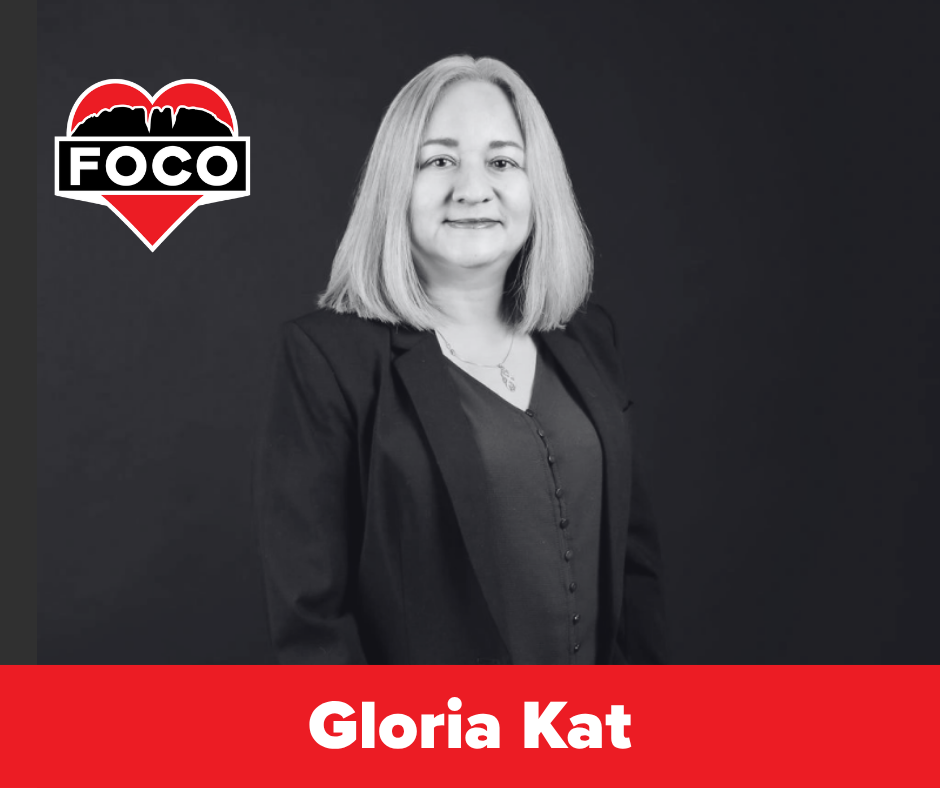
Gloria Kat is the Executive Director of The Family Center / La Familia in Fort Collins, CO. Born and raised in Mexico, she moved to the United States in 2005, first connecting with La Familia as a parent before stepping into staff and leadership roles. With a background in Communication Studies and Human Services, and experience managing community information and technology at United Way of Larimer County, Gloria brings strong technical and relational skills to her work. A bilingual advocate for equity and social justice, she focuses on expanding access to affordable, high‑quality childcare and supporting resident leaders through initiatives like Mi Voz, as they organize for housing stability, health equity, and a deeper sense of belonging in North Fort Collins.
Narrator • 00:08
This is the Love FoCo Show.
Gloria Kat • 00:11
It's a challenge for everybody, right? The parents that are trying to secure affordable and safe childcare. And so they can go back to work, so they can go back to school. And I'm the best example of that, right? I had childcare for Sophia. And then we have the teachers. We do everything to support the teachers. We were always recognizing them and giving them so much love that they need.
Narrator • 00:36
Welcome to the Love FoCo Show. Our podcast highlights the incredible people who make Fort Collins the place we're proud to call home. Each week, your host, Jeff Faust, sits down with local leaders, community champions, and changemakers to share their stories, what they love about our city and how they're helping it thrive. So whether you're out on the trail, at a brewery, or walking through Old Town, thanks for tuning in.
Jeff Faust • 01:01
Hey everyone, Jeff Faust here, your host for the Love FoCo Show. I am so excited to share this conversation with you today. Gloria, who leads La Familia, a community center here in Fort Collins, she is doing an incredible job caring for our neighbors, caring for our city. And I can't wait for her to just be able to share part of her story with you, how she landed in Fort Collins, her background, her history, how it all pointed her to this moment leading La Familia or the Family Center here in Fort Collins. And I think that like me, you'll become a fan of the work they are doing. I'm a fan of her leadership and just the way that they are helping lives thrive in and around our community. So excited to share this conversation with you today. And so with that, let's go ahead and jump in.
Well, Gloria, thank you so much for taking time out of your busy day to be with me. I know you're leading an incredible organization here called La Familia. We're going to get into that and all the ways you're loving our city one life at a time. But I'd love to start our conversation the way I start every conversation. Just tell me a little bit about your origin story. Like were you born and raised in Fort Collins? Did you move here? What was that journey like? And how did you find yourself in this great community?
Gloria Kat • 02:17
Absolutely. And thank you so much for having me. Well, I'm happy to share about where I come from.
Jeff Faust • 02:24
Yeah.
Gloria Kat • 02:25
I was born and raised in Mexico. In all my life, I was living and working in Mexico City. Oh, amazing. I love big cities, really.
Jeff Faust • 02:34
Well, this is quite a bit smaller than Mexico City. Fort Collins is like a neighborhood in Mexico City. Mexico City, I've been twice. It's, I mean, it's bigger than New York City. It's huge.
Gloria Kat • 02:48
Exactly. And I love it. You know, I was really lucky to be there and, you know, making amazing connections and friends and everything, but life changed for me because when I was 17, that's when I met my husband. Okay. My husband is French. His name is Patrick. And I think that maybe he was a troublemaker when he was 19 years old because my father-in-law send him to Mexico to learn Spanish and learn the culture.
Jeff Faust • 03:20
Yeah.
Gloria Kat • 03:20
And I think he did a good job, right? Because I'm here today.
Jeff Faust • 03:24
That's amazing.
Gloria Kat • 03:26
Basically, he was 19, I was 17. We got to meet each other. And then life happened a year later. And that's when I moved back into 2005. It's when I moved to the US to start a family. And we got married. And that's where my journey begins in the US.
Jeff Faust • 03:47
Okay. So I wanna ask about that and like where you landed in the US first. But so I'm hearing you correctly. So Padre is a Frenchman. - Yes, he's French. - His family was living in France and they were like, "Hey, you gotta go and learn the Spanish language. The best way to do that is to live in a Spanish speaking country." So instead of going to Spain, they sent him to Mexico. And you guys met as teenagers. - We were teenagers. - That's amazing.
Gloria Kat • 04:13
Yeah, I had curly hair and he had a mullet, so I have pictures like that. So it was back in 1987.
Jeff Faust • 04:22
Yeah. Well, mullets are coming back in. So yeah, that's. Del Padre, he can get the mullet to come back. If you go to CSU, mullets are everywhere. They're everywhere. Yeah. Yes. Yes.
Gloria Kat • 04:33
Well, I have to tell him.
Jeff Faust • 04:34
Yes.
Gloria Kat • 04:35
But actually, because my father-in-law got married with my mother-in-law, that she's from California, they wanted to settle in the US. So my husband basically moved from France when he was 13 years old, something like that. And then he grew up in Harvard, Massachusetts.
Jeff Faust • 04:55
- Okay.
Gloria Kat • 04:56
- So he came from Harvard, Massachusetts to do that student exchange program, right? In Mexico City, and that's how we met through another friend. So yeah, long story short, we moved to the US and I was in California doing all my paperwork for immigration, be able to work.
Jeff Faust • 05:20
- That's a process, isn't it?
Gloria Kat • 05:21
- It is a very complex.
Jeff Faust • 05:24
- I don't think people understand how challenging that process is.
Gloria Kat • 05:27
- It's very challenging. We're talking about 20 years ago when I did it, I'm sure that it has changed today. It's probably different and very, very more expensive. So anyways, I did my paperwork, we got married and we have two daughters. We have Yvonne, she's 27, she's living in Denver right now. She's her stylist and a business owner and she's going back to school to get an and a business degree. So she's very creative, she's more like an artist. And we also have Sophia, Sophia is 15 years old. She's a freshman at Fort Collins High School. - Oh, awesome. and she's an athlete, anything that involves movement and sports.
Jeff Faust • 06:11
- Did she get that from you or did she get that from Padre?
Gloria Kat • 06:13
- No, she got it from my husband. They're both very competitive. - Yes. - If you put it that way, I'm not competitive, I'm social.
Jeff Faust • 06:20
- Yeah.
Gloria Kat • 06:21
- I'm more into the cool stuff. You know, I can sit down and have a glass of wine while everybody's skiing. - I love it.
Jeff Faust • 06:28
That's not a bad place to find yourself.
Gloria Kat • 06:30
- I started like learning to ski recently. - Yeah. - Yes. I'm trying to go a little bit into being more aggressive.
Jeff Faust • 06:39
- Yeah, yeah, yeah.
Gloria Kat • 06:40
- More sports.
Jeff Faust • 06:41
- So you're learning some things that are rich in Colorado for sure. - Exactly. - Tell me a little bit about Mexico City though, 'cause I just find myself wondering like, I always like to ask this question because I love meeting people from different cultures and different backgrounds. What's something you really miss from Mexico City that you can just find your heart desiring or--
Gloria Kat • 07:03
Oh, there's so many things. I think the first thing that I would say is the food.
Jeff Faust • 07:07
The food.
Gloria Kat • 07:08
Yes, the authentic tacos and Mexican food and they're amazing restaurants.
Jeff Faust • 07:13
Yeah.
Gloria Kat • 07:14
And the culture as well. There are so many things that people can do there. Theater, shows, concerts.
Jeff Faust • 07:21
It's... I don't think people always realize just how big it is. The museums are... 20, are we talking 20 million people or something like that?
Gloria Kat • 07:29
About 22 million people live in Mexico City right now. and it's so amazing. - Incredible. - I love it, I love going back and I don't care, I drive anywhere.
Jeff Faust • 07:38
- Yeah. Do you get a chance to go back?
Gloria Kat • 07:40
- Yes, my dad still lives there. He's 97.
Jeff Faust • 07:44
- Yeah.
Gloria Kat • 07:45
- Yeah, so I take care of him from the distance.
Jeff Faust • 07:48
- Yeah, well, we were talking before we pushed record that my college roommate was from Puebla, which is just an hour and a half or two hour drive maybe, at least the way I remember, outside of Mexico City and got a chance to visit him, learned the real story of Cinco de Mayo from him. 'Cause that, you know, Puebla is like, this is where this story really originates and a different, yeah, yeah. It's maybe not the same way we celebrate it here in the United States, but--
Gloria Kat • 08:15
- The United States is the only country that celebrates Cinco de Mayo. - Oh boy. - That, yeah, that's-- - There's nothing wrong about it.
Jeff Faust • 08:22
- Well, we love our, yeah, we love celebrating it, but yeah, I learned a lot about the real story. I learned a lot about the real story there, but yeah.
Gloria Kat • 08:31
- So funny.
Jeff Faust • 08:32
- Yeah.
Gloria Kat • 08:33
- So yeah, anyways, I think I love Fort Collins and the first time I moved in here, I thought it was a very amazing city.
Jeff Faust • 08:41
- Yeah. - No. - When did you first, so you went to California and then how did you find Colorado and Fort Collins?
Gloria Kat • 08:48
- What happened is that my father-in-law, his French, he was working for HP. So they were living in Loveland, Colorado before they divorced. So my husband just fell in love with Fort Collins. He started, you know, looking into a house and he was buying a house. So when I moved to California and then I finished my paperwork, we decided that we were not gonna buy a house in California because it was so unaffordable. It was really very expensive. - Very expensive. - So you already have a house in Fort Collins. Why don't we move into that house and we settle in Fort Collins? - Yeah. - And be next to your dad. So that's what we did. We drove from California and then we've been in the same house.
Jeff Faust • 09:31
- That's so neat to hear. I've heard so many stories from people, some of these major employers, HP is definitely one of them that a few decades ago, they were hiring so many folks that really it really began to shape our community in a way. And people from all kinds of different cultures were moving here for those jobs. Yeah, really, I think really blessed our city in a big way.
Gloria Kat • 09:56
Yes, yeah, absolutely. So yeah, we ended up moving into that house that we still have until today, and I love it. The one thing that I can highlight about Fort Collins is that it felt very safe. I felt that it was a good place to raise our children, and just settle on. And the next challenge that came for me was finding employment.
Jeff Faust • 10:21
Yes.
Gloria Kat • 10:22
I need to find a job, right? Yeah, yeah. And after doing a couple of temp jobs that were terrible, I came across an opportunity at the United Way of Larimer County. And I can say that before that, I really wanted to volunteer and get to know the community much better. So my first approach to non-profit was through the Salvation Army. I was a volunteer, and I was registering children for their Christmas program, their Giving Tree program. And I noticed right there, we have a huge community that is needing support and resources. How can I use my skills to help them navigate that? And it was funny, I came across a position that I thought I was a really good match with my skills and knowledge at United Way as a resource coordinator. So I went to apply for the job, me not knowing how to look for a job in the US, ever. I printed my resumes. I had papers with me. My resume was in paper. And I walked into the office of United Way. They used to be located on Pine Street. Remember, maybe you were not here. And there was this nice gentleman at the front desk. And I said, "Hey, my name is Gloria." And I noticed that you posted that position for resource coordinator. I'm interested. He said, "Well, that has already been filled." And I'm like, "I have my resume." "Would you mind just circulating this in your building "and give something to have?" I didn't know how to look for a job. He's like, okay, I can do that. And then next week they called me because they actually had a part-time position that was available in the 211, the information referral, and I went to the interview and then I got that job.
Jeff Faust • 12:05
- Oh, it's great.
Gloria Kat • 12:06
- And then after a month, I moved into a full-time job. And then what happened after a couple of months?
Jeff Faust • 12:11
- Within a month, you went part-time to full-time in a month. They must've loved you.
Gloria Kat • 12:14
- Somebody left.
Jeff Faust • 12:16
- Yeah, they're like, we love Gloria and she was doing a great job, let's promote her.
Gloria Kat • 12:18
- I need the full-time job, I need the money, right?
Jeff Faust • 12:22
- Yeah.
Gloria Kat • 12:23
- But it was so funny because the resource coordinator back then, he quit and that position became available. And I said, I want that position, that's why I came. - That's why I came, yeah. - And I got it, and I kept it for over like 10 years. - Wow. - I stayed.
Jeff Faust • 12:37
- That's awesome.
Gloria Kat • 12:38
- I haven't really had that many jobs in my life because I do long time, 10 year cycles or something.
Jeff Faust • 12:44
- Yep.
Gloria Kat • 12:45
- So it was really amazing. me United Way was kind of like a nonprofit university. Yeah. And I loved it. You know,
Jeff Faust • 12:52
many amazing. A nonprofit university. That's a really good way to say it.
Gloria Kat • 12:55
I'm so grateful for them. The team was amazing and I learned a lot. I was the information and technology, information and, you know, committee information and technology manager. Yeah. It was my title. And I was managing the phone system and the resource database. We had an amazing statewide collaborative to make sure that we were entering the data in the same way. Yeah. I'm really passionate about data.
Jeff Faust • 13:20
That's very, very exciting.
Gloria Kat • 13:22
Yeah, sadly what happened is because of funding, they do want one to have to be outsourced to Mile High United Way, Okay. So that was really sad, you know, to lose that. Yeah. And then I said, "Well, you know, I still need a job. I got an offer at a corporate company in Loveland." That's when I started working there for a few years trying to decide what I was going to do. I must have had my midlife crisis because I went back to school. I said, you know, I have the knowledge. I know what it means to be in the nonprofit world, but I don't have the diploma of a local university. Even though my background is in and communication studies in Mexico, I needed something to be able to apply for other jobs. So I enrolled at CSU Global and I finished a degree in human services. So that was amazing because I felt that I knew everything, but I was just needing the theory of paper. I was missing the non-profit work. I was missing the connections, I was missing the resources and I said, "I think that I want to go back to the non-profit and work with families. I wanted to work in the case management. So bad. And I remember that, you know, there's WhatsApp groups that the community creates. And I remember reading at the position of our program director Adela familiar. - Yeah. - It was already Sunday night, I was coming back from Woodland Park or something and then something like a voice talked to me on my brain and said, "You need to apply for that job." It was already past the deadline, but they called me anyways. -
Jeff Faust • 15:04
I love it. That is awesome. Gloria, I have, listening to that, I have so many questions, comments and questions, right? I mean, one, I love that part of your story when you move here. You're like, well, I got to learn about the community. So I'm going to start volunteering. I mean, I feel like if our listeners could just hear that, like if you want to learn the city, you want to learn about the city, you want to just go and get plugged in across the board. You will learn, and what happened for you is, I mean, you had the exposure to HP, which is kind of like, you know, middle to upper class area of Fort Collins, a well-paying job, this is the air. But what you did, what you learned is there are pockets where there are folks with not those kinds of same resources and our city's trying to serve. There's people who are trying to serve our neighbor and our community. And I just love that you got plugged in right away. So kudos to you on that. But I love just hearing your journey through the United Way part time to full time in a month is incredible. I think there's something to that. Yeah, but they must have liked you. I mean, I really, but even just the agency that you had within your own mind, within your own heart. And of course, there's probably a lot of decisions that came back behind it. 'Cause you had Iman and Sophia, you're raising daughters and you have a family. But to go back to school and say, I'm just gonna get this degree. I'm gonna go for it.
Speaker 4 • 16:25
- Yes.
Jeff Faust • 16:26
- I think that's incredible. And you know, particularly in this time and season, kind of in this cultural moment where we're talking about immigration a lot and we're talking about folks of different ethnicities and races and cultures living in a community together. I think sometimes what people miss is the tenacity and the forward thinking heartbeat that so many of our neighbors from different countries have deep within them that just keep moving you forward. I just want to celebrate that. I think I hear that in your story and I think there's probably a lot of stories like yours of people who are, "No, I'll start a business." I do appreciate that it's a safe community, but I want to give back to this community. I want to grow my family here. And I think it's worth celebrating.
Gloria Kat • 17:16
Yes, absolutely. Thank you. Thank you for those words.
Jeff Faust • 17:19
Yeah. Well, I find myself kind of curious though. So you were in United Way and then you went to the corporate world. You had mentioned it. You wanted to get back in that nonpro— I wanted. What was it? Even thinking back to your childhood or your early adult life, where do you think that heartbeat came from? To be involved with families and be involved with children and that nonprofit space?
Gloria Kat • 17:45
I don't know. I mean, if I think of somebody that maybe was influential to that, could have been my mother. She was always helping people. Yeah. Or my sister, Olivia.
Jeff Faust • 17:56
Tell me about that.
Gloria Kat • 17:57
Like what kinds of things did you see? - How was that? - I, as far as I remember, my mom was always helping somebody. My mom stayed home, mainly. She passed away five years ago. And my dad's still there. My dad was always working. He's a mechanical engineer. And you know, both different personalities, but very generous, always helping. And then I was really close with my sister, Lina. She passed away two years ago.
Jeff Faust • 18:27
- Oh man, sorry to hear that.
Gloria Kat • 18:28
Closing, I remember her always helping, helping my brothers, helping everybody.
Jeff Faust • 18:32
Is she an older sister? Younger sister?
Gloria Kat • 18:34
I'm the youngest.
Jeff Faust • 18:35
Yeah. Okay. Yeah. So you had some great examples to look up to and...
Gloria Kat • 18:39
So those two were very influential in my life. I'm very grateful for that.
Jeff Faust • 18:44
Oh man, that is...
Gloria Kat • 18:45
But also I wanted to use my skills. You know, I wanted to use everything that I knew and just get involved and be more curious. And that's something that I would like to, as you said before, I really want to see the new generations or the actual generations just be curious and ask questions. If you are passionate for a non-profit or something that they're doing just get close to them. I know that there's social media, talking to people is so important. Nothing beats it. Making those relationships last. And maybe you don't like the mission of a non-profit, go to another non-profit and get involved. There's a lot of non-profits you can get
Jeff Faust • 19:27
And I like what you said about United Way, I think our young listeners need to hear this. Your job was like nonprofit university. You went to school. I mean, you probably learned, and you know, this now because you're leading a nonprofit and I am too, like, when you're in the nonprofit world, you might have a job description, but you're doing all kinds of different things. You're getting exposed to all kinds of, you know, and so I think that is, I think that's a really good word is, you can learn a lot. you can go to school.
Gloria Kat • 19:58
- Oh, the school of life.
Jeff Faust • 19:59
- Yes, that's right.
Gloria Kat • 20:00
- So yeah, so I started working at La Familia in August of 2019.
Jeff Faust • 20:05
- Okay.
Gloria Kat • 20:05
- And you probably remember that the pandemic was declared officially, but pandemic in that December of 2019. - Yeah. - I was already working here. - Yeah. - It was so funny because I'm like, well, I'm gonna work for La Familia and I'm not gonna have to deal with disasters anymore, like United Way. - Mm-hmm. are seeing fires, floods, tornadoes, everything. And I'm like, I'm going to be working with families. And I was like, yeah, let's do it. And then the pandemic comes. I'm a dad. It was not in my pocket. A disaster for everyone. And we need to address that. Those were very stressful times for everybody. Back then, my mother had been diagnosed with cancer, and I was trying to finish my university. I had a crazy third grader trying to go home. Home school. Yeah. I mean, we're safe. Mom, I'm not learning much. Don't worry about it. We're safe.
Jeff Faust • 20:59
Yeah. I mean, I don't know how you do it. We did at my house. We had a lot of PE classes. We're going outside. We're going for a run. Like, I just couldn't handle it. So I had a lot of gym class at our house.
Gloria Kat • 21:11
And the funny thing is that after a year, being the program director, that's when the board started looking for an ED, an executive director, because Joey Sullivan, that was the former ED of La Familia, got the CEO's position at United Away. It's funny, right? It's in the same circle, but then I was chosen to be the director. And I was learning a new role. I had never worked with boards. That's something that I'm... It is a different thing. If you have any listeners that would like to learn more about the experience of managing a board, I'm happy to be a peer to them because that's something that I had never done. I never had the opportunity. I went straight into the role, leading in the most difficult time and my personal life and the pandemic and everything was just like very, very like challenging. Chaos. I need to graduate, I need to finish school and graduate and it happened and yeah. Yeah. Wow. That is a that
Jeff Faust • 22:15
is a tough time to become an executive director. And like you said, again, this nonprofit space, people don't always realize it because you're fundraising, you're leading different staff, and you also have to lead a board. Exactly. And you and you know, the nature of boards is you want people on your board who are bright, intelligent, full of wisdom. Those folks have opinions. You know, and you need them to. But you also have to lead that board.
Gloria Kat • 22:40
And so it's a challenging thing to do. Right now I really want to brag about our board. We have 12 members. This is the most we have had in years. They are all amazing. They're involved, they're talented divers. And we have a waitlist. That's great.
Jeff Faust • 22:57
Yeah. That is a sign of a good organization. When you have people who are wanting to serve on that board. And yeah, that's really, really good to hear. Again, just want to reflect back to you, Gloria, that you have just continued to serve and lead in a way that gets you promoted. So not just United Way part-time to full-time, not just these, but program director to executive director. That's a real promotion. I mean, again, what do you think? I mean, I'm just curious, How would you define some of the qualities and characteristics that kept getting you promoted? 'Cause there's more than just showing up on time. I mean, there's something that people have been seeing in you time and time again, it's hard to talk about yourself maybe in this way, but how did you just keep, 'cause I wanna learn from that. I think others wanna learn from that.
Gloria Kat • 23:47
- Yeah, I think it's a matter of really listening to the people that are leaving the issue, right? And I can talk a little bit more about what we do at La Familia, if that's okay.
Jeff Faust • 24:02
- Yeah.
Gloria Kat • 24:03
- My personality, I'm open to learning. I think that knowledge is something that is just present in me, I need to learn. I need to learn and I need to really have, bring that critical thinking into everything I do. And also be approachable. I can talk to the teachers, I can talk to the community, It's a blessing that I'm bilingual, right? But Spanish is my native language and I can communicate well. But I think just being open to embracing diversity, as you mentioned before, and really into the decision-making process, make sure that we have all those voices. And the work that we do here is key to that.
Jeff Faust • 24:47
- Yep, yeah. So I hear in that, just to correct me if I'm wrong, what I hear, I heard you talk a little bit about critical thinking by way of listening and being a learner. - Yes. - But also like I hear like a thread of collaboration, like let's grab some of this and grab some of this and get this in the same room and come up with the best idea together.
Gloria Kat • 25:11
- I mean, we need to talk to everybody because we're all in this together.
Jeff Faust • 25:16
- Yeah.
Gloria Kat • 25:16
- And I think that my commitment is to bridge that gap and narrow the gap between the systems the community, residents. I feel that there needs to be dialogue and more cohesion into like the systems making changes from within. They cannot expect a family to be everything for everybody. We cannot be the weak office, we cannot be their full-stamp office, we cannot like be everything because then we just go crazy and we don't have enough of it, right?
Jeff Faust • 25:48
Well, a non-profit burnout is a real thing, you know?
Gloria Kat • 25:51
And I'm so passionate. I really love what I do here. And I think with leadership is key. If I see that our families, they bring their own leadership, they are leaders of their own community. We need to embrace that. We need to stop placing labels on people. Oh, here comes the undocumented, here comes the migrants, here comes the LGBTQ people, here comes the whatever. You on so much division that we need to stop putting labels and really embrace everybody and utilize that talent for the good. They're amazing community members.
Jeff Faust • 26:32
So many gifts out there.
Gloria Kat • 26:34
Exactly. We just hired a resident. She has a degree in agricultural science, I think in Honduras, but she's going to work in our garden.
Jeff Faust • 26:45
Oh, that's awesome.
Gloria Kat • 26:46
That's just the best way to really recognize and celebrate diversity.
Jeff Faust • 26:51
Yeah.
Gloria Kat • 26:51
And the talent that people have.
Jeff Faust • 26:54
I love that. I love that so much. I so much of what you're talking about, Gloria, resonates with me. I'm I'm grateful to get to know you a little bit more. I do want to talk specifically about La Familia. I mean, just hearing your stories, incredible in the way that you're getting back to our city. But let's talk for everybody listening, kind of specifically what La Familia is all about, what you guys are doing in our community. And then maybe we'll wrap our conversation with how people could support you or get involved and things like that. So tell us a little bit about La Familia. If someone's never heard of La Familia, tell us who you guys are and what you guys are about.
Gloria Kat • 27:29
Exactly. So the family-centered La Familia has served the community for 30 years now. It was created with the idea of providing affordable and quality childcare or early care and education. I'm going to refer to as childcare because it's easier for the audience to understand that. So it was created 30 years ago, it was founded 30 years ago and it has remained through to its mission of making sure that we can support families in Northern Colorado with the services that they need. So we base our work on three pillars of service. The first one is LED DOD, the early care and education program. It's Colorado Shands rating level five is the highest. I was gonna say what's that five out of five or five out of five? Five out of five, okay. Colorado Shands level five rating is like the highest standards of quality. A licensed childcare in Colorado. So Kudos to Joe, our education director, Kudos to him and his team for that. So we have that service, which is the childcare. We have 55 children from six weeks all the way to five. They graduate from here to go to kindergarten, whatever they need, be it a steer or whatever. That's the first graduation happens here. And it's the cutest. - I bet that is amazing to celebrate. - It's very emotional for the college. And I must say that my daughter, Sofia, came to Lafamila. So La Familia has been in my heart for a long time. When I was a mother and I wanted to work and they had a space for Sofia, she was born and I was so grateful for that. So I know as a parent how it feels when you get that support and you can continue with your professional career or this and all this. But now that I'm here, I can see all the systemic issues that the childcare sector is facing.
Jeff Faust • 29:35
- It is a tough space to be in. I would love to talk about, I do have one quick question. I think it'd be good just for me to ask for everyone listening too. It's called the Family Center or La Familia. You use those, I mean, it's just English and Spanish. You use them synonymously with one another or?
Gloria Kat • 29:51
- Our legal name is the Family Center/La Familia.
Jeff Faust • 29:55
- Okay.
Gloria Kat • 29:55
- That's our legal name.
Jeff Faust • 29:56
- Yep.
Gloria Kat • 29:56
- But just like a nickname everybody refers to of a La Familia.
Jeff Faust • 30:00
- I've always known you as La Familia.
Gloria Kat • 30:02
- Yeah, yeah. - That's perfectly fine.
Jeff Faust • 30:03
- Yeah.
Gloria Kat • 30:03
- Yeah.
Jeff Faust • 30:04
- And then like in the early education, is it in English or is it in Spanish Do you use La Familia as a way to kind of be forward-facing in the community, especially our Spanish-speaking neighbors? Like, hey, this is a friendly environment. Tell me a little bit about that.
Gloria Kat • 30:20
We don't have a curriculum that is bilingual, but we do have teachers that speak Spanish and are bilingual, and we have teachers that speak English. So I feel that integrating that diversity and language and celebrating all their cultures as well because we have people that come, came from the Middle East or Native Americans. You know,
Jeff Faust • 30:42
we, yeah. Well, you were giving me a tour before this interview and we walked past the Penguin classroom and the Otter classroom, which were over the top with cuteness. Exactly. But you saw kids from all kinds of different backgrounds in that class. I think that's wonderful. I think
Gloria Kat • 30:57
that's wonderful. One thing to maybe keep in mind, the other programs that we have, one being the bilingual case management. And the other program that we have is the MIVOS, the leadership development program. I can say that maybe 90% of the families that we're serving are Spanish-speaking or they
Jeff Faust • 31:17
identify as Hispanic. Okay. Now MIVOS, that's something I've heard because I did an interview with current mayor Emily and she talked about MIVOS and how important she felt like it was going to to be for our community. Can you share from your vantage point on how MIVOS is impacting young leaders, adult leaders, and how that might be helping our community?
Gloria Kat • 31:42
Absolutely. Yeah, so when we think of MIVOS, I think that there has to be a little bit more context. We have 42 mobile home parks in just across Lama County.
Jeff Faust • 31:55
Wow. Let's say that again. 42 mobile home communities across Larimer County. I don't think everybody realizes that about Larimer County.
Gloria Kat • 32:04
We're talking about near 5,000 affordable housing units. Yeah. Well, affordable.
Jeff Faust • 32:10
Yeah. Yeah.
Gloria Kat • 32:12
We can talk about this. Yeah, that was an air quotes for everyone who can't see. But yeah, I mean, that is. The mobile home is still considered one of the most affordable types of housing in the US.
Jeff Faust • 32:24
OK.
Gloria Kat • 32:24
So our team, the MiVos team works with about 10 of those communities, mainly in Fort Collins, in Southern Scotland. But it has created a model that is a resident led initiative on how they can acquire the technical skills or the knowledge on how to better advocate within their own communities because they all have different issues. Yes, and for all of our non-Spanish speaking
Jeff Faust • 32:53
friends, Mi Vos, it just means my voice. So you are empowering people to lift their voice, to share their voice, to advocate for themselves and their community. Exactly. That's when you see
Gloria Kat • 33:05
maybe a city council meeting and then you see somebody providing public comment, you see a lot of the residents of the mobile home communities. It has evolved through the years when I started, the boss was already a program here and the leaders were learning many skills in getting involved and now they are able to organize their own events. They can go speak with whoever they need to talk to and know how to address different issues. Yeah. Yeah. I think that's incredible.
Jeff Faust • 33:42
That is incredible. Because there really is, there's a cultural gap sometimes to know like, Well, this is how I will engage at this government meeting or this business meeting or this is how I can show up in this space to be effective for my community. Yeah, and those unwritten rules
Gloria Kat • 33:59
sometimes aren't always... Exactly. And exactly what we were discussing before, how do we make sure that the voices are represented? Yeah. Having that connection to the many programs that the city offers and then being able to understand what's needed for families to really be able to access
Jeff Faust • 34:20
what they're offering. Yeah, let me, can I ask maybe a sensitive question around, because I've tried to learn a lot about our city, which means not only what's happening now, but also the history of our city. And you know, there's always amazing things about a city's past, but there are also Also some shadow sides, some sides that maybe weren't as lovely about our past. And I know in our past that there were some, you know, maybe we'll call racial tensions or just, you know, oppression and just different things that particularly around the Latino community and the white community. Talking decades back and just even some, some things around neighborhoods and housing and how do you feel like, do you feel like Meavos is helping bridge some of that gap? What are maybe some success stories, but where is some work that still needs to be done?
Gloria Kat • 35:12
Well, there's a lot of work that still needs to be done, but I feel that the level of organization that NIVOS has achieved amongst different mobile home communities is just amazing.
Jeff Faust • 35:25
Yeah.
Gloria Kat • 35:25
Just to give you an example, the four of the residents, they finally formed the Northern Colorado Mobile Home Collective.
Jeff Faust • 35:34
Yeah.
Gloria Kat • 35:34
To gain that representation that is needed. So it's kind of like the touching a little bit from Meavos itself, which is more like a leadership development program into becoming their own. That's the goal, right? Yeah, that would be the goal of Meavos. So that's a big achievement.
Jeff Faust • 35:52
That is.
Gloria Kat • 35:52
Because they're gonna be the ones that are going to be representing the mobile homes in Darmark County or different cities, and they can grow. There's so much potential. They can still grow and integrate more leaders and more initiative. So that is something that has, it was just born last year, thanks to VBOSS.
Jeff Faust • 36:15
- That is a, boy, that's a really good sign. You know, we talked about it earlier about how you have people who want to be on your board. That's a good sign for your organization. the fact that there are real leaders who are organizing their own thing, empowered by Mivos, but independent of that. I mean, that's a great case study. That's a good sign.
Gloria Kat • 36:34
- I can totally see God growing in the future and doing amazing things, but being the voice now, representing and empowering the new generation. 'Cause they're seeing what their moms are doing. I'm going to city council. And those voices, they're so important.
Jeff Faust • 36:54
- It is very important. Well, you had generations that you could look up to with your mother, with your older sister, and so yeah, that's a big deal. It's a big deal. Well, let's go back to the kids. You said you're serving 55 kids. Which represents probably a number of families, probably, you know, and that the impact of that is gonna go beyond 55 children, of course. Tell me a little bit about what else you kind of provide, how you support some of the families of our community and things that you guys are involved in.
Gloria Kat • 37:27
- Yeah, absolutely. So, well, first of all, I also wanna add that we are a family resource center. We are part of the Family Resource Center Association. It's a statewide initiative and we have about 33 centers. - Oh, really? - They're different. It depends, maybe some of the rural areas, provide different services. Some might not have what we have here because it depends on the community what they're needing. But we follow the model and how we approach the way we work with families through a strength-based model, which is an evidence-based intervention. So we don't tell the families what to do. We welcome them, we establish those relationships thanks to our team, they're fully bilingual, they are also part of the community. So that right there is an advantage. We want to support the families with whatever they need. It could be a parenting class, it could be a mental health or safety class, and the car safety class as well is key because...
Jeff Faust • 38:36
You don't always think about that until you have a kid and you realize, "Oh, there's like real rules here. I don't have to get this thing situated."
Gloria Kat • 38:42
So we have so many things that we can provide a family with a connection to resources, a connection to all their organizations if we don't have what they need and just involvement. We are about to have an open house and are growing together. Open house is going to happen
Jeff Faust • 39:02
on May 2nd. I was going to say let's get that information out there. Before I forget, anyone
Gloria Kat • 39:07
and wanting to really learn more about what we do and the classes that we provide and the support that we provide. That's the best way for people to come and tour the center. The doors will be open. It's gonna be a--
Jeff Faust • 39:20
- So it'll be Saturday, May 2nd?
Gloria Kat • 39:22
- Saturday, May 2nd.
Jeff Faust • 39:23
- Any need to register for that or just a--
Gloria Kat • 39:26
- Ideally, we would like people to register because we would like to bring the games.
Jeff Faust • 39:31
- Yeah, well, Gloria, share that registration with me. And when this goes live,
Gloria Kat • 39:36
We'll make sure to put that registration link
Jeff Faust • 39:38
in the podcast notes.
Gloria Kat • 39:40
- Yeah, I can give you all that information. People can go to our website and find it there. Please send there fc.org. - Fc.org. - Exactly. And we're gonna have registration. You don't need to pay a ticket. Everyone's welcome. You're gonna have games and it is a fundraiser. So if somebody wants to donate, they will.
Jeff Faust • 39:59
- That's great. Hey, nonprofit world doesn't mean no money. - Exactly. - There's money involved. Tell us a little bit about that. Since you, I would love to hear, you know, you're doing incredible work. There's gotta be a real budget to this. I mean, childcare is early education, excuse me, that's not cheap. Caring for the families beyond the children is not cheap. And so that has real price tag. So how can folks jump on board with that? What are your goals? And how can people help you get there?
Gloria Kat • 40:34
So yeah, no, I appreciate you asking that question. Yeah, childcare is very expensive. Just running a licensed childcare facility comes with a high cost. - Especially if you want to be five out of five. - Exactly, exactly. So, we need to meet licensing requirements, we need to pay our teachers. I feel that we don't pay our teachers living wages. We are trying to always increase that number, but it's really so hard to sustain. And the operation itself is very costly. I think that we need to come as a community and really support not only the children, but also the workforce.
Jeff Faust • 41:17
- Yes.
Gloria Kat • 41:18
- And about two years ago, I started a collaboration with the Front Range Community College to start teaching the early childhood courses in Spanish.
Jeff Faust • 41:26
- Really?
Gloria Kat • 41:27
- Because we have a population that wants to go back to school, that language is a barrier. And that's amazing. - That's a great idea. - That first generation of students were like about over a hundred and this is a statewide initiative. - Yeah. - Right now, I don't know, that program might be a little bit of a risk because of funding, you know, there's always funding issues, but it's out there. And it's an option to really enhance and bring that workforce back. - Big time.
Jeff Faust • 41:53
Well, and this is a big challenge that people don't always realize that childcare and early education, it is such a need in our community. If we're not caring for the next generation, It's gonna affect the working parents, it's gonna affect the entire family unit. But if you can't pay the teachers a living wage, people will leave that workforce. They'll have to go get a job somewhere. And so, yeah, but that's a big, that is a big challenge funding-wise. - Exactly.
Gloria Kat • 42:19
Yeah, so it's a challenge for everybody, right? The parents that are trying to secure affordable and safe childcare, and so they can go back to work, so they can go back to school. And I'm the best example of that, right? I had childcare for Sophia and then we have the teachers. We do everything to support the teachers. We were always recognizing them and giving them so much love that they need. We don't want them to leave, but it's also a challenge hiring certified teachers. Right now we're hiring, by the way. - Okay, that's good to know. - Good job. I wanna make that announcement and say that we're hiring for two positions. So they can contact us and come and check the place. We're open to anyone that wants to come and learn more about them.
Jeff Faust • 43:03
- That's fantastic. You know, and when you're working with children, of course we walk through the hallway, we got a little quiet 'cause they were getting ready to take nap time, but we also walk past the cafeteria. And so tell me, 'cause you're feeding these kids, you know? And you had a cook in a commercial kitchen running things. I mean, I've done some renovations in buildings. That's not an inexpensive thing to have, But in terms of quality of care, that's probably a really big part of what you offer.
Gloria Kat • 43:34
- Exactly, it's a big part of that. So grateful for Phil, he's our kitchen manager. So when children come here, not only they receive the education and the care, but they access nutritious meals. We are subject to inspections from the health department, just like a commercial kitchen, as you said. So when you run this operation, There are so many requirements, right? Children can access the food that they need in the morning with a healthy breakfast, a healthy snack, and then lunch.
Jeff Faust • 44:11
- And it just takes a little pressure off of home too.
Gloria Kat • 44:13
- Yes.
Jeff Faust • 44:13
- You know, like, okay, kids are gonna be cared for holistically.
Gloria Kat • 44:17
- Exactly.
Jeff Faust • 44:17
- Not just education, not just safety, but also nourishment and care. That's a big deal.
Gloria Kat • 44:23
- Exactly, and also development. You know, the early years are so crucial for a child. Just two years ago, thanks to funding that we have been receiving through the Larimer County Behavioral Health Office, we were able to integrate occupational therapy with an embedded program, collaboration with CSU. So we're very grateful.
Jeff Faust • 44:46
- Wow, you guys are serving in so many different ways.
Gloria Kat • 44:50
- So many different ways. Like children don't even know that there is getting--
Jeff Faust • 44:54
- Well, and it's a good thing that you love data. You mentioned earlier that you love data. As an executive director, if you're gonna get these grants, if you're gonna get this statewide funding, you have to be able to lay out a real case for people you're serving, outcomes that are being reached, lives that are being impacted. And so the fact that you love data has set you up for this well. It's gonna set your organization up well in the long term.
Gloria Kat • 45:17
- I think right now we are at a very good moment. I know that politically and the economic environment seems to be very-- - It's volatile. - Faultful. - It's very unpredictable and uncertain, But I feel that we have positioned ourselves in such a good spot right now. We're solid. We have programs that are still effective. We're adding the supports that families are needing with the OT, with everything that we do. And we are blessed. Like really, we're really blessed right now. Last year in December, we were awarded an entowment through the Colorado Health Foundation, through the equity collective initiative. For a moment, I thought we were not gonna get it. - Yeah. - When you ask for a million dollars, I'm gonna get it. - Yeah. - And then suddenly I get the call and so you have been selected.
Jeff Faust • 46:08
- Incredible.
Gloria Kat • 46:08
- I was crying. - Yes. - My emotions were like, whoa. - Well, 'cause you get a nonprofit because you care. - Because I care.
Jeff Faust • 46:16
- You care.
Gloria Kat • 46:17
- And to me, it was like the best legacy that we can leave for these generations of children and for the staff and for the community because we're part of the community. And this is for them. It's not for me to say, oh, yeah, we've got a million dollars. It's an endowment. And yeah, you can't touch it for a while. But then once you start getting that revenue, and there are so many steps to make that happen, that's why I'm so grateful we're all bored. But yeah, and you know, with the donors, this is thanks to the donors as well. And if somebody wants to make that grow and keep supporting us, because this is gonna-- - Yeah.
Jeff Faust • 46:55
fc.org they can get on and give.
Gloria Kat • 46:57
- Exactly.
Jeff Faust • 46:58
- Yeah.
Gloria Kat • 46:59
- Yeah, so it's about making sure that we can continue providing the services that we have and you grow with the community. That's why we have the growing together open house. It used to be called belong, but I didn't like that name. We don't need to belong anywhere. Where did you belong? Like why didn't I belong before? Right, it feels like exclusive and growing together is more, it involves everything.
Jeff Faust • 47:25
- I really like that.
Gloria Kat • 47:26
- We're all together. So this is the second year that we're doing growing.
Jeff Faust • 47:30
- Oh, that is special. So, and again, that's Saturday, May 2nd. We'll make sure to share that as well. Gloria, the time has flown by. This has been such a good conversation. I do wanna give you a moment to share just any last thing that might be on your heart as we get kind of ready to wrap up. But I just wanna say, you know, you've got a fan. I am, add me to the list. I know you have a ton of fans. You don't get this many donors and endowments without fans. Add me to the list. Add love, Foko, to the list of fans. The work that you guys are doing is really great. And I'm so grateful. I feel like we could have another conversation to learn more about what you're doing. But let me just give it to you to wrap up. If you have any one last thing that you would love to share, I'd love to just give you the floor for one must moment as we wrap up.
Gloria Kat • 48:18
Yeah. Really, I think we had a really nice time. And I would really like to invite the people that are listening to this amazing conversation that I'm having with you, Jeff, to really explore, be really curious, don't be afraid, just reach out and connect with people. Just think of all of us as one community that we're all in this together. And Fort Collins has so much potential. We wanna see business thriving. We wanna see children thriving and healthy. And if you wanna learn more, please feel free to reach out.
Jeff Faust • 48:56
- Gloria, thank you so much. Thank you for your time. Yeah, just grateful. Grateful for what you're doing in our community for your entire team. I know it's a big team. That's making this happen.
Gloria Kat • 49:06
- We love the team.
Jeff Faust • 49:07
- Yeah, it's great to spend time with you. Yeah, mucho gusto.
Gloria Kat •
- Thank you very much. Gracias. -
Narrator • 49:10
Thanks for listening to the Love FoCo Show. If today's conversation inspired you, share it with a friend who loves Fort Collins as much as you do. Don't forget to subscribe so you never miss an episode, and leave us a review. It helps more people discover us. To learn more about Love FoCo and find opportunities for loving our city one life at a time, visit lovefoco.com. For now, keep loving Fort Collins well.

