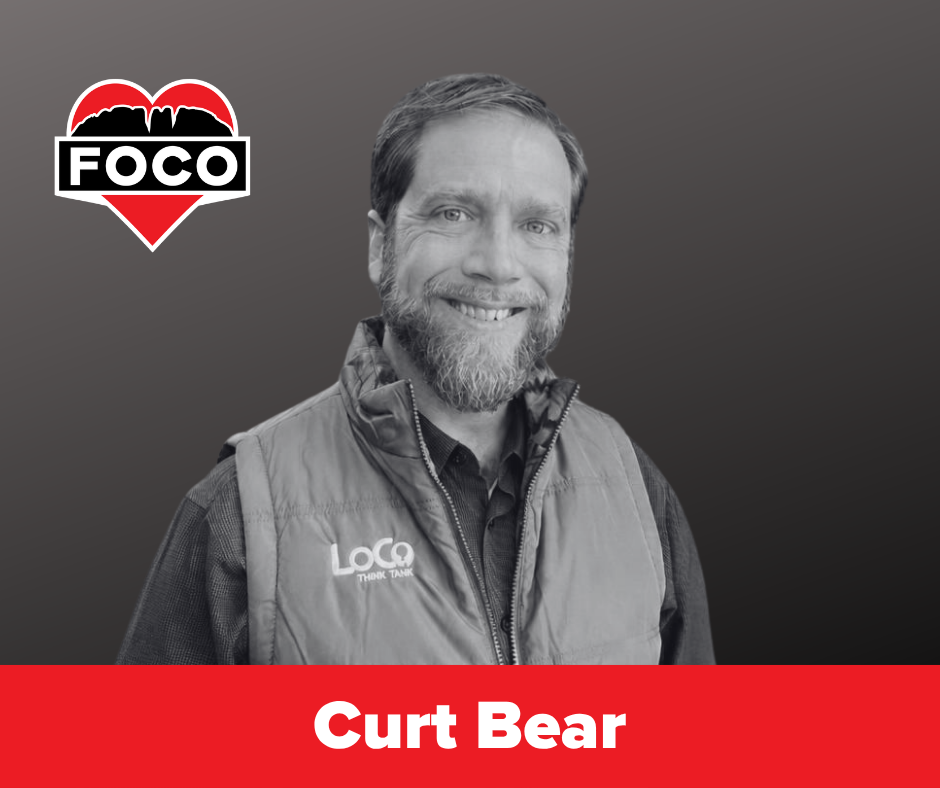

Curt Bear is the founder and CEO of LoCo Think Tank, a Fort Collins–based peer advisory organization that helps small business owners grow through collaboration and accountability. Drawing on a 15-year career in business banking and his roots as a North Dakota farm kid, Curt left a near six-figure salary to pursue local food ventures, eventually discovering his true passion in equipping entrepreneurs. Today he leads multiple LoCo chapters and hosts The LoCo Experience podcast, sharing the stories and wisdom of Northern Colorado business leaders.
Narrator • 00:06
This is the Love FoCo Show.
Curt Bear • 00:09
We want to really try to emphasize not just our community, but every community, that where you are is where you should love the most.
Narrator • 00:18
Welcome to the Love FoCo Show. Our podcast highlights the incredible people who make Fort Collins the place we're proud to call home. Each week, your host, Jeff Boust, sits down with local leaders, community champions, and change makers to share their stories. What they love about our city and how they're helping it thrive. So whether you're out on the trail, at a brewery, or walking through Old Town, thanks for tuning in.
Jeff Faust • 00:43
How do you love the people and how do you love the businesses that are right down your street? Today's guest, Curt Bear, is a leader in this space... Leads LoCo Think Tank, does a great job of gathering business leaders, connecting them with mentors, and championing being loco for local businesses. I loved my time with Curt, and quick shout out to his podcast, The LoCo Think Tank. I was a guest on his podcast, now he is a guest on the LoCo, or the Love FoCo show. So grateful that he spent time with us. I think you're in love this conversation as we meander through some of the challenges that local businesses face here in Fort Collins and beyond and what we can do to make a difference in helping these local businesses thrive. Hope you enjoy this conversation as much as I did.
Well, Curt, thank you so much for giving us some of your time. I know you're a busy guy running around the city, involved in a lot of different things. And yeah, we've been doing this podcast for a while I'm just grateful every time I get a guest on here who's got an interesting story and doing things for our city. And I want to get into all the ways that you're loving our city, all the ways that you're giving back, as well as just kind of creating space for people to grow. But I want to start our conversation the way I start every conversation. I'd love to hear your Fort Collins origin story. Like, where'd you come from? I mean, imagine yourself in a comic book. Like, what's that first- what's that first comic book coming out? What is your origin story? And how did you land here?
Curt Bear • 02:17
I've got a pretty good one. Well, first thanks for having me on. And thanks for doing this in this awesome space here at FoCo building. It's nice to be in here instead of in...
Jeff Faust • 02:27
Well, it's been fun. Because I've been like running around town. And I'm like, hey, I'll go and I'll meet you. I'll do your podcast wherever. But now I actually have a place like, hey, Love FoCo's open. You can come and we can do it here.
Curt Bear • 02:40
So my Fort Collins origin story actually started just about a mile and a half on the road on East Mulberry. There was a bank there that I had been hired to come work for about a year out of college. So I graduated college at North Dakota State, degree in economics, finance emphasis, got a job with Community First National Bank.
Jeff Faust • 03:03
North Dakota State.
Curt Bear • 03:05
North Dakota State, yeah, Go Herd.
Jeff Faust • 03:07
The Herd, the Bison, yeah. They're like amazing at that division of football.
Curt Bear • 03:12
They had been amazing previous to my residency there and then later again. Okay. I was there, they were marginal. Yeah. Yeah. But the Fargo Dome did get built while I was a colleague there and I worked at the Fargo Dome a little bit in college. Yeah. So, so anyway, I landed in, so I worked in Minnesota for a year and kind of an internship kind of thing. And I landed a job in Fort Collins over the phone in the same organization, Site Unseen. Wow. So I was one of those quite a few more people that you think that came here for the first time for a job having already not already been here. Yeah. You know, came here moved here site unseen.
Jeff Faust • 03:50
Yeah, sweet. A lot of Midwest folks come out here too. I have noticed that. Minnesota, North Dakota, Ohio, Nebraska. Like why would I winter in the upper Midwest where it's cloudy and 20 below all the time?
Curt Bear • 04:03
And it was, you know, now the cost of living here has increased a lot so much so that a lot of times it's like Californians and then some other people. Yeah. Right? Cause they can down side. Yeah. That's cause they can afford it. Yeah. But for me, I got a $2,000 a year raise on my salary from the bank and my cost of my rent was $400 a month. So $5,000 a year. Wow. Wow. More. Yeah. And so I went, you know, backwards a significant amount in that logic anyway. Plus there was so much more to do. Yeah. So, so much. So I had to, you know, get some second.
Jeff Faust • 04:39
No, North Dakota is like basically, you know, shiver and drink beer. Yeah, yeah, but there's a lot of bowls. (laughing)
Curt Bear • 04:48
And actually, Fargo is an actually really cool town. There's a music culture there. Fort Collins reminded me a lot of that Fargo area that I had been spending time in.
Jeff Faust • 04:57
My brother-in-law, I think, went to school there to be a pilot. And then my sister and her husband, they live in Detroit Lakes. So in Minnesota, but about that far north. Yeah, yeah. Just east, an hour or two or something like that.
Curt Bear • 05:11
And it's amazing.
Jeff Faust • 05:12
Yeah.
Curt Bear • 05:12
In summertime, especially the rest of the time, not so much. So the story I was hesitating to tell was I got here on a Friday night, pulled my 92 Pontiac Grand Prix out on a U-Haul truck, stayed at the Kiwa Inn down the street here, and went to Old Chicago's Pizza Restaurant.
Jeff Faust • 05:35
OK.
Curt Bear • 05:35
And just a few minutes after I sat down, a group of like seven came in and somehow struck a conversation and found out I just moved to town like an hour before.
Jeff Faust • 05:46
Yeah.
Curt Bear • 05:47
And they're like, well, you gotta come pub crawl with us for Suzie's birthday or whatever. Yeah. And so I ended up going to like four or five different taverns. That's awesome. My friends. Yeah. To a house party afterwards. Found my way back to the hotel. I didn't drink at the house party. I was minding my smart, it was so cool to be just like, immediately welcomed. Oh, I think that's awesome. New community, cool people of my age. Yep. And where I grew up in North Dakota, people don't move there very much. And so people, they're a lot more suspicious of you if you do. Yeah. Here the trend was really like, oh, where are you from? Welcome, 'cause you're here. Yeah. And so that's my origin story, ultimately. That's sweet.
Jeff Faust • 06:32
The first few pages of that comic book are bar hopping with some random dudes that you met at Old Chicago.
Curt Bear • 06:40
It was four girls and three dudes. So I rounded out the-
Jeff Faust • 06:43
Yeah, you made it all even. Yeah. (laughing)
Curt Bear • 06:47
Yeah, it would have been a different day. Dudes right away, that's cool enough.
Jeff Faust • 06:51
That's sweet.
Curt Bear • 06:52
Anyway, that was kind of my-
Jeff Faust • 06:54
So move to your site on seat. Were you, I mean, obviously you were looking for a job. You were like in this-
Curt Bear • 06:59
I was a job at the bank.
Jeff Faust • 07:00
Okay.
Curt Bear • 07:01
through this kind of training and internship program in Fargo and then in Minnesota, and then interviewed with a bank out here that had been acquired by that system to take on an entry-level consumer and commercial end.
Jeff Faust • 07:14
And were you like the age of stage where like you can uproot without a lot of like responsibilities that you had to hold? So like, or were you like actively looking to leave that region and find somewhere else?
Curt Bear • 07:27
I wanted to, yes, I was planning to move to Colorado on credit card balance, ability and hope.
Jeff Faust • 07:34
Yeah, yes.
Curt Bear • 07:35
Getting a job, it's a banking company that had just acquired 20 some banks in Colorado. I was like, oh, I'm not a risk expert yet, but that seems like a nice piece of heat.
Jeff Faust • 07:46
Did you have like Colorado history or why did you, I mean, are you an outdoors guy?
Curt Bear • 07:51
You know, I had some family that had been out here. I'd never been to Colorado at all, but I thought I should go to school at CU, you know, the MBAs were all the rage in those days. And so I thought that could be a next step. I researched a bunch of different colleges and stuff. And it was close enough to still get home to family, a little bit easier than going to California or something like that. And I didn't have anywhere near enough financial resources to pay out of state tuition at CU. And so I thought I would just move here, work for a couple of years, get residency established, and then go back to school. Yeah. You know, then ultimately the bank started just, You know, giving me a raise and a promotion every couple years. And it was like, I don't really know if I need an MBA or not. Yeah. So that-- just kind of, you know, my career was a great joy for many years. My wife and I lived in Windsor when we were first married in Colorado Springs. Back up here, I met her just six weeks after moving to-
Jeff Faust • 08:49
Yeah, I was going to say, you dropped that in there, and then we just kept talking. But I wanted to circle back to it. So yeah, how did you-- I mean, is she from around here, or did she transplant in like you?
Curt Bear • 08:58
She was a John Deere guy's daughter. So she lived all around the country and he came out here with John Deere as well. And so I found a place to live that Saturday after going out bar crawling the Friday night and moved in on Sunday and it happened to be a two bedroom apartment in a converted garage. And in the prior town I'd lived at was a friend, Angie was her name, and she had gotten done with two year college. I was like, "Ange, you should rent my extra bedroom." It was very much a platonic relationship, but her town kind of sucked and she was cool. And I was broke.
Jeff Faust • 09:35
Yeah. So I had to- You gotta split that rent, man.
Curt Bear • 09:38
250 bucks a month. Yeah. Got covered part of my deficit. And then she started bringing home Jill as my wife. And so Jill's twin sister, Erin, worked with Angie at Shopco.
Jeff Faust • 09:51
Okay.
Curt Bear • 09:52
And so pretty soon- Dude, you're dating yourself now. It was Shopco, man. I was a 25 year old guy with three, like 20 year old girls hanging out at my apartment on regular basis that were all super cute. And so Jill and I kind of developed a friendship first for a couple of years and then when she was a little older, the six year spread didn't seem quite as severe than when we started dating and been married for 23 years, two weeks ago.
Jeff Faust • 10:19
Wow, congrats.
Curt Bear • 10:21
That's awesome.
Jeff Faust • 10:22
Yeah, we're just a little behind. a very similar anniversary era late May for my wife and I, 18 years for us. So yeah, we're like planning now like what are we going to do for our 20th anniversary?
Curt Bear • 10:33
Well, having just had you on my podcast recently, I know that you didn't make the early years especially that acceptable for me.
Jeff Faust • 10:41
Yeah, yeah, yeah, that's right, that's right. Yeah, no, we're going to go, we're going to do something big. I know we're going to do something big, so it'll be good, yeah. So you've been here for a while. Tell me a little bit about your journey from kind of banking to what you do now as the leader of the local think tank and how that all came to be about.
Curt Bear • 11:03
It's a longer story than I can give it justice here probably too, but I had become really passionate about locally sourcing food and kind of the local business economy and farm economy. And I was worried they were gonna wreck the world currency back in the financial crisis days and stuff. So I really got involved in that scene and eventually decided I should start an international fusion locally sourced kind of concept restaurant that invited everybody to be in community and really to, I guess, to appreciate the diversity and the beauty of diversity in food and in culture and community.
Jeff Faust • 11:42
That's interesting, where'd that come from?
Curt Bear • 11:44
I don't know, 'cause God wanted me to do local think tank and it was too hard to put into a dream of that. I don't know. I guess study of economics, study of sociology and ethics and things over time. I didn't really like the way the world was going into kind of this one world kind of government movement. And I've always been kind of a libertarian leaning person even before I came to faith. And that's been strengthened since then in some ways. And so, we don't need a lot as humans to be happy. We really don't need 800,000 square foot data centers in our backyard and stuff. We can be happy with a really nice tent and some good friends and a month in the mountains. As long as there's a decent supply of Jim Beam or something like that. (laughing) Just good people and if we're warm, if we feel love, if we are-
Jeff Faust • 12:46
Yeah, I think there's a whole like, I mean, I just had this conversation with some of the other day. You can tell we live in a pretty entitled culture right now by the things we squabble over. It's like we're fighting over some of the dumbest stuff. And I've traveled enough and seen enough of the world, the developing world, where maybe they're not as fluent as we are, they don't have as many resources, kind of at our fingertips. Or maybe more. Or maybe more generous, which is a wild thing to think about. But they gather commonly. They gather around food, some form of music or, you know.
Curt Bear • 13:26
All the best actual cooking is poor people. Yeah. You know, they had to learn how to make that brisket tolerable or whatever the innards from the sheep, and the, you know, a lot, and it has to be cooked low and slow, but you know, they got time, a little bit sometimes, and those kind of places more too. Yep. And so I guess I've always appreciated that. Yeah. And in banking, one of the things that was really a disappointment to me was quite a while back, and I was making maybe $75,000 a year. Pretty decent income, nothing special. This is back.
Jeff Faust • 14:04
Especially a few years back, yeah.
Curt Bear • 14:08
But I was donating more actual dollars to charitable causes than a lot of my clients whose tax returns I had to read to see if they should get a loan that were making two, three, four, five times as much income as me. And it kind of, it made me a little annoyed. Yeah.
Jeff Faust • 14:26
You know. That's a nice way to say it.
Curt Bear • 14:28
That's part of, yeah.
Jeff Faust • 14:29
It was like, I'd give you a little chaffed is what I'd be.
Curt Bear • 14:32
Ask of your needs and share of your abundance. Yeah. And that's been my motto since years before local think tank even started, but it was kind of part of this kind of forming philosophy of like local first and if you've been blessed with extra resources like this building, frankly, like and then you can be a blessing to somebody else without it really sacrificing your situation.
Jeff Faust • 14:58
What a great thing that is. I mean, I have so many questions about that because I think it is a unique, It's unfortunate that's a unique perspective. I wish it was more ubiquitous across our society. It's not, it's too reality. But like, how did you come about that? Was it just kind of like this holy discontent of what you were seeing and how you were trying to live? Or, I mean, did your parents plant seeds of generosity in your life when you were younger or? You know, I think I've always been a student
Curt Bear • 15:31
of how then should one live or something. There's an old book that kind of, how then should we live or something like that that I've enjoyed. And I, you know, I didn't, I grew up in a church but I'd never heard the good news really until really I was here in Fort Collins. But I had studied ethics and metaphysics and you know, economics of course and college and things and was just always learning of what is the right kind of way to live.
Jeff Faust • 15:58
Yeah, a philosophy of life in a way and yeah.
Curt Bear • 16:01
Yeah, exactly. And so I guess it was more formed from relationships with people along the way and conversations and inquisitive questions of people I value and to bring the story back around a little bit. So I had this vision of this international fusion restaurant. Yeah. Ultimately when a local business here in town, local food distribution had grown enough, then it became viable for me to try to do this locally sourced restaurant concept. And in the meantime, banking had gotten really annoying. I had been the interim president of the bank for a year. And I couldn't make bets with other people's money anymore 'cause it was just too constricted and controlled. And so I didn't really want that job anymore. And so I imagined that I could like suddenly transition myself from a hacker to restaurant tour without too much capital, a little bit of support for my father whose farm had grown a lot since. So a deep deep root is my dad started his farm evenings and weekends as he was a motorcycle mechanic going back to 14 years old. Wow. And then when he was 25, I guess, or so, he rented some land, finally found a banker that would loan him some money to put the crop in and lucked out and got a good crop and was able to kind of keep reinvesting until he's, you know, my brother operated like 10,000 acres now. Wow. - Yeah, yeah. And so I've seen, you know, my family's, you know, fortunes change. You know, we had free school lunch until I was 17, 18 years old. Yep. - Well, the farm continued to grow on the side and down fed us with whatever the motorcycle job would pay. And so that was really my source of loving business and loving people that create jobs and business and opportunities and I'd work in the bank with all these people and stuff. And so anyway, long story short, as I started LoCo Think Tank, give me a venue because I'd heard about, I'd been involved with Vistage and with other mastermind models. And of my banking clients, the ones that were the best at running their business, many of them had the commonality of being in a group, you know, like a men's group to a church might be, that's a lot like what a peer advisory group is for business leaders because it's hard to obscure yourself and to have the pressure, peer pressure to do so and you know, to let go of an unperforming employee, even though you like them and their family is struggling financially right now, that's really hard. >> Oh, it's so hard. >> To be a steward of your business, you've kind of gotta make those decisions. >> Yeah. >> So that's-
Jeff Faust • 18:47
>> Well and that level of decision-making, like you gotta find some other people who who are at that level to sharpen you. Yeah. 'Cause you just feel the burden in a different kind of way. I mean, no one feels, no one's gotta break the water other than the tip of the boat, you know? I mean, it's just, you're just taking blows sometimes. Do you get together with other pastors? All the time, yeah. We talk about this a lot because there's just, I mean, I was not a lead pastor for most of my life and now I am a lead pastor. And I kept hearing cliches like, dude, I can't prepare you for this part. Like there are a lot of things that can prepare you for, but there's nothing like the seat of the senior pastor, lead pastor. And you know, you're 25, you're 28, you're 32, and you're like, okay, cool, whatever. I'll be different. You know, you just like the arrogant thought of like, yeah, I'm sure that happened for you, but like, I think I'll probably hit it. And then you become a lead pastor, and you're like, all of a sudden you're not sleeping well at night, you're super lonely, you know? Like you have thoughts you've never thought before, and you're like, what is happening to me? like, oh, this is like, well, and as a pastor, like, I think it's the weight of leadership. It's the loneliness of being at the tip of the spear. And then because I'm a pastor of a faith community, I also have this other thing that we believe is just like, the idea of spiritual warfare, you know, and just like, actually we- You're still learning the souls that are in yours. Yeah, yeah, like, we don't believe, you know, as much as we believe that Jesus Christ has died for our sins, we also believe that there are, there's an enemy that wants my life to crumble. And so maybe the spiritual warfare at that level is a little different than I've ever experienced. And I have to imagine, it's not, there's some things that aren't the exact same as like being a CEO or an entrepreneur, but there's a lot of overlap. And I feel like I've learned a lot from entrepreneurs and CEOs.
Curt Bear • 20:33
Well, planning a church or growing a church is very entrepreneurial. You can't even ask people for money really. You gotta get a guy into them.
Narrator • 20:40
Somebody.
Curt Bear • 20:41
(laughing) I shouldn't overlook in that origin story of local either that, so I met my wife and she was from a Christian family and it wasn't too much longer where I came to faith as well. I mean, her mom had been a discussion leader for Bible study fellowship for years. And so I started attending BSF and went through their whole course of 10 different-
Jeff Faust • 21:05
It's pretty extensive, man.
Curt Bear • 21:06
Oh yeah, you know, it's a whole year of study Genesis, Isaiah.
Jeff Faust • 21:09
I know it, serious.
Curt Bear • 21:11
And in year two or three of that, they ask if I would want to become a discussion leader. They're like, you know, we can see how you communicate with people and stuff. We think you're gifted in that.
Jeff Faust • 21:24
Yeah, you're good at communicating. You have a killer voice. Like, let's just get you to talk to them. I hear your voice is amazing. (laughing)
Curt Bear • 21:29
I don't have anything, I don't really think about the Bible. You know, I was tears into being a Christian and they're like, well, you don't have to. If we teach you how to facilitate good discussions, the power is in the group and learning together what the truth is. So all those elements kind of came together really to form LoCo Think Tank. Rotary club experience, the Matthews house was a non-profit board that I was actually the president of during this whole time of hanging and becoming an entrepreneur. And so all those kind of sauces just mixed together. And I did not get a restaurant. I spent two years as a mobile food catering business at my primary quote unquote income source. and a local think tank growing on the side. And then a couple years after that, after a season in financial advising, I went full-time local. Went all in. That's in eight more years.
Jeff Faust • 22:24
So tell us, and everyone listening, who's maybe not aware of you, Curt and local think tank, just give us kind of a big overview of what it is that you're doing and what you're up to. Thanks.
Curt Bear • 22:36
So I leverage high achieving business veterans. You've probably got some among your congregation even that sometimes they'll sell a business and they've been growing it and leading teams and people for 30 years. And now I don't do that anymore. And so there's a gap for many leaders. And so I try to find people like that that have maybe traveled the world and done some stuff, got the edge out a little bit after a lot of years of hard work. and then give them a 10 hour a month kind of a role where they, I train them how to manage a chapter of business leaders that are actively growing their businesses. So my team and myself do most of the work to find the smart kids running businesses around and put them, we tear our chapters by littles like under five employees, kind of the five to 25 and then the 25 to 250. So we put similar sizes together that don't compete with each other and create, you know, ultimately what would be like a life group for a church or whatever, but a structured agenda that I, you know, like I said, I train our facilitators to deliver the goods and they send out the agendas each month. People take turns being on the, the focus member and putting their real challenges on the, on the table. Yeah. Um, and then going through what's ultimately a Socratic method process that we call the low collaborative process, Yeah. To find truth together and to find positive, pure pressure to do those hard things. Oh, that's so good. And resources as well. Yeah. Oh, we need business valuation. Oh, we need intellectual property protection lawyers. Who's got a good one? Yeah. And all that kind of things that goes with all the many things that are business. So. So valuable. It's, it's, I love some of the stories that have come out over time. Yeah. You know, don't share too many of them, but it's really neat to see people and businesses trends. I mean, you get to see that too, right? Yeah. Like, sometimes anyway, you see people that come in pretty broken. Yep. And before too long, they're leading a life group and bringing it.
Jeff Faust • 24:41
Yeah, life has changed. Well, that's our hope, right? That like, we actually don't have to stay the same. We can be, not just like modify behavior, but we can actually be transformed.
Curt Bear • 24:51
Yeah.
Jeff Faust • 24:52
Yeah, that's our hope and our Christian faith that we don't even need to grit and bear it until we go to heaven someday that actually Jesus came and demonstrated that heaven comes to earth. and maybe not in the fullness in our own lives, like there's still little broken parts of my life that need to be, yeah. But every now and then we get a taste of heaven and it's a wonderful thing, it reinvigorates our hope. I'm curious as someone who's around a lot of business leaders in our space and things like that, what are some of the key challenges that you're kind of bearing witness to in our community?
Curt Bear • 25:28
Well, you know, and I'm not in a lot of these conversations, right? I'm kind of the recruiter sales guy. Do the back of the house billing and websites and things, but always it was relationships, navigating challenges with staff, with key leaders, growing, developing people, moving on. So I think probably half of our processing conversations across all the chapters have to do with people stuff in some fashion or another. Yeah.
Jeff Faust • 26:02
And I feel like, I mean, correct me if I'm wrong, but I would imagine, I'm like trying to put myself at a round table with your folks like. You'd be a good candidate for that. I would, yeah, yeah. I would imagine that oftentimes they come in and they're like, I need to bring this up. And I kind of know the right answer. But I need like real accountability. I need encouragement from five or six other people to like do the hard thing.
Curt Bear • 26:28
I need 90% confidence that it's the right thing. Yeah. 72% confidence is where I'm at right now. Yeah, yeah, yeah. Yeah, all that is your spot on. That's the value of that kind of positive peer pressure.
Jeff Faust • 26:40
There's a book that-
Curt Bear • 26:41
And blind spot avoidance too.
Jeff Faust • 26:43
Blind spot avoidance, yeah. There's a book that I've been slowly reading, just like little by little, 'cause it's one of, I mean, I usually am reading five or six books at the same time and just kind of piecemealing things together and so- Interesting. Never done that. Yeah, one of the ones I'm kind of slowly reading is a failure of nerve by this old Jewish theologian. And he talks about how businesses are similar, not exactly the same, but they're similar to any family system that you have grown up in. And so you've got the boss who's like the head of the family system, and you've got a bunch of other folks who are part of that family system. Not that we're all brothers and sisters, I mean, that can be overplayed, of course, but his argument is that just like a family system where like maybe I grew up, there's a fair amount of strengths, there's a fair amount of dysfunction, and all of that, we're like navigating anxious moments and figuring out how to do this together, and how businesses or organizations, even churches and temples, because he's got a Jewish background, have a family system to their organization, and things that are unaddressed, they don't just like magically go away. They fester, they grow, or you learn a way of functioning. And one of the problems in those are is that when the leader has a failure of nerve to not address it head on or talk about it, like- Confidential. Yes. Confidential.
Curt Bear • 28:11
Okay. Look, we'll think tank, confront the dragon.
Jeff Faust • 28:12
Confidential. So tell me a little bit about that, 'cause I'd love to learn from you around that. Like-
Curt Bear • 28:16
It's just one of our cultural values of, you know, keep short lists of accounts and confront, if there's a problem that's got you not sleeping, Well, it'd be better if you confront the dragon now than wait six months until he's grown and learn how to breathe fire. (laughing) Yeah, baby dragons are easier to deal with
Jeff Faust • 28:36
than full grown dragons, yeah.
Curt Bear • 28:39
Oh, it's a little bit, yeah. So yeah, and cultivating an environment where people feel safe to do that. So my selection process on my facilitators is, it's really an important role to play as well as every single member. Yeah. You know, if I've got somebody in there that all he wants to do is bitch about his wife for 40 minutes every time we have a meeting, that doesn't do anybody any good. It probably does everybody some bad. Right. You know, and in the right circumstance, taking 20 minutes to process, hey, how do I come up with a breakthrough? 'Cause we're really struggling. I'll say we're two parts business, one part personal. Yeah. So we've processed questions like, should I divorce my husband? Sure. Should I fire my wife from working for my business? Yeah. All those kind of things as well, because it's very interpersonal and this is kind of the trusted place. Yeah.
Jeff Faust • 29:34
Well, and we like to think that we can compartmentalize everything.
Curt Bear • 29:37
Right.
Jeff Faust • 29:38
Turns out we actually can't, 'cause that doesn't, I mean, like humanity doesn't work that way. 100%. So yeah, these things have a way of bleeding into other areas of our life for sure. For sure.
Curt Bear • 29:50
Yeah. Yeah, that's kind of the vision and the views of it. And we're supply constrained, so the more awesome business veterans that are looking for not much work, but a little bit of work, a lot of freedom, but ability to also see.
Jeff Faust • 30:08
Yeah, facilitate, mentor, give back, yeah.
Curt Bear • 30:10
And you can help a dozen people at a time to advance the ball at a time. 'Cause that's all, everybody's looking for a quick fix or an easy button or a new software, It'll fix all your problems, but none of those things exist. Certainly there's been a lot of value in the last 10 or 20 years in the EOS operating system and some of the other spin-offs and derivatives of that and whatnot, but so it's at least better than just kind of winging it as a lot of people have done over time, but being able to compare notes on what's working for you, what's not, it's been a joy. I feel honored.
Jeff Faust • 30:50
Well, and I love that you break it down by size too, because there's just different challenges and different, you know, 'cause I, isn't it true? I mean, you're more the expert in this than I am, but I think you said, you know, zero to five, employees five to 25, 25, 250, something like that. 'Cause a small business is technically that 250 number, right? I mean, that would be-- - Right, they're all small business. Yeah, yeah, they're all like, by the letter of the law, that would be called a small business, even though it might be large in comparison to some others.
Curt Bear • 31:18
of descriptions around kind of the both the feels and kind of the reasoning for these groups kind of for the next level which is my biggest one I say too big to be small too small to be big yeah you know you don't have unlimited resources but I used to remember everybody's name in the whole company and now I can't get anymore yeah you know or whatever with the builders the little ones the big crucial crux is getting that first person really on board and contributing so that you're not a sole opener anymore. Because a sole opener is hard. You know, your customers don't want you to spend two weeks in Fiji.
Jeff Faust • 31:56
Yeah.
Curt Bear • 31:57
You have to be a sole printer, you're their fractional HR person. Right. Or whatever, you know, that just doesn't really work. And so you kind of need to build machines a little bigger just so that they're sustainable. Yep. for the mid-sizers, you know, most people can manage five people, but they can't manage 10. Yeah. You know, so to go from that five to the, breaking through that 10 and 15 employee kind of range, it's gonna require you to train and trust.
Jeff Faust • 32:25
Yeah, you're gonna have to lead differently. Yeah, you're gonna give up another level of control that you're gonna have to give away.
Curt Bear • 32:30
Exactly, exactly. Yeah. And having those examples from each other of, oh, how did you get rid of this hat? Yeah. Right? Anyway, it's been fun to just see the evolution.
Jeff Faust • 32:40
And does the business world, does it track like annual operating budget in terms of scale size or is it largely more around like the size of employees that you have?
Curt Bear • 32:50
It's more about the employees and complexity in general. Okay. So like a 20% national scope software development business is a pretty big business. Yeah. They would probably be next level. Yep. Because they're addressing a national audience. It might be a five or $10 million a year plus business. Yeah. Very complex marketplace. And so it depends a little bit on complex- whereas like a roofing company with five employees and outsourced contract labor might do $20 million of revenue. Right. But it's not really that complex. Right. We've got a central office.
Jeff Faust • 33:26
Totally. That makes a lot of sense, yeah.
Curt Bear • 33:28
And so they would be a mid-sizer rather than a next level, even though the revenues might qualify them. Yeah. So it's more about, you know, my 15 years of banking helps me to kind of understand what business models look like in different industries and I learning all the time. But so having been under the hood of a lot of those conversations over my banking career helps me to figure out kind of where somebody fits and even who they would fit in with each chapter has its own kind of culture and each leader has its own, their own style and trying to help me that a little bit. Yeah, there is.
Jeff Faust • 34:04
So I would imagine you're just taking, you're taking clients or businesses on and you're also taking kind of these mentors, these facilitators on. Correct. And people find you, website, they find you.
Curt Bear • 34:19
Yeah, and I go to realities for children events. Yep. I go to the Fort Collins Chamber, a Loveland Chamber. I should join the Windsor Chamber. They're doing a great job growing there. I've always kind of got my head on a swivel looking for the growing businesses around. Right. And I look for clues, you know, like I, I've never had a good conversation with them, but Lima Coffee is where I had coffee today. And when they first had their first real location, not just a kiosk, I was like, this is a winning concept, whoever's running, this is pretty awesome, you know? And then recently I got two, three, four locations. Right. Yep, I knew it.
Jeff Faust • 34:55
Yeah, I know the coffee scene is like growing around here.
Curt Bear • 34:57
Yeah, yeah. So that's part of my model. and then just getting referrals from our members and things like that. But yeah, they find me. There's national organizations like Vistage that I've been involved with that you can join a chapter, but we're kind of community driven, period advisory here in Northern Colorado.
Jeff Faust • 35:18
When I feel like it fits the culture of Fort Collins, 'cause I mean, a lot of the people that I meet are just, they're not just like, they don't wanna just support local businesses. They're like hyper local. They're like really loyal. Yes, yeah.
Curt Bear • 35:31
That's kind of the same element of our brand. Like I'm recruiting members in part because of what they can bring and contribute to the conversation and they stay longer 'cause they like helping each other. And that's kind of the culture I walked into 27 years ago now.
Jeff Faust • 35:49
I think that's really sweet. I just a little side note question that is less about local think tank and more just about like business philosophy and culture, like how do you think, 'cause that's something that was here when I moved here, this like, yeah, the culture, the desire to champion local businesses and see this. How do you think that stays as the community grows? Because we're getting bigger, the city's getting more complex.
Curt Bear • 36:20
Well, it's faded a little bit already, I think. Yeah. You know, I think there's a few things, But strong leaders willing to speak up and actually just be direct about the importance. It's not really up there in the public yet, but LoCo Think Tank is one of a few organizations that are trying to championing a local for local kind of movement. We wanna really try to emphasize not just our community, but every community that where you are is where you should love the most.
Jeff Faust • 36:55
Yeah.
Curt Bear • 36:57
kind of, you know, in, I think there's an old philosopher guy, John, something, not from the Bible, but a different guy that had kind of this theory of, you know, at first you love those closest to your family and then maybe your village and then, you know, outside of your village, maybe it's a county or your city or your state or whatever, in kind of a concentric way. Yep. And I, we were talking about, We've got kind of the immigrant integration kind of program starting. I love FOCO and I love that. I love traveling to other places and I would say I've got a heart for immigrants as well. But and I still should love that people closest to me right now more than I should send checks to Cubans because they're suffering right now. I mean, I feel for them. I don't know, not cold to it, but if I can help the people closest to me, I think that everybody should have that.
Jeff Faust • 37:52
Well, if everybody had that, then a lot of things would be taken. I mean, imagine, you know, I mean, obviously the political landscape right now is, feels volatile and it feels more volatile for some people than others. And it just depends on if your person got elected or not. But like, the really interesting thing that I always talk with people about is like, do you wanna like really make a difference in politics? Like look at who's on your local school board, your city council, who's championing things in your city. Because there are big decisions that are happening at a macro level That can impact us. But really, what's really going to impact you is what's happening down the street.
Curt Bear • 38:29
It's funny you should mention that, because I'm listening to Megan Kelly on Sean Ryan podcast right now. I'm just only 30 minutes in. Yeah. And they're talking about why Trump got us into this whole Iran debacle and things like that. And they stumbled upon a hot clip from a few six months ago or something where Trump basically said something like there's actually very little the federal government can actually do to make life better on the ground for individuals. It's really local government and local state decisions and that kind of stuff that makes a difference there. And that he ultimately got tired of trying to do some of this local stuff that the federal government sucks at actually doing, which is why we have things like love, foco and huge welfare fraud and fake autism clinics and hospices that nobody ever dies after they sign up and stuff. 'Cause if everyone government sucks that, carrying good people right goes to you. And that clip was scrubbed off of the White House website quickly thereafter and stuff like that. But that was the speculation that Megyn Kelly shared, at least was, I think he's doing this foreign adventurism 'cause some of the other stuff is just too hard
Jeff Faust • 39:46
and you don't have- Well, if you think about- You know, if you think about who's next to you, who's closest to you, who's right around you, you know, like the emails that are really important to me right now, or like who's gonna be the principal of my kid's school next year? And you know, I just got one from Brian King, and Brian Kingsley, we just had him on the podcast, it was a great interview, and that guy really cares for our school district. You know, people can agree or disagree with what maybe he's doing, but I can tell you, they're talking about like, he really cares.
Curt Bear • 40:14
He really cares.
Jeff Faust • 40:15
He really cares. And it's important to me that my kid's school continues to be one that champions excellence because, you know, they're going through a principal transition, someone's retiring, and I want it to continue to be excellent because my kids have loved it so far and I want them to continue to love it.
Curt Bear • 40:33
I just met somebody that moved here because their kid got into Ridgeview Classical School.
Jeff Faust • 40:37
Yeah. But I mean-
Curt Bear • 40:39
From South Denver.
Jeff Faust • 40:40
Yeah, this is still happening. I, and not just like a Ridgeview Classical, a family who had kids with disabilities. Poudre School District does such a good job on the IEPs and just kind of creating space for integrated care and moved to Fort Collins. So their kids could be not just cared for, but like educated and cared for in a hospital environment. I mean, these are really big things that actually impact the next 10 years of our life on a day-to-day basis.
Curt Bear • 41:09
That's one of the, Jill and I don't have kids of our own. And we've hosted a bunch of, maybe a dozen exchange students over the year awesome, but and they go to school, but I've never really got very involved with what the school system is up to. Yeah, because I haven't had to. Sure. Like they're just going to go poodle. Yeah. Yeah. But it is an area of our community that I feel a little bit of regret that I don't understand more about and the dynamics at play and all that. And now they're closing schools, right? Yeah. Got to, because we're gonna shrink probably in the next 10 years. Yeah. Population. Yeah,
Jeff Faust • 41:42
Yeah, just even, I mean, even population migration, just from the West side to the East side, and different things like that, I mean, it's a, yeah, it's a fascinating little concept, but what can even happen in Northern Colorado?
Curt Bear • 41:53
Very much so, yeah, very much so. So, I don't know, to circle back around, I think it takes brave, smart people advocating, repeating, encouraging, prodding along. You know, it is easy to order stuff off of Amazon that you could pick up at Manweiler Hardware in Windsor instead. Yep. But it's probably, it's not better for anybody really. Even for the seller of, even for the manufacturer of that good, ultimately, they probably make more selling to Manweiler, they can just sell so many to Amazon that it, as far as it's.
Jeff Faust • 42:29
Yeah, yeah. So you said local, what’d you say local for loco?
Curt Bear • 42:35
Loco for local.
Jeff Faust • 42:36
Yes, so like what would some of those things be like? Like let's just say someone's listening They're a frequent Amazon buyer or what, you know, they're just like, I do want it, like, but I want to do more than like support your local business with my Visa card on that Tuesday one time in December. Like, what, like, how can you orient your life to support local and really get after it?
Curt Bear • 42:59
You know, I guess the first place I would start is your food. Go to the farmers market nearest you all season long or get a membership at a local CSA. I grow a huge backyard garden. Yeah. Keep chickens. So I enjoy that because of my farmer roots kind of thing, but I still go to the farmer's market at least twice a month. And by stuff that isn't producing in my garden, I didn't plant, whatever. Do you buy meat, local meat? I do, not all of it. I'm a Safeway buyer as well. Friendly Nick’s Butcher is also a great place for local meat. They're a great community. Fantastic, yeah. For the localization as well. But yeah, the farmers markets too, now there's gonna be.
Jeff Faust • 43:43
There's like this growing, Yeah, people like people with little Yeah, yeah.
Curt Bear • 43:46
stuff, you're gonna buy it right there. Yeah. I happen to really like beef liver.
Jeff Faust • 43:50
Do you really? I don't think I've ever, I guess the first person I probably have ever heard that say out loud.
Curt Bear • 43:54
I've heard liver, so I was like, oh, I was wrong. Yeah. But it's actually pretty affordable. Yeah. With super high nutrition and they, a lot of times those farmers markets. The vitamins and minerals packed inside of a liver, I bet are. I just like crave a little bit even if it's weird, and slimy, and gross. But so that localizing your food, and then there's a huge… Research your supplier. So like the HVAC and plumbing and electrical industries have been snapped up by private equity firms at an alarming pace. Almost all the veterinary clinics that you think are local veterinarian are not.
Jeff Faust • 44:36
They're owned by someone else.
Curt Bear • 44:37
probably two or three local veterinary clinics in Fort Collins right now. And so, you know, our, you know, your local, you know, Fort Collins heating in air, now Origin heating air, plumbing, air conditioning or whatever. Like he's intentional. He's had offers from many people to sell his business, but his son and his adopted stepson are gonna be the leaders of the next generation of that company that unfolds, you know?
Jeff Faust • 45:08
Those jobs aren't going anywhere by the way. People are freaked out about the AI job ceiling. It's gonna stick around.
Curt Bear • 45:15
Guess what the employee satisfaction at the private equity acquired businesses are compared to the ones that have been managed by a family operator over the last 20 years? Way down. Interesting. Guess what even the health plans are. A lot of times, an entrepreneur might run a business and get a 10 or 15% net profit margin on a company like Veterinary Practice or an HVAC company or whatever, that's not good enough for private equity. They need 30% net profit. And so they both wanna cut costs often on the benefit side and things like that and raise prices. So it's harder to be a customer of them as well. The cost of veterinary care, You can listen to podcasts. The cost of veterinary care, and the add-ons, it's become freakin' Wells Fargo, where they wanna give you a freakin' CAT scan on your cat every time you take it in to have his claws trimmed. Yeah. If you're a pet, you probably missed it.
Jeff Faust • 46:18
Yeah. Like, everything with the kitchen. Now I'm not a cat guy, I'm a dog guy. So I'm not throwing stones at anybody, I'm just sayin'. But yeah, no, it's bonkers.
Curt Bear • 46:27
Right, the culture has completely shifted in that whole industry, and they're trying to slap on every additional. So research your actual supplier of goods and services, especially on the services side, and choose the local companies. And if you've got a young, if your neighbor has a young HVAC company and you can be one of those early customers, Yeah, be the early adopter. Yeah, I mean, the American dream is to get something off the ground. And so when you have a chance, take a chance sometimes, I think is another thing I would say.
Jeff Faust • 47:01
I mean, I just have so many questions around this 'cause I love talking about this space. But 'cause entrepreneurship, it's super interesting to me. The grind, the grit, even the ideation part of it to take that and to launch it, I love that space. And for Coles is kind of has this entrepreneurial spirit to it, but how is that fitting in with increased cost of living, do you feel like that's impacting The entrepreneurship, are some of those, is it easier now to start, do a startup somewhere else? Like how is that impacting the staying power of that culture?
Curt Bear • 47:39
I think it's definitely harder to spin something up. You know, you can't, the cost of living is so high that you gotta pay- It's a big risk. A high-priced person has that first employee and things. The culture is there, but I just think, Like people used to really celebrate entrepreneurship and the give-backs, the communities that all these businesses do and stuff more. And the culture worldwide has turned into a little bit more tax the rich, eat the rich, right? And people think that some of that runs a five-person plumbing company out of their home office is rich.
Jeff Faust • 48:19
Yeah, yeah. 'Cause they have a business.
Curt Bear • 48:21
Yeah. You know, and maybe someday they will be, but they're not. Yep. that doesn't change what people's perceptions are. So I think getting to know, and one of the reasons I do my podcast is kind of really get to know these actual business people. So you can see that they're, you know, they put their pants on one another time, just like me and you. And they work hard every day and take that risk. You don't go through.
Jeff Faust • 48:46
Did I answer the question? Yeah, no, I think it is. Primarily I kind of look at this because one of the things I talk about in the church world It's just, it's really challenging. Like, unless you're developing your leaders from within, I mean, it's hard to hire someone to bring them in. It's so expensive. And in the church world, it's hard to plant churches here because buildings are expensive and all kinds, you know.
Curt Bear • 49:09
Well, how was your permitting and oversight process on this project?
Jeff Faust • 49:14
Well, it was quite challenging.
Curt Bear • 49:16
Yes.
Jeff Faust • 49:16
Quite challenging. And I ran into a lot of walls and I don't know how to navigate that space very well because I'm trained to like read and preach the Bible, not necessarily go to these kinds of meetings. And so I said some things I probably shouldn't have said. And I had to apologize for being maybe overly forceful. But I think they're used to working with direct people. So I mean, maybe they just weren't used to a pastor talking like that, but like I wanted to get things done. And I happen to know some of the goals at the city level that what love FoCo could do is actually help alleviate some of those things. And so.
Curt Bear • 49:49
But that doesn't change when confronted with a bureaucratic monster that's been.
Jeff Faust • 49:53
Well, and it's just hard. And some of the things that make Fort Collins amazing also are some of the things that make Fort Collins expensive.
Curt Bear • 50:01
A decent number of my members live in Fort Collins or South Fort Collins or Timoth Ranch or things like that, especially the next level members. And they drive over to Greeley or Evans or Millican or something for their plant or factory or business location. 'Cause it was half as much money twice as fast as expanding their business in Fort Collins.
Jeff Faust • 50:26
Well, someone's gotta be paying attention to that.
Curt Bear • 50:28
Yeah, I know at least five people that fit that exact infrastructure. Most of whom are CSU graduates too.
Jeff Faust • 50:34
Yeah.
Curt Bear • 50:35
So they started something.
Jeff Faust • 50:36
Well then they love it here. They want it, yeah, they want it to work.
Curt Bear • 50:39
So they have to manufacture their log wood siding over here looking 'cause they never got that plan to even approve it here. Yeah. So anyway, little-
Jeff Faust • 50:49
That's a big deal.
Curt Bear • 50:50
I like to give the city static once in a while. Yeah. It's a good place for it, because they do need to keep working on that. Otherwise they're not gonna keep attracting the best jobs, you're the best, the smartest people. It has to be a business friendly environment. Otherwise we'll lose our mojo eventually.
Jeff Faust • 51:05
Yep.
Curt Bear • 51:06
You know, so that's, I guess my encouragement on that front is do whatever you can to make that easier without ruining the character, I suppose. Yeah. But I'm glad to hear you got sideways with them a little bit.
Jeff Faust • 51:18
Well, just a little bit. not so much that we couldn't get this project done. And I had to learn some stuff, you know? You know, that's what I thought you would. Yeah, well, it felt forever for me, you know? But that's when you're kind of in the midst of it and things and, you know, we wanted to do it the right way. I just wanted it, I just wanted it to be fair. Just wanted it to be equitable and it was, but yeah, just a lot of learning, a lot of learning. So, yeah, I'm curious, like, I don't go back to that dragon metaphor that we were talking about, the confront the dragon. You know, cost of living, things like that, but even just like even a micro scale for local businesses, what are some of those things that you think, oh, I mean interpersonal, that was one that you had mentioned, but what are some baby dragons that you see, maybe in our community around that we need to wrangle? a little bit.
Curt Bear • 52:20
Well, you know, business owners are constantly scared to raise their prices. I don't know if people don't want to hear this, but they have a responsibility to, because the insurance goes up a little bit every year, the software subscription tally, you're hopefully raising the income of your employees individually as well, and things. That's one of the things we help our members to understand, or they help each other usually, is, you know, am I pricing right? Have I changed my price? Yeah. Often enough to keep up with this inflation. And, you know, as a consumer, you're like, well, don't do that, because then my inflation is even higher. But ultimately, you know, that stewardship element. And that, I guess, taking the time to, you know, AI is obviously a huge thing that people are talking about. But taking the time to build the skills that you need to have a little bit of knowledge about a lot of things as a business leader. Probably for you getting the lead pass to role like just financial stewardship becomes a much more important thing. And so as a business owner, if you don't feel like you can understand those reports, your bookkeepers or accountant says you every month or once a quarter or whatever, then invest. I mean, that's like it's a lot easier to do that when you've got a peer, two chairs down that tells you a bunch of stuff about your financials that you didn't know when they're in a meeting with you. And it's like, okay, well, I guess, all right, I'm gonna need to figure that out more. 'Cause all the knowledge in the world is available. You can take a course, you can read a book on personal finance, nearly an MBA, quality of understanding.
Jeff Faust • 54:11
Knowledge right now probably is not, or access to knowledge probably isn't the problem. Access to knowledge is unlimited. Yeah, that's not the problem right now. It's free.
Curt Bear • 54:17
Yeah. I'm sure there's, you know, MBA and 10 week YouTube video series out there for you to walk you through a bunch of stuff that you wouldn't know for your business. Yeah. Or heck, feed your financials to chat GPT and ask them to walk you through it and help make you a smarter financial understander. Yeah. So those are the kind of things I think that constant challenges in business, but especially in an inflationary environment. You know, there was a lot of loose money flowing around in 2021, 2022, 2023. There sure was. It was easy. Or, you know, and then it kind of started fading in '24 and '25. And so a lot of businesses, even within our region and network are, you know, working harder to grow slower than they have been some of those years.
Jeff Faust • 55:11
Boy, that's a tough discipline to learn though, isn't it?
Curt Bear • 55:15
Working hard and grow slower. Yeah. Well, it's better than working less hard and shrinking. That's true. Shrinking as hard as a business. Yeah. Then you're going to make real hard decisions. Yeah. So, yeah. So, that's, I guess, where I would go with that. Yeah, yeah. I love it.
Jeff Faust • 55:33
Well, Kerr, I, you know, this has been a fascinating conversation to me. I think we could talk more and more about business. I mean, just my mind is.
Curt Bear • 55:40
I think your future is for real, for real things, actually.
Jeff Faust • 55:43
Yeah, I mean, I find myself dreaming and thinking about all these little crevices in my brain, you know, like what can we do here, what can we do there? And I always, you know, talk to people a lot about, yes, I pastor at the vineyard, it's what I do, but I feel like I'm a spiritual entrepreneur as much as I am anything, you know? It just so happens to be the things I tend to start in the nonprofit space.
Curt Bear • 56:04
They're still far anyway.
Jeff Faust • 56:05
Yeah, so far anyway, yeah. But I do wanna always allow, We've talked a lot about the local think tank. I also want to give you an opportunity to talk about different things that you do around our city to give back, ways that you love, the people who are closest to you, and champion local business, obviously one of those things, champion farmers market and knowing your food source, and those are definitely those things. But where do you find yourself giving back? Where do you find yourself volunteering? Are there some things that you would love to personally highlight and let our listeners know? Like you guys should look at this place, or what take a look at that?
Curt Bear • 56:42
You know, I always got a shout out the Matthews House 'cause it was part of the DNA of LoCo Think Tank back in the day. Yeah. And it had a full spectrum, a lot of resonance to this center here, your culture. I'm a business member of Reality's for Children, which does some awesome work. Yeah. Kind of last ditch funding for abused and neglected kids in our county.
Jeff Faust • 57:06
Realities for Children has done a great job at making themselves known, getting partners, getting connected. They're as good as maybe any nonprofit I've seen at networking around the city and getting plugged in.
Curt Bear • 57:18
Yeah, it's a fun organization to be a part of. That's one way. I mean, the Rotary Club, the Breakfast Rotary Club, we just had the flag display at the Veterans Plaza for a whole weekend. We do a number of other fundraisers and grant writing, both locally and international. One of the things I love about Rotary is we basically split our money in half of its days and local causes to help people right here and half of it goes to help those less fortunate farther away. And so I did that as well.
Jeff Faust • 57:51
I feel like I golfed in a Rotary golf tournament one time.
Curt Bear • 57:55
We don't have one in our club anymore.
Jeff Faust • 57:57
Okay.
Curt Bear • 57:58
Yeah, if you ever wanna, Thursday mornings at seven o'clock upstairs Ginger and Baker is the club if you're born. Your first breakfast is on the club. Yeah. And then you know right now we're we're hosting an exchange student just for a few days. Lenny from Finland who stayed with us a couple years ago. Oh cool. In the fall we'll have. You say you and your wife have done that a lot. Yeah we've done it a dozen times at least. Yeah. And that really started. Who do
Jeff Faust • 58:27
you work with? Who do you work with to to find these students and? It started
Curt Bear • 58:33
and the Greek has a great exchange program. And then I was with Green Heart Exchange for a while, and we've got a new one that my wife had. It was all the paperwork for it. I wish I could give them a plug, but I didn' t know.
Jeff Faust • 58:41
Yeah, yeah, that's fine.
Curt Bear • 58:43
But there's a number of organizations out there that are reputable. Every town has them, so that would be an encouragement for listeners is that if you had a little extra space, maybe your kids are gone, or maybe they're young enough now that a teenager in the house would be a cool influence, bring in an exchange too, because it's just a neat thing and you can build these long relationships. And like I said, Lenny's not staying with us now. He stayed with us two years ago. He's visiting. He's got his mandatory military service starting in a month and the parents treating him for two weeks.
Jeff Faust • 59:17
Yeah, 'cause he's from another one of those countries that has that.
Curt Bear • 59:20
Yeah, yeah. Finland is real pretty much, I think, a few more.
Jeff Faust • 59:27
It's mutually beneficial too. My wife and I had had a gal from France living in our basement last year. Our kids loved it. Our family, we did benefit to a degree because she'd be able to watch our kids. I could go out on a date with my wife because I have young children. And also, she benefited from it. She got to come and experience America and go up to the mountains and go to DC. Yeah, I mean, it was an incredible experience for her.
Curt Bear • 59:54
Yeah. fans of that. I like to tease that it's a lot easier than foster parenting or something. It's actually hard. But it is. And like Sarah, the last gal we had, she had like 27 girls come to her going to Whitbart. Yeah, she made an impact on that school. And so that's cool too. So yeah, we're big fans of that. Sorry, place else. I guess I really love introducing people to new restaurants. Yeah. Like the yellow crunch Colombian restaurant down in the exchange. They've been around for a couple of years, but they just grew out of like a storage container to like a 3,500 square foot, what used to be the crooked stave.
Jeff Faust • 01:00:46
Okay. Yeah, yeah. Three up there?
Curt Bear • 01:00:49
Yeah, that's the best food around.
Jeff Faust • 01:00:50
Really?
Curt Bear • 01:00:50
I think I've taken, including their old- Well, I'm gonna have to go and try it now. I'm 15 people, I've taken there for the first time, and everybody's like, "Ooh, I'll be back."
Jeff Faust • 01:00:58
Yeah, it's Colombian?
Curt Bear • 01:01:00
Colombian, yeah. Yeah. Oh, it's very good, yeah.
Jeff Faust • 01:01:02
Which like, wouldn't be like at the top of my list of like foods I need to go try, but-
Curt Bear • 01:01:05
Didn't even know I liked Colombian until I tried it, and I was like, "Oh, I really like this." So, I like doing things like that. I don't mind going to Penrose or to Austin's, those are all great, I really like pulling for the little guy, the underdog of sorts. So I guess I would say that's one of the things I try to do in business as well, is help encourage.
Jeff Faust • 01:01:31
Well, I love the little, not just the local joints, but like the micro-local joints.
Curt Bear • 01:01:38
Right.
Jeff Faust • 01:01:40
There is a pretty big ripple effect when you go and spend your dollars on a place like that. 'cause you're impacting a lot of employees. And if you want good restaurants to eat at, then you have to eat at them 'cause they have to be able to keep their doors open. They gotta be able to make some money. Like my wife and I went to a new-ish restaurant and we loved it and we're like, man, I hope like thousands of people go there to eat because I don't wanna see another restaurant close. Like I like this place.
Curt Bear • 01:02:09
Yeah, so that's, I guess, that's a, and do more than just leave a review on Facebook. You know, maybe invite your neighbors to go down there and have dinner. - Yep. Sometime or those kind of things. That's, I think, what really builds community and shows people you care.
Jeff Faust • 01:02:25
Yep, yeah, for sure. Well, Curt, I've loved this conversation. I really appreciate you coming out to the Love FoCos Center and, you know, putting the microphone on and talking with me for a little while. I appreciate what you do for the CD. Check out my look and I feel like it doesn't matter if I pick my nose. Yeah, no, you can pick your nose and be on my podcast. You have the freedom to do that.
Curt Bear • 01:02:46
And so- Maybe next time.
Jeff Faust • 01:02:47
Yeah, no, I do appreciate you. You're a fun guy to be around, man, and appreciate your encouragement for love, FoCo. Can't wait for the golf challenge. Yeah, it's coming up, coming up in September again. And I just found out that the Lovelin Air Show is happening again the next day. So all their training runs will be happening the day of our golf tournament again, which would be really, really fun. But yeah, you know, you're a big part of our community, gathering people together, putting them at a table together and creating that space. And so we'll continue to share what you're doing in our city and we'll be grateful for you and yeah, thanks again for your time. Thanks for appreciate it.
Narrator • 01:03:22
Thanks for listening to the Love FoCo Show. If today's conversation inspired you, share it with a friend who loves Fort Collins as much as you do. Don't forget to subscribe so you never miss an episode and leave us a review. It helps more people discover us. To learn more about Love FoCo and find opportunities for loving our city one life at a time, visit lovefoco.com. For now, keep loving Fort Collins as well.

