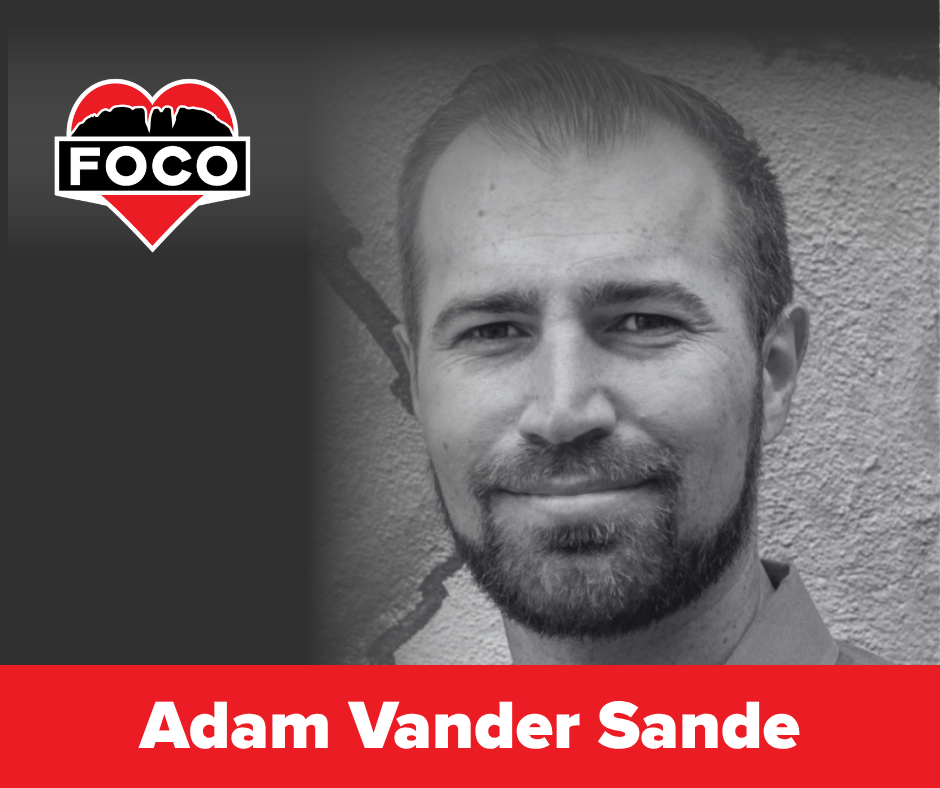
Adam Vander Sande is the Chief Operating Officer and a partner at Hot Corner Concepts, the Fort Collins restaurant group behind Austin’s American Grill, The Moot House, Big Al’s Burgers and Dogs, and Comet Chicken. After a turbulent young adulthood in Southern California and Wisconsin, he moved to Fort Collins in 2007 looking for a fresh start after being carjacked and robbed just before the move.
He began as a busser at The Moot House and worked his way through the restaurant world into management, ownership, and executive leadership. Today, Adam is known for his resilience, love for hospitality, and commitment to strengthening Northern Colorado through both business leadership and community investment.
Narrator • 00:08
This is the Love FoCo Show.
Adam Vander Sande • 00:13
Maybe not put on that quick to judge mindset and try to seek to understand and look at somebody's perspective 'cause nobody I think intends to end up in those dark places, right? But a series of decisions, whether intentional or not, puts people there.
Narrator • 00:32
Welcome to the Love Foco Show. Our podcast highlights the incredible people who make Fort Collins the place we're proud to call home. Each week, your host, Jeff Faust, sits down with local leaders, community champions, and change makers to share their stories, what they love about our city and how they're helping it thrive. So whether you're out on the trail, at a brewery, or walking through Old Town, thanks for tuning in.
Jeff Faust • 00:57
How do you go from busboy to CEO and part owner of one of the best restaurants here in town? That's exactly what my conversation is today. As I, Jeff Faust, the host for the Love Foco Show, sit down with Adam Vander Sande, who's leading the Hot Corner Concepts restaurant family here in Fort Collins. I think you're gonna love his story of how he moved here, how he was promoted over the years to now part owner of Hot Corner Concepts and everything that they are doing to give back to our community. It's a great conversation. I know I enjoyed it and I'm so thankful that we get to share it with you today.
Well, Adam, thanks so much for giving me some of your time this morning. I'm excited to share this conversation with the Greater Fort Collins area. We've known each other for a little while and I've been looking forward to just kind of sharing stories and talking about life in Fort Collins and everything that's happening. But I definitely want to get into everything you do in our city, the way that you lead and all of that. But I want to start our conversation, the way I start every conversation on the podcast. What is your Fort Collins origin story? Like, I mean, I know where you grew up, I think, but like tell us what's your origin story here.
Adam Vander Sande • 02:11
Awesome. Well, hey, thanks for having me on. I appreciate your time as well and all you do in the community. So my origin story is pretty typical. I was born in Southern California, had a very diverse upbringing, parents divorced young, moved around a lot, both remarried. And so my dad moved back to Wisconsin where my parents are from. And so I spent a lot of summers and holidays back in Wisconsin. And then my mom's parents retired here in Fort Collins, Loveland, Barrier. And so I got to spend some time out here growing up as well. And, you know, typical upbringing, you know, did a lot of sports, had a bigger family, all those type of things. And when I was a young man, I started hanging out with kind of the wrong crowd, if you will. (laughing) And I could just see this direction I was on. It wasn't a great path. And I had family moving out here to be closer to my grandparents and came out here in the summer. And the magic of this area, just from a little bit older eyes, I just saw it and said, "Hey, this is a place "I could really change my trajectory, "change my future and hit the reset button." And so brought myself out here in 2007, end of 2006, right during that big snowstorm. And it was one of the best decisions of my life.
Jeff Faust • 03:46
That's sweet, that's sweet. So I heard a lot of different cities, areas, and states there. I mean, first of all, I think it is important for us to just recognize you are a California transplant. Yes, yes. But you've been here for a while. You've been here for a while and-
Adam Vander Sande • 03:59
Almost 20 years,
Jeff Faust • 04:00
yeah. And you have like some Midwest fruits too. I mean, I've been to Wisconsin a few times. Wisconsin and Southern California are two very different places. Absolutely. I mean, like the thing I think about most when I think about Wisconsin is just drinking lots of beer and watching the Packers. That's just like my stereotype of Wisconsin. And of course, fishing. If you like love the outdoors, you can get after it in Wisconsin. But you did some summers out there, but tell me about life in Southern California. You said you kind of had an interesting past. You found yourself into the wrong little crowd and things like that. What does that mean? I mean, that can mean a lot of different things. What does that mean for you? Yeah, so,
Adam Vander Sande • 04:46
you know, so coming from, you know, in the 90s and 2000s and having a single mom and getting remarried, you know, there was a lot of unsupervised time, take yourself to school. Yeah. You know, I played sports growing up a lot. So, you know, what brought us together was, you know, playing soccer or going to different sporting events, but the rest of the time we were pretty self-sustainable. So, you know, took ourselves to school, took ourselves home, you know, the classic be home when the street lights are on type of style. And that - It's a lot of opportunity to get in trouble. Yeah, yeah. - That's what,
Jeff Faust • 05:25
I mean, that's how
Adam Vander Sande • 05:25
my childhood was like that. Yeah, yeah. And that independence, you know, is great character builder in the sense of learning how to be independent and all those things. And then, you know, as a teenager in Southern California, you're exposed to a lot of things that typically wouldn't be exposed to maybe in other areas. And it's a melting pot of socioeconomics, right? So you have everything from the deepest of poverty to the wealthiest of families, and they go to high school together. And so it creates these avenues of... That's a really interesting high school culture to be around. Right, right. And you know, and it's massive, right? It's a dense population. When people say, what was it like growing up in California? It's really interesting to me 'cause I feel like in California I see it now when some outside of it, but everything's A to B as fast as you can. And there's, and this doesn't apply to the whole state, but in the area I was in, it felt like there was a missing element of community, right? Everyone's on their journey from A to B as quick as they can. And so if you're not moving that fast, you get left behind. And so there's just this immense amount of pressure. And then going back to Wisconsin and going fishing and going to Packers games. It's a slower life, man. It's a more casual, slower life, enjoying the grid things around you. But I always joke that I got the Midwest work ethic and I got to see what this fast paced life is like in California and I felt like Colorado was a blend of both in a very good way.
Jeff Faust • 07:06
Yeah, so let me ask a question about, 'cause you had mentioned like, just about a freedom that you had growing up and how that's good and bad, like 'cause I think you said that kind of independence, it forces a self-sufficiency in a way and you kind of have to navigate your own life. And there are pros and cons to that, right? So tell me a little bit more about some of the best things that you take from your growing up years And some of the things that shaped you maybe in a negative way too, that I think in your own words needed that reset button. Yeah. So tell me a little bit about that journey and, because it's not every young man that's like, I need to reset right now. Right. So there had to have been something that got you to that point. So tell me just the good, bad, the ugly, a little bit about kind of that journey.
Adam Vander Sande • 07:54
Yeah. Well, I think the good part of the independence is it teaches you accountability, self-accountability. Right. So you're making your own decisions and you have to live with either the success or the consequences of that, right? So you learn time management, all those great things that come with it. And you learn hopefully from the mistakes you make 'cause you make a ton of them, you know, as a 12 or 13 year old, you don't have the best focus on your life, you know? And so I think I carry a lot of that with me to this day. And I always joke with my kids that I wouldn't say, when I was your age, but I still do it. But getting into the more meat on the bone, if you will, as a teenager and a young adult, hanging out with my friends and being exposed to drugs and alcohol and parties in Southern California scene, I started to watch my friends get involved with activities that I would never imagine myself in these situations. and you start being exposed to things that can really shape your life in a negative way. And so I watched my friends get in trouble, watch them go to jail, I watched violence happen, shootings, stabbings, et cetera from that side of things. And I could see myself being put in these situations that everything inside my core and my DNA said, "You shouldn't be here. "You know, I need to get out of this." And luckily, I'm a super blessed and lucky guy. The situation was presented and you know, family certainly played a part in that. And I'm grateful and thankful for those pieces.
Jeff Faust • 09:40
That is interesting to hear you say that though, because I mean, I think hearing your story, and what's interesting to me is that you could take a hundred people and drop them into that situation where their friends are getting in trouble, maybe you're getting into a varied amount of degrees of trouble, but you're being exposed to those extremes of socioeconomic wealth or poverty, violence and just some of the gnarly activities that can happen in a melting pot like that. And out of the hundred people you drop into that, not everybody is like, you know what, I need to hit a reset. There's something inside of me that's telling me this is not for me, I've gotta get out and change. 'Cause there's gonna be a whole bunch of people that just dive deeper into that. Right, right. And we probably both have stories about people we've seen get up and out and people who just get in deeper. What made that difference for you, do you think?
Adam Vander Sande • 10:37
I think it was just the sense of purpose and where I wanted to go in life. As you mentioned, we both watch people, it get pulled in deeper into that, that whirlpool of it just gets worse and worse and we've watched people pull themselves out and I've lost friends over the years from that lifestyle and it was just in my DNA of knowing that it just didn't feel comfortable, it didn't feel right and I just finally listened to that voice and pulled myself out and I was lucky to have all those people around me to support and to help me get out of that lifestyle. Relationships are key, aren't they?
Jeff Faust • 11:23
They are. And just the ability to lean on them, to have them, whether it's support you relationally, emotionally, financially, whatever it is, that support system is so, so vital. We talk a lot about at the Love Foco Center, we talk a lot about like how poverty just has a lot of different faces, a lot of different backgrounds, and one of the most overlooked forms of poverty is the poverty of relationship. That if you don't have people that can surround you, lock arms with you, point you in the right direction and actually take a few steps with you, that's a deficiency that we want to help. 'Cause community is so vital.
Adam Vander Sande • 12:04
It's so important. Yeah, there's a lot of gaps for a lot of people. And I was extremely lucky to have others around me to help facilitate.
Jeff Faust • 12:12
Was it more like a slow burn for you where it was like the proverbial frog in the kettle pot of like, oh man, just over time it just got worse and worse and worse. Or was there like a dramatic moment where you were like, this was the straw that broke the camel's back.
Adam Vander Sande • 12:29
I gotta get out. So I don't jump into things half-footed. So I was playing sports and had a good balance of things going on and I got hurt. and all of a sudden what filled my time, there was a void, right? And so I filled that with the wrong things. I put the wrong things on my plate and I dove headfirst into that, you know, and lost focus on my priorities and my future. And, you know, in six months I went from where I thought I was to a completely different space and it can be so destructive. It can happen fast too. Yep, yep. And I watched two of my friends almost die, one from a stabbing and another one from an overdose. And that, I think that was my wake up call to say, "Hey, and as a young adult, your friends and your environment is everything." Right? And that's a lot of peer pressure and a lot of components. And you, to your point, you just have to have that moment of saying, I'm gonna change. Yeah, yeah.
Jeff Faust • 13:43
Yeah, I mean, I know parts of that story with you and I was reflecting on my own life, even preparing to talk with you today. And I was like, man, there's just a fair amount of overlap in our upbringings and some of the choices that we made that would like, you know, just knucklehead decisions. I'd like to rewrite, but I can't. It's part of my story now. But I think both of us recognize and plenty of people listening to this would know, like we're actually all just like one or two decisions away from being those guys. Right, right. And it is kind of, it's, you know, you can get lost in philosophical thought and almost like a metaphysical reality of like, well, why not me or why, you know, how was I able to, it's just interesting how when you look back, you're like, man, one decision this way or that way, in some cases for me, it was like two feet this way or two feet that way, you catch a stray or whatever it is and your life looks very different. Absolutely. And in a way it's an invitation to humility in a lot of ways of like, yeah, when I look back at it, I'm like, yeah, maybe I can stack these few things together but I could have stacked a few things in the opposite direction and it would have gone even worse than it was. You know, I mean, it's kind of interesting to think back by that.
Adam Vander Sande • 15:04
Yeah, yeah. And I think it teaches you compassion and understanding. It helps you maybe not put on that quick to judge mindset and try to seek to understand and look at somebody's perspective. 'Cause nobody I think intends to end up in those dark places, right? But a series of decisions, whether intentional or not puts people there. And I certainly can fill your whole podcast with six months of stories in that space.
Jeff Faust • 15:33
That's really interesting. I mean, I think that's really true though, because playing cards with my kids the other night, and I was teaching them a different card game, one where your ability to succeed is somewhat related to the luck of what was dealt to you. 100%. Not a lot of skill in this particular card game. It's just like, you got the cards or you don't. And I've noticed that my compassion has really grown, even like viewing life over the course of 20 or 30 years, not just the interaction I have in this moment of like some people are just, they were just dealt a different hand, you know, and had no control over that. They had no control over that. They were the cards they were dealt and they're learning to play them. And, you know, I think the beautiful thing is we get to come alongside of them and maybe offer them some new cards and set them up for success in the future. But there is a reality that compassion can grow with empathy and with understanding. And yeah, I think it's super important.
Adam Vander Sande • 16:36
Yeah, yeah, absolutely. I love that analogy.
Jeff Faust • 16:39
Well, I wanna talk to you a little bit. So you ended up landing here. You had some kind of wherewithal family help a little bit. I mean, did you come out with like a car full of furniture and a bunch of cash in your pocket? Or like, did you come out and you're like, I'm gonna build my life here. And then either way that that story started, like what were some of the next steps when you first got out here? Yeah, yeah,
Adam Vander Sande • 17:00
well, so I got Kar-Jacked and Rob, but the day before I moved out here on Christmas Eve. Oh, Christmas Eve. Yep, and I lost everything. So when I came out here, I literally had nothing but family to rely on. My plan was just to go back to school and figure out what I wanted to do and find that passion.
Jeff Faust • 17:27
How old were you about this time?
Adam Vander Sande • 17:28
What was it? 1920. Okay, yeah. - Yeah, yeah. So, you know, young man, it's funny when you look at as a little bit older now, you're like, you're still a kid. Yeah. - You know, but at that time you think you should have everything figured out, but you don't have anything. So I landed here, didn't have much, didn't have a vehicle. I was like, I need to get work right away. You start saving up to buy a car, need to reset all those things. And so I landed, did a little bit of sales. I was a manager at Safeway and needed another job as well. And so got a third job at the Moot House and I pulled in and- Wait, so you're in your 20s,
Jeff Faust • 18:14
you're doing some sales. You did you get hired as a manager at Safeway or did you work your way to this manager position at Safeway?
Adam Vander Sande • 18:23
You know, it was a night stock manager, so I could work during the day. Yeah. So it's like I had.
Jeff Faust • 18:30
And you got a job at Moot House. So your working day, your working nights, I mean, you had a care to be able to just go and grind it out.
Adam Vander Sande • 18:39
Yeah, I think so. But at the time that Safeway was going through a transition, it was going non-union, it was just a weird environment culturally during that transition. And so I just needed to find something else, a better fit for me. And so I'd worked in restaurants before and wanted to just get another job. And I had ate at the moot house many times with my grandparents and family and I was driving by. I pulled in and just something said just to pull in and the timing was right. And they didn't have any positions open, but I said, "Hey, I'll bust tables, I'll wash dishes, whatever I can do on that side. And so I got hired and that started my love and passion for the restaurant and hospitality industry and put me onto my career path today.
Jeff Faust • 19:33
I just love that story too. I mean, you're driving by, you've been there before, it's a familiar place, but you go in and introduce yourself. I mean, like, do you ask to talk to the manager or something? Or like, hey, like, I need a job. Like, what do you got? Yep. And they said nothing. And you're like, yeah, but really I need it. Like, I'll do anything. Yeah, yeah, you know. I mean, that's an interesting conversation though.
Adam Vander Sande • 19:53
Yeah, yeah, and I was just really fortunate the timing. You know, restaurants are busy for lunch and dinner and the shoulder period is when you can sit and talk to people and reset. And so my timing was right. And luckily the manager at the time was available and willing to sit down and chat with me. And he must have liked what he saw on me and said, "Hey, we'll set you up for the interview, come on back and got me set up and I started that job in April of '07. So that was 19 years ago. Yeah.
Jeff Faust • 20:25
Yeah. And because I know what you do for a living now, and that makes it even more interesting, but tell us just kind of the career trajectory from bus and tables or washing dishes at Moot House to where you're at today.
Adam Vander Sande • 20:39
Yeah. Yeah. the team at the Moot House and in 2007 it looked a little different. It's been through a remodel since then. But I immediately fell in love with the octane of the restaurant. So I was working in this place where everyone cared. We were coming together as a team and as somebody that played sports, I know this resonates with you, but everyone had their role to play and we knew what winning looked like and we knew that we're there to provide an exceptional experience and it's like being in the pocket or the zone or you know when you're playing sports and you're locked in, I quickly moved into the kitchen and got to work under these amazing chefs and during service it's like being in that zone, right? When everything comes together, it's this beautiful symphony and everyone's moving in and out and assembling food and cooking and it's just this beautiful form that comes together. When it's in the right zone, it's so much fun. The octane, the energy. There's like an adrenaline hit. Yeah. I was blessed and lucky enough to work for Hot Corner then and I saw that there was these incredible leaders and mentors around me and they truly cared. And I just wanted to be a part of it. I wanted to learn more. And so I did the journey in the kitchen, found my passion for cooking, and luckily learned the innards and outs from a couple years in that side. And at that point I realized, okay, I can make a career out of this. I need to go through the steps. So I need to learn the front. So I went in the front, learned the whole front of the house, learned how to serve, and that's, hospitality's in my DNA, right? That fills my bucket. I love coaching, I love teaching, I like serving others. And so that aligned and clicked for me early on and out front was really smooth and easy for me and learning to bartend was, you know, assembling things just like cooking, but you're doing a performance in front of people. And so once I had those under, learned those skill sets, I jumped into management and had an incredible training program and got linked with some really good leaders. And so from there, kind of started my next phase of my journey.
Jeff Faust • 23:05
Yeah, I love that. It just kept growing and growing and growing, but there, you can't just make yourself get promoted either. And it's hard sometimes to self reflect and brag about yourself, but I'm just curious, what was everybody who was like over you seen that kept you getting new positions and getting invited to take steps further in to the organization. 'Cause they must have seen something in you. They were like, "Hey, this kid's got crazy determination and grit. He can show up, he can work long, like he can do the hours, he can do the work." But there needs to be other things besides just hard work. Right. That you must have contained.
Adam Vander Sande • 23:47
Yeah, yeah. You know, it's a, you hit the nail on the head. Sometimes it's hard to praise yourself, right? And it's much easier to praise others. But I think I just, you know, I said yes to opportunity. I was willing to dive headfirst into things. I asked a ton of questions. I was curious. That's one of my superpowers. I'm just, I'm curious about the why behind everything. And so I was willing to stay late to learn.
Jeff Faust • 24:18
Which is counterintuitive a little bit for like young professionals out there. 'Cause I think sometimes there's a fear that asking all these questions will disclose that you don't know the answers. Got it, yeah. And I think there's a fear in some young workers that then if people find out I don't know the answers, then they'll know. It's like the uncovering of the imposter syndrome, right? But actually what helps qualify you is having like a tenacious appetite to learn the answers and to pursue that growth and that continued learning. I mean, that's, I think that's a lesson we could all learn. Probably even still today in our, in our a little slightly older age.
Adam Vander Sande • 24:59
Yeah, yeah. And I would say to anyone listening to this, certainly don't be afraid to ask questions. It's how you learn, right? And I could totally can respect and understand that fear. But if you can get over that and you're willing to ask questions and listen, there's lots of brilliant and willing people to teach and guide you and tell you start to build relationships. Yeah, and so, you know, for me, I was lucky enough to have a great culture and a great company that was willing to invest in me. And so I jumped into management and I worked at many different restaurants. I did Austin's Downtown, the kitchen, did our country club out in Windsor when we had that. And so I got to see a lot of different leadership styles, a lot of different perspectives, got to learn a ton of how to do things the right way, what mistakes were. And at that point, I had met my wife, we met at the Moot House working together. Nice. And Erica had graduated from CSU and got hired as a graphic designer up at Woodward at Copper Mountain, up in Summit County. And so I knew that she was the one and I better follow her wherever she went. Yeah, Wise Man. Yeah, yeah, one of my best decisions in life, hands down. So, I did probably, I don't know, two or three years in management, working at many different stores and learning and growing and moved up to the mountains and got a really fun chapter of our life. I worked for a restaurant group up there, got to do brewery expansion, restaurant remodel, bars, got to, uh, it was probably one of my biggest growth points as, as a young man, uh, because I came from hot corner, which had all these really great systems and practices and, um, uh, you knew what success was, right? And what the right thing is. And, uh, not that this, the other place I went to, um, didn't have that, but it was more wild west in the mountains, right? Yeah. And so I got to really, truly learn, hey, am I gonna implement change or am I gonna get absorbed into it, right? And a little bit of both happened. I learned a lot of leadership skills from mistakes up there. And I got to learn a lot from my mentors up there, Annie and Travis, Candice, they were great people. And it was a really fun time in our life, as a newly married couple and getting to snowboard a hundred days a year whenever you wanted, but then having a big next step in our careers. And so it was a really fun time. We did that for a couple of years and decided at a rooftop restaurant in Durango that we wanted to have kids and probably settle down. And so Fort Collins pulled us back. This is so many people's stories.
Jeff Faust • 28:11
I tell like almost everyone I talk to who is like around here at some point in their life and moved away They're like counting down the days like when can we go back? Yeah, like I want to do I want to I want to raise my family in northern Colorado I want to be in Fort Collins or whatever it is and so yeah,
Adam Vander Sande • 28:26
yeah, and so it you know, it was it was pretty pretty wild the magnetism of Fort Collins and so So we're at a wedding in Durango We're having lunch before the wedding. We're on the rooftop, Eric and I are chatting, and we decide, okay, yep, let's figure out what our next step is, right? And so she puts her resume out there, and the Downtown Business Association emails her right away while we're at the wedding, saying, hey, we'd love to interview you for a position. And so we detour straight after the wedding. Yeah, that's quick. Yeah, two Fort Collins, and 30 days later, we're back in Fort Collins. Wow. And picked right back up with Hot Corner and we've been back since. Yeah. And so glad to have our roots here.
Jeff Faust • 29:15
Yeah. So you were managing here for a little while, went up the mountain and kind of managed it and added a few more, you know, cards to your deck, so to speak. Yeah. Just keep pulling on that analogy of just like expansion and, you know, organizational change and how we can do those things. And then you landed back here. And so what have the last couple of years been like and where do you find yourself leading today?
Adam Vander Sande • 29:38
Yeah, so the last 10 years have been an incredible chapter of my life, big transition. So we had our two daughters, I jumped back into management, did that side of things, grew to a GM, got the opportunity to get tutelage under great mentors, grew through the company, designed a concept, opened some stores, got into the director role, moved into the C-suite, and then been a part owner of Hot Corner now for a handful of years, and just been super blessed and lucky along the way.
Jeff Faust • 30:18
This is like, you know, I don't know, you know, Shark Tank, not quite Shark Tank 'cause you're not like pitching to VCs, but this is kind of like, in a way, like the American dream. Right, right, right. I like you grew up, you fell in some hard times, you saw some stuff you shouldn't have seen, you're like, I gotta reset it. Move out here, you become a busboy at Moot House, and now you're part owner of Moot House. Yeah, yeah. That's awesome.
Adam Vander Sande • 30:47
Yeah, thanks, man.
Jeff Faust • 30:48
That is a really, really sweet journey. And I think there's a, I mean, just in this conversation, there's so many lessons for young men and women and aspiring people to glean from. But that's quite the journey. Yeah. - From Busboy to C-Suite.
Adam Vander Sande • 31:06
I mean, it's incredible. Thanks, man. Thanks, yeah. And in that 10-year gap we had in the pandemic, which that was a crash course and HBO special in itself for everybody. Yeah, I'm kidding. Yeah, and so that was a, that was a, I call it a time warp, right? Because it feels like it was just yesterday and also feels like it was 10 years ago. but that was a really challenging-
Jeff Faust • 31:29
Well, COVID hit the restaurant business. I mean, you know, I passed her in town. So like, we had no idea. We had no idea, like, are we, are people call this church still their home or not, like, are they with us or that? And COVID blasted restaurants. I mean, that would have been incredibly challenging.
Adam Vander Sande • 31:46
Yeah, yeah. And I, you know, I love hearing people's COVID story, you know, because everyone has their own perspective and had different from frontline workers to not sure if I'm gonna have a job, to moving across country, to you know, there's all these amazing incredible changes.
Jeff Faust • 32:04
Learning what is essential, what's not essential. Right. - Moving that, classification. Right, right. - That's so interesting.
Adam Vander Sande • 32:09
Yeah, you know, when I share what it was like for us at the kickoff, so it was a wild time because I was a director at the time and I oversaw our quick service side of the company, so Comet Chicken and Big Al's. And we started having pandemic meetings in February, and we'd get together once a week to say, hey, we don't have a pandemic plan, and I don't think many people did. And so we started to get together and say, let's keep an eye on this.
Jeff Faust • 32:40
And were you like watching California at the time? And you were like, hey, this is coming? Or it could come?
Adam Vander Sande • 32:46
Or like, how confident were you that it was gonna land? Well, I was extremely optimistic that it wasn't gonna happen. And we were just gonna be prepared. And nobody knew what was gonna happen or what we were doing. And so, we started just casually to say, what would happen if the restaurant's closed, right? And we're looking at China and what's going on and watching the coast a little bit. And so we were actually in one of the meetings. We had great plates going on. So it's wild to think this, right? So we had lines out the door for the specials going on downtown. It's packed, we're in a meeting and we get a call saying, hey, the capital state capital is gonna announce it right now. They're announcing it that we're shutting down.
Jeff Faust • 33:35
Crazy.
Adam Vander Sande • 33:36
Right? And so that kicked off just the craziest next 90 days.
Jeff Faust • 33:41
And like one week before, no one had a care in the world, man. Right. I was telling someone this story the other day. I was having, 'cause there's a CDC in just outside of four, or in four calls, right? Yeah, it's a CCO. And so not as big as Atlanta, but it's part of the extension. And we were trying to get ready ourselves in a way. I'm like, how could this hit the church? And I was super optimistic, like maybe we'll be out for a couple of weeks, but then we'll be back by Easter, you know, and did not happen. But I was out for Mexican with one of my friends, who works at the CDC. And you know, like a lot of Mexican restaurants we're sharing chips and salsa before our food comes out. And he leans forward and he goes, "Jeff, in one month's time, people will not be doing this." Wow. And I'm like, and he said it so calmly, but so confidently. Just bonchill drop. And I'm like, I'm like going, I'm like trying not to double dip. Like that's my version of not swapping germs. And he's like, "Yeah, this won't happen." And I was like, I am not prepared for that. You know? And it just sent me into this journey that sounds like you were ahead of the curve a little bit in preparedness. Yeah, I don't know, maybe half a step.
Adam Vander Sande • 34:55
Yeah, I mean, as prepared as you can be, yeah. Yeah, yeah, it was, I can't even describe how the feeling of just what is happening Fort Collins and I was one of five cars downtown. So 24 hours ago, packed, vibrant, things are happening and then to come to downtown and it's just empty. The roads are empty, you know, you had this experience and you know, in the restaurant world, we were producing a product that is perishable, right? So we have restaurants full of food. We have now, we're responsible for employees, We have hundreds of employees that are looking to us for guidance.
Jeff Faust • 35:47
You guys have so many different styles of restaurants too. 'Cause Hot Core is, I mean, it's not just Moot House. It's cycle through all of them for us. Yeah, yeah,
Adam Vander Sande • 35:56
so we have four different brands. So we have Austin's American Grill. So classic American Grill. We have three locations for that in Northern Colorado. The Moot House, which English style pub, been around since '72. Then we have their Quick Service side. So we have big Alice burgers and dogs and downtown Fort Collins. And then we have Comet Chicken and Fort Collins and Loveland. Yeah.
Jeff Faust • 36:18
It's such a wide range. And like you said, all of a sudden, and you probably had like, not only perishable food on site, but perishable food in route. Like, I mean, 'cause you're always trying to stay ahead. I mean, there's some kind of supply chain coming to you of stuff that's already been bought or paid for. I mean, yeah, that's a,
Adam Vander Sande • 36:38
that's a logistical nightmare in a lot of ways. Yeah, yeah, so without us going too deep onto a sidetrack or rabbit hole or side quest, my team makes fun of me for going down rabbit holes. And I know you and I would love to go down them. But, you know, in that 90 days, we were building the plan while we were flying it, you know, trying to figure it out. And luckily, Bohemian was a wonderful partner to us and we kicked off feeding our community. We worked with a lot of different leaders and groups in town and we started that program. So we were able to provide meals to the community, take and bake style. It was wild to watch this thing happen so quickly. And so we went from being able to just feed our team in the first week to starting to feed others in need. No questions asked. Then we had the beer purveyors, New Belgium, Odell stepping up and saying, "Hey, we'll help distribute it out to communities that maybe don't have access to this communication or these resources. And so that was happening on one lane. And then we worked on how do we reopen? What does it look like? What are the rules?
Jeff Faust • 37:54
How do we be safe? What are the rules that are changing all the time? All the time, yeah. And so you were made for this though. I mean, I really think, because even going back, like you're an athlete, you're around sports, you're living kind of on the edge, even when you're done playing sports, you're living kind of on the edge, you're up in the mountains, you're bored all the time, you love the fast-paced culture of the kitchen. Those little dopamine hits and those little adrenaline hits, you seem to thrive in spaces like that.
Adam Vander Sande • 38:22
Yeah,
Jeff Faust • 38:22
yeah. And COVID was like a new one every couple of days. Yeah, yeah. I know, we gotta figure out a new thing. Like, let's go. And there was probably, some of that like innate tenacity within you probably really helped you in that space.
Adam Vander Sande • 38:34
Yeah, yeah. I was surrounded by incredible people. So you have your own ups and downs, right? And so when you're surrounded with an incredible team and I was really lucky to have Steve Taylor as my mentor and business partner. And we all looked at Steve and others looked to us and we were able to just do our very best to navigate through it. And it was not a linear path, right? There's a lot of ups and downs, but we learned, I think everyone learned an incredible amount about themselves personally, their community, and see how everyone responded. And so I think I grew as a person a lot in just a short amount of time from that period.
Jeff Faust • 39:20
Well, and it reminds me of something that we said earlier. It was like you drop 100 kids into the environment where you were at when you were young and they'll go a bunch of different directions. We also watched a bunch of people get thrown into COVID and go a bunch of different directions too.
Adam Vander Sande • 39:37
Yeah.
Jeff Faust • 39:38
So again, there's just something was inside of you that helps you navigate that really, really well. You mentioned a couple of things I wanna go back to. One, it was the magnetism of Fort Collins that kind of drew your family back. I hear at least a little bit in your story that part of that magnetism, it's hard to define it, but the community aspect, in a real sense, coming together, even in a time like COVID where it's not just you guys cooking food and feeding the hungry, it's Bohemian helping support that, it's New Belgium and Odell's and whoever else was involved in the distribution of that. And even getting to parts of this community that maybe, you know, aren't as, you know, in the know or on these communication things or have access to just like drive to wherever they need to get to. I mean, that's pretty electric really. When you think about how loving our community is and how much buy-in there is across small employers and major employers alike, right? I mean, I've been so impressed with that. And you're obviously leading a large organization. You have a lot of employees, but talk to me a little bit about how you've seen businesses work together, the community and business, like, and how all that life has been shaped in Fort Collins.
Adam Vander Sande • 40:57
Yeah, so I think there's this deep appreciation and gratitude for Fort Collins from almost everyone that lives here, right? So we, even if you can't quantify or express why the magnetism or the magic is there, and that pull is different for everybody, but there's sense of belonging and that magic and purpose, we wanna help facilitate that, right? And so in my personal experience, I don't think I've ever come across anybody in this area that doesn't want to do their best for the community, right? And I think when you have a willingness and resources and support to help facilitate giving back to our community, it can be really special. And I think there's a lot of wonderful things that happen every single day in our community to address a lot of bad things that happen in our community every single day. And I think we're really lucky to live in this place because CSU at its roots is, Fort Collins is an ag town if you go back, right? And having CSU as this incredible place that attracts talent and brings these people to the community and then they get to see Fort Collins and they're like, "What? I want to be a part of this." This magic, this culture, this art, this tech industry, you name it, Fort Collins has a little bit of everything. And somehow as we've grown through brilliant people that have come before us, they managed to retain that specialness. So you still have that small town in a large town setting. And so people come here and they want to be a part of it. They want to stay, right? And they want to give back.
Jeff Faust • 42:52
Yeah. And we saw a lot of that and just even learning through that, through a shared experience that we had. When I first moved into, you were already here for a while, but when I first moved to town, we landed in Leadership 4 Collins around the same time. That's where our relationship really began. And before the interview started, we were kind of talking and reminiscing about some of those days and just a quick plug to Leadership 4 Collins and really the work the chamber is doing. Anne was one of my first interviews, Anne Huggins. and it really helps people acclimate to the city, or if you've been here for a while, grow in a deeper appreciation and really uncover the story behind the story, behind the story about some of the stuff that's happening. What were some of your takeaways from Leadership 4 Collins, or just like your growing awareness of the city?
Adam Vander Sande • 43:41
Yeah, yeah, so appreciate the plug, and I double that and shout out Leadership 4 Collins. Anyone listening that wants to find their passion or how to give back, I highly suggest leadership for Collins. It's an incredible program. And so my takeaways from leadership for Collins were learning, seeking to understand, right? Learning how and the why behind things in our community, the intentionality and how easy it is to get involved. And so you and I were talking about it before, but an email and getting together over a cup of coffee can really help somebody discover their passion and connect them with people to give back and to care. And it was my entry point into giving back to the community for sure. It definitely showed me all different aspects and how they all come together to make Four Collins special.
Jeff Faust • 44:43
Yeah, well, I wanna talk about that. I wanna talk about the way that you love our city life at a time. That's kind of our tagline at LoveFoco, trying to love our city more life at a time. If you want to get into that personally and maybe even organizationally, because I know Hot Corners is just involved in the community, you shared a little bit about that already. But first I want to just have a quick intermission. I don't know how much you can share, but I'm hoping you can just share, Trance, you got a lot of restaurants. And a lot of us go to these restaurants. So let's say I go to Moot House, Austin's, Comet Chicken, or Big Owls, and I'm with Adam. Like, what are you ordering at these, like what is your ticket item? Okay. Give me some insights, 'cause I've got some of my favorites, particularly at like, I find myself frequenting Austin's probably more than the others. Yeah. I've been to all of them. I have like a couple items on each menu though. Yeah. I'd love to hear like, what's one of your go-tos at these places? Yeah, yeah, I get that question a lot.
Adam Vander Sande • 45:35
It's,
Jeff Faust • 45:36
And don't give me, don't give me like, all the whole menu is great. I know the whole menu is great. Yeah, yeah.
Adam Vander Sande • 45:40
I know it's all great. It's like picking your favorite kid. Yeah. (laughing) So, So 6040 at Big Al's is a home run. That's for sure. That stems from a place I used to eat at in high school in California. And we wanted to replicate that here. Did you help create that burger? Yeah, TJ Charles, who's at the Whiskey Still owner over there. And I just had part of the idea. He made it happen, but that's my go to. And that's the blend burger, right?
Jeff Faust • 46:14
So it's like some pork, some beef, is that right?
Adam Vander Sande • 46:16
Right, 60%, beef, 40% bacon. So it's definitely my favorite at Big Al's. Comet Chicken is extra special to me. So as part of the team that designed that, I launched them. And so one of the fun things with Comet Chicken was, you know, going into that quick serve space, coming from a full service company is, we do scratch cooking there, right? And so one of the things that's held true for us at Hot Corner is we always just want to start with the best. So we want to pick quality ingredients, treat them right, right? Be the caretaker of that ingredient and then put it out with pride and care, right? And so Comet Chicken, so our chicken there and the chicken at Austin's is never, ever chicken. So it comes from a specific breed of chicken. It comes from small farms. It's green fed. It's fresh, never frozen, not messed with in any way. And so my favorite there is Nashville chicken. That's my go-to.
Jeff Faust • 47:20
Have you had it? I have. Yep. I'd probably go there once a month to be on. I mean, full disclosure. Awesome. I'd still like a Sunday after we'll just take a crew out there and take a couple tables.
Adam Vander Sande • 47:30
Yeah, Austin's got to get anything from the rotisserie, man, that rotisserie chicken's winner. But my favorite go-to is the bison steak. Ooh, I haven't not had that. You got to try it next time. Yeah, that's from Frontier, that's a winner. Moot House is a special place for me 'cause that's where I met my wife where I came into the company. Always have to start with the pretzels. Okay. Make them from scratch every day in the morning, real deal. And then if I had to pick two, it's the prime rib and the schnitzel. Love it. Yeah, so the pork schnitzel with the mustard cream sauce.
Jeff Faust • 48:09
I've got ideas already about. what I'll get next time, but I'll re-listen to this and I'll make sure I hit everything on that list.
Adam Vander Sande • 48:16
Go to the Moot House, do happy hour spread. It's one of the best happy hours in town, if not the best. And so you can go there with a family. Eric and I like to do it. We do family style. So we just fill the whole table with appetizers and small plates and that side, get the fish and chips. That's incredible. And it's one of our favorite things
Jeff Faust • 48:37
to do after practice. - That's sweet. I love it. The Moot House was, I think the second restaurant I ever ate at when I moved here. Oh, very cool. So the first, I won't name the first one. It may be a competitor of yours. Oh, that's all right. But it's all, yeah, I have distinct memories of going to the Moot House early on when I moved here because I met some important people in my life there and they took me out there and- We have that in common. Yeah, it's what restaurants can do, right? Yeah. But it's a place of gathering, especially when there's a hospitable kind of value to the organization to set the table and where real conversations and real relationships can start or grow or whatever it is.
Adam Vander Sande • 49:14
You said that much more eloquently than me. I'm gonna copy that.
Jeff Faust • 49:18
Yeah. It's a real thing, man. It's a real thing. So, well, let's finish the conversation by talking a little bit about how you love our city, whether that's personally, organizationally, just kind of tell us wherever you'd like to go with that.
Adam Vander Sande • 49:30
Yeah, sure. So, one of the things that I learned from leadership for Collins I thought was so special was that we get the benefit of the previous generation's foresight. There was so much intentionality of each generation having that ownership and that steward to set up the next generation, right, from burying power lines, getting resources, designing the roadways. There's a lot of intentionality that we get that benefit from today that somebody that came before us thought through and said, "Hey, I may not get the benefit now, but the next generation will. My kids will. The people coming to Fort Collins will." And so that really resonated with me and instilled that sense to give back and to say, how can I help shape and give back to the community? And so I volunteer in a number of different ways. I do the chair of the local legislative affairs committee. We meet every Friday at 7.30 and work with local leaders from the city, the county, the state on shaping policy going forward. I'm always surprised and amazed at the brilliant people in that room. I feel like I learned from it every single day and I get a great sense of positive and peace of mind that there's these brilliant people coming together to help solve today's problems and thinking about that future side. And I want to be a part of that in any capacity, whether it's time, energy, resources, or do a handful of other different volunteering side. And then Hot Corner, we do Hot Corner Cares, which is our philanthropic side of things. And we take half of our marketing budget and we give it all to supporting the community. Wow. And so, that goes to the local schools, anyone in the nonprofit space, we help support events, facilitate, and so we do a ton of work with Habitat for Humanity, Matthew's House, the Food Bank, you name it, Respicare. I think last year was over 200 different organizations that we supported in some capacity.
Jeff Faust • 51:54
I love that that's like a thought out organizational plan. And I think a lot of, whether it's small businesses or large businesses could, I mean, the intentionality behind that, because otherwise it's easy to always just make decisions kind of on the fly. But when you have like a well, even if it's not these organizations at this particular time, but like, hey, no, half the marketing budget is going to go to this. And I'm sure there's some kind of pod like this is how it's disseminate, you know, across the space. But to have kind of a clear thing, a clear marker in your org, I think would be so helpful for so many others to implement whatever they can do to get that ball rolling.
Adam Vander Sande • 52:36
Yeah, and I was lucky enough to have my mentor design that program, sent it up, and it's my responsibility to steward that now. And there's a lot of amazing people in Northern Colorado doing a lot of amazing things, right? And if we help create bandwidth and capacity and support, we'll continue to make Northern Colorado an amazing place. So, the community supports us. They helped us through the difficult time during the pandemic and they help us every single day. They choose to eat at our restaurants and we wanna make sure we put our money where our mouth is with our resources, our time, our energy, our intentionality and give back to the community. That's really important value to me personally and to our organization.
Jeff Faust • 53:25
I love it. Well, that's a good phrase or two to end this conversation on. Adam, thank you so much for your time. If you're listening, hit up these restaurants. Sounds like Happy Hour at Mute House is a great place to be at, Austin's, Combat Chicken, Big Al's. Frequent these places because by doing so, you're helping give back and helping make our city just to continue to be a great place. Adam, thanks for your leadership, your story, and spending some time with us today.
Adam Vander Sande • 53:50
Awesome, thank you, Jeff. Appreciate it.
Narrator • 53:54
Thanks for listening to The Love Foco Show. If today's conversation inspired you, Share it with a friend who loves Fort Collins as much as you do. Don't forget to subscribe so you never miss an episode, and leave us a review. It helps more people discover us. To learn more about Love Foco and find opportunities for loving our city one life at a time, visit lovefoco.com. For now, keep loving Fort Collins well.

