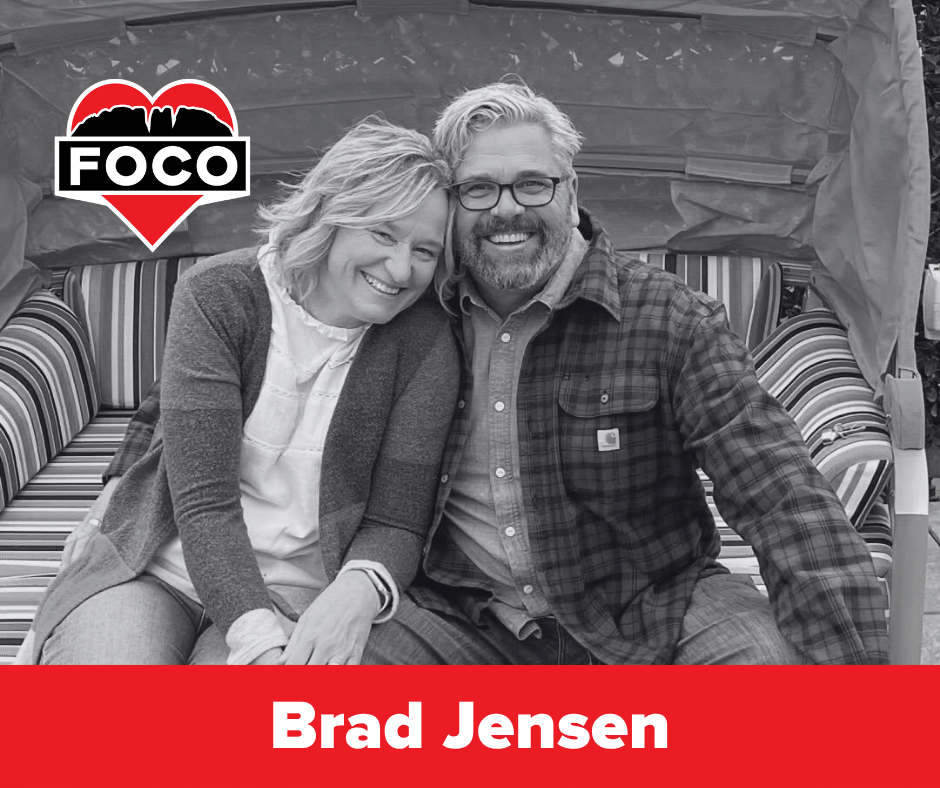

Brad Jensen is the founder and executive director of Refugee Oasis, a global nonprofit helping local churches in Europe and Northern Colorado welcome refugees and immigrants through free language classes, deep relationships, and invitation-based “Jesus Nights.” A longtime Fort Collins pastor and PhD in organizational leadership from Colorado State University, Brad now equips congregations across six countries to love their cities one life at a time.
Narrator • 00:06
This is the Love FoCo Show.
Brad Jensen • 00:09
>> The reason so many of our students come to Jesus Night is because of the relationships that have been developed, relationships of trust. They now believe that these students coming into the class now believe the best of the people who have been teaching them. And so when those volunteers, those teachers invite them to come, They know, hey, what I'm going to experience here will be consistent with what they've provided for them.
Narrator • 00:37
Welcome to the Love FoCoshow. Our podcast highlights the incredible people who make Fort Collins the place we're proud to call home. Each week, your host, Jeff Faust, sits down with local leaders, community champions, and changemakers to share their stories, what they love about our city, and how they're helping it thrive. So whether you're out on the trail, at a brewery, or walking through Old Town, thanks for tuning in.
Jeff Faust • 01:03
Hey everyone, Jeff Faust here, your host for the Love FoCo show. Today's guest, Brad Jensen, is the founder and leader of a global nonprofit that is impacting our local community called Refugee Oasis. Right now, all over the world, folks are moving from their country of origin to a new place. They've either been uprooted because of violence or government volatility or economic strife, you name it. People are migrating all over the world and landing in places that do not feel at like home. And so what can we do as a, as a local community, as a faith community, as business partners, and just neighbors who want to love well to create a hospitable environment to welcome the folks who are landing in our communities. Brad has an extensive history of leadership in the faith community and of course in this space caring for refugees and immigrants all around us. I'm so grateful for his leadership in our city. So grateful that he is going to be partnering with the Love FoCo Community Center right here in our own backyard. And grateful that we're going to be loving our city one life at a time together. But with that, I want you to hear his story and hear all the things that we have planned together for the future. And I hope you enjoy this conversation as much as I do.
Well, Brad, thank you so much for spending some time on the Love FoCo Show. I'm grateful that you're on the podcast, that people will be able to hear your story, but also the way that you're loving our city one life at a time. I know personally I'm grateful for your leadership in our city, but also your leadership globally. We'll get into all of those things, but I wanna start the way I start every podcast, and every time we have a guest on. I'd love to just hear your Fort Collins origin story. We all have an origin story. Some of us are born here, some of us transplant in, but what is that for you and how did you find yourself here in Fort Collins?
Brad Jensen • 03:12
Yeah, well, first of all, Jeff, thanks for having me. Fun to be here with you, fun to see what's happening here with the Love FoCo Center. It's a really fantastic space. And look forward to just how it's going to bless our community. How it's gonna pull people together to bless our community. So that's really exciting. Fort Collins origin story. So my wife and I met in Chicago where I was going to graduate school, seminary,
Jeff Faust • 03:39
graduate school. - Northside or Southside? Like are you a Cubs fan or?
Brad Jensen • 03:43
Actually not a fan at all.
Jeff Faust
Oh man, Brad, okay, we're not off to a good start here.
And I'm a Vikings fan from Minnesota originally. So I actually hate the Bears. So, but we love Chicago. We really did. We fell in love with the city. It's where we fell in love. And she was from Fort Collins, my wife.
Jeff Faust • 04:00
Okay.
Brad Jensen • 04:01
And so as I was finishing up seminary, my dad-in-law extended an invitation to do an internship with him at Faith Evangelical Free Church, Faith's Church today. And so 1996, we loaded up U-Haul from Chicago with our six month old and sitting in the seat between us. And we rolled into Fort Collins and rented a house on the west side of town. I did internship my first year at Faith.
Jeff Faust • 04:33
That's sweet. Faith is on the West Side too, kind of Southwest. So it's a perfect spot to set up shop. And I can't imagine, I mean, these are my words, not yours. So just correct me where I'm wrong. If you're a Midwest guy and your wife was a Fort Collins gal, picking the spot to move to probably wasn't that hard. Let's try the front range. Not enough.
Brad Jensen • 04:55
Yeah. Well, and relationally, I mean, My dad-in-law, my wife's dad, really gracious guy. He really had a heart for his city. And right away I felt that from him. Right, when I landed here, we started interacting in ministry and I had a chance to be on staff with him as an intern to begin with. Just really respected his heart to see the city, to see the campus impacted by a local church. And so, yeah, right from the start, we fell in love with this city.
Jeff Faust • 05:32
That's awesome. Now, let me just ask a couple questions, 'cause I mean, that's how you landed here, but I am curious, like you were in seminary in Chicago. How did you choose seminary? Like what about your background? What about, like when did you feel like, I don't know, maybe I'm a pastor, maybe that's who I am. Like how did that come about?
Brad Jensen • 05:54
That's a great question. So it was actually in college that I had a spiritual awakening, where I realized who Jesus is and who he was for me personally. And so it was the second year of college that I said, "Okay, if this is really who you are, then I wanna be not only engaged with you personally in my own life, developing this relationship, following you, lining my life by your grace, right, to who you are. But I wanted to be a part of what he was doing in the lives of others, and had no idea what that meant. And so I got involved with ministry that I just found. So I found a ministry called Young Life, that's where it kind of started for me, and realized, wow, I really love this, but I really don't know anything about the Bible. And so I started-
Jeff Faust • 06:53
Young life knows how to throw a party too.
Brad Jensen • 06:54
They will help you love. And I learned how to throw, well, I knew how to throw a party even before young life. Just not a Jesus party. Not a Jesus party. So Jesus parties happen, we had a great time and watching students engage with the reality of this God who loved us was just, I mean, I loved being part of it. But realize I wanted something more. So that's how I ended up in seminary. Because I just started looking for, Okay, where can I deepen my roots, right, to understand so that I actually have something to provide other than the party, right? Well, you know, alongside the party, to provide something for these students. And we're looking for something real. I mean, they were desperate. I mean, they have plenty of parties. So they're desperate for actually finding something meaningful at the bottom of it. And so I wanted to- Yeah, plenty of us are living life.
Jeff Faust • 07:49
I mean, if you're alive, you're living. but not very many people are living a life of significance, a life of meaning and impact. And somewhere deep down, I mean, plenty of us have built kind of crusty walls around our heart to the deepest parts of our souls, but in reality, we all have those questions. Like what actually does it mean to live a life of impact and meaning? And that's sweet that you were asking those questions, you started getting them answered, and then you wanted to help other people answer those same questions. Exactly.
Brad Jensen • 08:16
So that's what happened. So when I-
Jeff Faust • 08:18
Did you grow up with faith? In your home?
Brad Jensen • 08:21
It was actually in our home from the-
Jeff Faust • 08:22
You're a Minnesota guy?
Brad Jensen • 08:23
Middle school, basically from middle school on.
Jeff Faust • 08:26
Okay.
Brad Jensen • 08:26
Because when I was in middle school, my parents went through a divorce, terrible, terrible thing, just ripped us apart as a family. And it was actually at that point that my mom had a spiritual awakening to the person of Christ. And so that's basically, that started my journey. And I kind of watched from this, from the edges, kind of watching what was happening watching what was happening in the lives of the people, we started attending churches, I talked about Christ, but it wasn't until that second year of college, then I'm like, okay, this is for me. Yeah. Yeah, so, and that's where it happened. Yeah, and then as it relates to being a pastor, no, I had no idea. I knew I wanted to be in ministry, that's what I knew. And my idea of a pastor was pretty limited. You know, I mean, I really didn't know. like I really didn't know. I saw this dude up front. And this is what he did on a Sunday. This is how he acted, this is how he dressed. But I had no idea what it looked like to actually be engaged in that.
Jeff Faust • 09:33
But yeah, it's like eerily similar stories. I mean, I grew up really far from the Lord and I learned how to throw parties by the time I was 12 years old, but none of them were ever forgotten. And my mom had a spiritual awakening when I was like a junior senior in high school. and I thought she went crazy actually. But then I was pretty desperate in college, ended up giving my life to the Lord and feeling called to ministry. Wow, really similar. But looking back at that and experiencing an introduction to faith and then really to my own identity and just really being like, this is what I feel like I've made for, I had very, very few memories of what it meant to be a pastor nonprofit leader, a ministry leader, and most of them were dressed funny, really boring, and spent a lot of time at the hospital. And I was like, I don't think I'm that guy. I don't think I would be very good at that at all, actually. And of course, it was just a very short-sighted view, because I was just ignorant in the most honest and naive way. I just had no idea.
Brad Jensen • 10:40
Yeah, yeah. Same.
Jeff Faust • 10:41
Yeah.
Brad Jensen • 10:42
Very, very similar. actually coming out of seminary, coming to do this internship at faith, that not only did my dad-in-law inspire me by his commitment to the local church and the local church's ability to impact a community, but also inspired by his openness. His openness, even though he was a certain kind of pastor, his openness to me discovering what that looked like for me as as being part of his team. And so I began exploring early on, you know, what does this mean for me, you know, to be in ministry. And I remember, I remember it was a guy who joined our staff who was a former HP manager. He and I were having a discussion one day and I just had questions about leadership and organizational issues in our church and how could these things be better and be more effective to mobilize more people for ministry. And he said, he told, he, I remember him saying, I've read the kind of questions you're asking are basic organizational leadership questions. And I said, well, where do I go to get answers? 'Cause seminary, great job teaching you how to handle the Bible, great job church history, basic systematic theology.
Jeff Faust • 11:54
Maybe not so great at organizational systems
Brad Jensen • 11:57
and leadership. - No, no.
Jeff Faust • 11:57
Yeah, yeah. - And it just,
Brad Jensen • 11:59
there's only so much you can do. Right. - Yeah. And so, which I believe, like, people should be learning that in a healthy local church, right, understanding how a thing should actually run.
Jeff Faust • 12:08
I mean, I tell people a lot of times, like it usually a seminary grad needs training on how to be a church leader. Exactly, it's exactly right. And it sounds like a gift that you got that. Yeah, he handed me a book.
Brad Jensen • 12:19
He slid a book across the table, basic management leadership organizational issues. And I remember I devoured the thing. And I remember thinking, wow, someone else thinks like this. Someone else has like this, this keeps them up at night. And so I just, as many, I just got my hands on every book I could find.
Jeff Faust • 12:37
That is a unique skill set for a pastor to have because I feel like a lot of pastors, they're like, the stereotypical thing that we would all think, they're great with people, they drink coffee for a living, and you know, this is what we do. And some of those things are true. But if you really, what you're talking about, if you really wanna be a church that blesses the city, advances the kingdom of God, and actually mobilizes scores of volunteers to do the work, you gotta have some systematic thinking as well.
Brad Jensen • 13:04
Well, or at least someone on your team, right? that can do that with you, right? Because we don't all have all of those skills and all, you know, we don't have the entire skill set, right? I mean, that's the reason why it's so good that we're together in community because we all have different gifts, all have different abilities. And I just realized that mine was really focused in on this organizational piece, so much so that I actually pursued a PhD at CSU and ended up in the School of Education and did a PhD in organizational leadership at CSU. Yeah, just again, it's here in my community, fell in love with the school, fell in love with that whole department and just had a blast.
Jeff Faust • 13:50
That's cool.
Brad Jensen • 13:51
Learning with people from all over the community, people in educational administration from CSU, from Front Range Community College, and had a great chance and great community with those leaders who are wanting to learn more.
Jeff Faust • 14:08
Yep, oh that's sweet. Yeah, it was really sweet time. So in turn to PhD, to explore in all these different things, I know that part of your story was you ended up being, coming like the senior pastor of faith church. So when did that take place and how long did you do that and how did that shape you?
Brad Jensen • 14:28
So what happened, kind of through the beginning of my ministry, again, I'm there with my father, We had a great time together. He was really, he was the guy focused on preaching, the guy focused on visiting people in the hospitals. He loved that aspect of the church.
Jeff Faust • 14:44
And he's not the founder of that church.
Brad Jensen • 14:46
No, no, no.
Jeff Faust • 14:47
His faith has a long legacy in our city.
Brad Jensen • 14:49
Yeah, yeah.
Jeff Faust • 14:51
It's an old church.
Brad Jensen • 14:51
100 years old and it is amazing. Yeah, in fact, here's the encouraging thing, right? The last two lead pastors are still a part of that church. which is a neat thing.
Jeff Faust • 15:04
That is a really good sign.
Brad Jensen • 15:05
Yeah, because it means it's a healthy place and honors those who have invested without having to feel threatened by leadership. Yeah, like the new leader's not insecure
Jeff Faust • 15:16
about having the previous guy there.
Brad Jensen • 15:19
Really special.
Jeff Faust • 15:19
I think that is a sign of health for sure.
Brad Jensen • 15:21
Agreed. And so this opportunity, like I said, my father-in-law gave me, hey, explore, figure out what this is for you. So really I was involved in just about every ministry available in the church. Small groups and evangelism ministry and larger community groups, young adults, college ministry, involved in all of those things, missions, so international ministry. Just had a chance to be involved in all of it and ended up in a position where, and didn't realize what it was because at the time, there's this position called executive pastor. But at the time, very few people had executive pastors. And so it was kind of a new thing, but that's where I ended up in relationship with my father-in-law because he didn't want to touch the organizational stuff. You know, just he bored him. And so that's where I ended up. So that's where most of my time was. And then he was ready, his wife, end up with Parkinson's, so my mom-in-law. And so he needed more time with her to take care of her. So he started to slow down and then eventually had a plan of retiring. I applied for the position. I was the executive pastor at the time when he kinda stepped down. And then 17, well, it's now 20 years ago, but I was lead pastor there for 17 years at faith.
Jeff Faust • 16:53
That's a great, that's a great story.
Brad Jensen • 16:54
Oh, it's a great story. Yeah. - Yeah, a great story.
Jeff Faust • 16:57
Yeah, the whole internship to senior pastor and now, I mean, if we just, I mean, I really honor the faith community church, I mean, faith church in our community because of not only the longevity, but like you said, the heart for the campus, what I see, at least from a distance, a real intergenerational approach to loving our city. And when you're driving down on shields Southside like you know it's a visible part of our church, or a community faith community, but also our city. And so just a really important part of our city. Yeah, grateful you guys are in Fort Collins. But I also know that's not where the story ends. And what we're talking about today is partly like how are you loving our city one life at a time? And I know that senior pastor at faith also led you to like a global ministry. Brad, you are a global minister. I know that you're an international speaker. Right. And global ministry guy with still a huge heart for the local city, the community that you are in. So tell us, tell our listeners a little bit about what you're doing now at a global scale, but also how that's impacting our city, how Four Collins, how much we love it, and how you're loving our city one life at a time.
Brad Jensen • 18:18
Yeah, so it was a little more than three years ago. My wife and I ended up on a vision trip in France because we had heard about a guy who was a French-born Algerian that he was with a small group of people providing language classes for refugees and immigrants coming to Europe. And we thought, well, this is a cool idea. Like we could send short-term teams from faith to be there and they would have a chance to, in a week, share some English, develop relationships with these folks, share about their own relationship with Jesus, with them. And we saw this opportunity, in fact, millions. There are more than 117 million forcibly displaced people in the world. It's the largest movement of people in human history. It's happening right now. In this thing they call the diaspora, right? This scattering of people and it just continues.
Jeff Faust • 19:17
And obviously it's impacting the US, but Western Europe has seen a ton of this movement right now.
Brad Jensen • 19:21
Yeah, the largest density is in Europe. And so we saw that opportunity, and so we, through a process, thought Faith Church could do something to help impact that, could help mobilize people in churches in Europe to help serve refugees, and in the middle of that process, my wife and I realized that it was actually something that Jesus was actually inviting us into, the two of us, which is pretty really ridiculous. Why is that ridiculous? Why is that ridiculous? We're 53 at the time, 53 years old. Yeah, we got a great job. A great job, we've got a great team. We've got kids here, we have a grandchild on the way. We're living in Fort Collins. We love our community. There's no reason for us to even consider this. And yet this like rock solid overwhelming conviction that something had to be done and we are the ones to step into it. I don't know why, but we did. And so we liquidated everything. We sold everything in our house, rented out our house 'cause we knew someday we'd be back in this back in Fort Collins.
Jeff Faust • 20:35
Well, it has a way of bringing you back.
Brad Jensen • 20:36
It does. - And it does. And we packed five suitcases and moved to France. Moved to the city of Nantes, and because that's where we had seen this opportunity. And we started talking to pastors and churches about this possibility, and they responded right away. And so Refugee Oasis, this ministry, basically began. We're three years old, started May 25th.
Jeff Faust • 21:02
You're the founder. - Founder.
Brad Jensen • 21:03
You're the founder, okay. - Refugee Oasis. and a name that came up while I was working, I was working out at the Alive Club on Drake and Shields, on the elliptical, and I thought Oasis, and then refugee Oasis, and this is how this thing began. So we started connecting with churches and they just responded. Jeff, it was incredible. They felt the same way many churches feel in the US.
Jeff Faust • 21:32
Now when you say you started connecting with churches, Do you mean in France?
Brad Jensen • 21:35
In France.
Jeff Faust • 21:36
And I have to imagine, I've not been to France. I lived in Europe for a little while, but I never made it to France. But with this diaspora, with this just sheer number of kind of migrants just moving all over the world, through Western Europe, that good pastors in churches who want to make a difference are looking around them and they're asking, "What the heck do I do? I've got to do something, but I don't know what to do." And so I think you said, "What was it?" a French born Algerian and you connected and this whole thing was birthed and then you started pitching it. And it probably felt like a relief to some of these churches in Pastor's Life. We've been wondering what to do.
Brad Jensen • 22:15
Yeah, in fact, one pastor told me, he said, "Brad, we have been praying knowing that this was the situation, knowing that we were ill-equipped to actually do anything about it, knowing how busy I am as a pastor. I mean, I have ministry, I have a mission that I have as a local church to do this specific ministry And we see this opportunity, but we don't know how to respond. And so our simple way of doing it is to provide materials, resources, and support for volunteers in those churches to do basic language classes, and then every couple months to invite students to come to find out more about who Jesus is, to explore Christianity, and it's an invitation to that. And so we started that process and churches responded quickly. And so we opened our first center in a local church in September of 2023.
Jeff Faust • 23:07
And then- In Nantes.
Brad Jensen • 23:09
In Nantes, yeah. And then the second one- Where is Nantes, by the way?
Jeff Faust • 23:12
I would like, in relation to Paris.
Brad Jensen • 23:14
Paris. It's two and a half hours by train to the West Coast. So you get to travel through Le Mans, right? There are 24 hours of Le Mans. So if you hit that at just the right time, you can actually enjoy that race for a day. Yeah, yeah, yeah, that's great. And then make your way to Nantes. And yeah, so we did that. And then in just this incredible, really almost miraculous event, we saw clearly that this could go beyond the city of Nantes. And so we started reaching out to pastors throughout Europe. And we had our first pastor in Madrid, Spain, who wrote back and said, this is awesome, when can you start? And so we had four people on our team in Nantes. We told the team about it, it said who would like to move to Madrid. We had a couple that said, "We'll move to Madrid." So they raised their hands. Within a month, they're in Madrid, and they were then starting classes with three centers that opened within three months.
Jeff Faust • 24:10
It does feel like favor.
Brad Jensen • 24:11
Oh yeah, it really was.
Jeff Faust • 24:13
It really does.
Brad Jensen • 24:14
And so again, that's less than three years ago from when we opened our first center. Today, we now have 27 centers in Madrid, Nantes, Paris, Antwerp, Hamburg, Frankfurt, Munich, and Antwerp, do I say Antwerp? So we have-
Jeff Faust • 24:35
So for, if you're not paying attention, now you're adding other countries here too.
Brad Jensen • 24:38
Yes, yes, oh, in London, as of this last week. Oh, sweet. This last week, so six countries now, 13, 14 cities, and 27 churches. So when this thing started to expand, we realized, my wife and I realized that, Hey, we could stay in France, but if we're now operating in all of these other countries, then it seems like we could do this ministry from anywhere we want. And so where we wanted to be was for college.
Jeff Faust • 25:10
Yeah, well I think I heard you say something about a grandkids.
Brad Jensen • 25:13
Yeah, exactly. I mean like, there's a gravitation. Exactly. And so we, yeah, so we moved back, moved back into an empty house. So we built a whole new household at 50 now, 54, 55. And then this ministry just kept expanding in Europe. But as soon as we got back, Jeff, and this is what happened here, as soon as we got back as in a conversation with the director of the Immigrant and Refugees Center of Northern Colorado. And he asked me the question, when I was telling him what it is that we do, he asked me the question, well, would you think of doing something like that here? And I said, well, what do you think? Do you think this would be helpful? Is there a need for this? And I'll never forget his words to me. He said, Brad, if you could help a church open its doors to provide language classes, I would have 50 Haitians there tomorrow. Wow. And recognizing the fact that you have people in need and love in the walls of a local church demonstrating itself to be a place of help and hope.
Jeff Faust • 26:31
Yeah.
Brad Jensen • 26:32
We said, "Okay." And so we started talking to churches, and the first center that we opened, 17 volunteers showed up and 40 students from 12 different countries in four columns, Colorado.
Jeff Faust • 26:48
That's incredible.
Brad Jensen • 26:49
It's amazing.
Jeff Faust • 26:50
And I just want you to repeat that 'cause I'm not sure everyone always realizes who your neighbor is, right? Obviously, local churches are designed and orchestrated by the sovereignty of God to be places of hope, to be places of hospitality, places of belonging where you can encounter God and become part of the body of Christ. - Exactly. And of course we all know, you have to love your neighbor as you love yourself. We don't always know who our neighbor is, what they look like, their background, their history, their challenges, their struggles, but you said 17 volunteers, 40 participants.
Brad Jensen • 27:28
40 participants.
Jeff Faust • 27:29
From 12 countries. From 12 countries. In Fort Collins.
Brad Jensen • 27:33
In Fort Collins.
Jeff Faust • 27:34
Which, you know, stereotypically is seen as a pretty white upper middle class area. But with one drop of the bucket, you had 12 nations. And I know that's not even the entirety of what's actually around us in Larimer County
Brad Jensen • 27:48
Exactly. And you may not think it's too strange if you've worked with international students, for example, on campus, but I think we had one person connected with the international student community on CSU campus. So that meant these were people, not international students, these were people coming into our community in desperate need of language tools and accessibility to language that weren't part of weren't part of an educated international student population. Yep. And that's not to say that the people coming in were not educated. In fact, you'll find people in our centers who are coming from places where they were engineers, professors, mathematicians, executives who are now find themselves in a place where they're struggling to get their asylum papers so that they can even find a job to start with. And so you just never know.
Jeff Faust • 28:51
We gotta put our heads together at some point about helping that legal process 'cause it is a bear to tackle.
Brad Jensen • 28:57
It is, in every country, it really is.
Jeff Faust • 29:01
But I love that because I think you can watch the news and you can think about the migration patterns of the world population and I think you can be aware of what's happening in Western Europe. But I think oftentimes Americans, and definitely folks in Northern Colorado, will blissfully think this is like in Arizona, or Texas, or Southern California, or Florida kind of thing. It's not true. This is happening throughout the United States, and it's happening right in our neighborhoods. It is. So where do you find, like how are you operating kind of now? I mean, you open one center, what else is happening in and around Northern Colorado? And then maybe we can finish our conversation by talking about what we're gonna try to do here together.
Brad Jensen • 29:48
Yeah, yeah, yeah. So, well, we started with a one center, but it quickly expanded from there because word got out that this was happening not only in the church community, but in the community overall, that there was a local church offering free language classes four refugees and immigrants. And that word got out. So we now actually have four centers that are operating in local churches in Fort Collins and one in Greeley with the second one opening this fall. So we've actually seen that expand. And now we're so excited to be working with you, with Vineyard and with Love Vocal Center to see classes begin here at Love Vocal Center.
Jeff Faust • 30:38
Well, we're thrilled to be kind of next on your guys' list. I mean, what we're trying to do here in LaFoca is really create like you know, like this collaborative environment where people can come to this space and get a plethora of needs and resources met, whether it's free healthcare, food, clothing, you know, help with transportation. And also like, you know, our heart is to learn lots of different languages, but it's also to help teach English because it's the predominant language around us. and these highly educated folks who are moving to our areas, they will have a leg up if they can kind of navigate the space and fill out the legal paperwork. That's a tough thing to handle. Excited to partner with you in that way. And just fill us in a little bit on like the Jesus aspect of it, the faith aspect of it, because everyone who's listening might not know the way that that operates or even the interest level that you see from the folks. And so tell us a little bit about how the Jesus meal works that kind of plays out.
Brad Jensen • 31:38
Oh, that's great. Yeah, we, what we wanted to do was to offer free language classes with no hitch. So we didn't want there to be any, we didn't want there to be any idea of, getting them in the door. Yeah, no bait and switch. Yeah, there's no bait and switch, exactly. And so we made it very clear right from the beginning that what would happen in the language classes is only that, just language, right? and the development of relationships. And so relationships get developed as regular everyday Christians in these churches show up on a weeknight and sit down next to someone and help them learn this language, whether it's basic English or more advanced English. And then the relationship that's developed by the end of a two month session, those volunteers are inviting the students who are coming to come to a class party, what we call Jesus night. And the students are told, "Hey, this is gonna be a great time together." Class is done. You received your certificate for the last two months. You know, the next class will start in three weeks, but for right now, here's this class party. We'd love for you to come. Here's what's gonna happen. We're gonna play a game together. We're gonna share a meal together. And then we're gonna read a story about Jesus. And so they know when they come, this is what this- They're not at a time. They're not at a time. They're opt in or opt out. Here's what's happening. And they're invited warmly. Again, they've built the relationship. The reason they come, Jeff, the reason so many of our students come to Jesus night is because of the relationships that have been developed. Relationships of trust. They now believe that these students coming into the class now believe the best of the people who have been teaching them. And so when those volunteers, those teachers, invite them to come, they know, Hey, what I'm gonna experience here will be consistent with what they've provided for me. It is beautiful.
Jeff Faust • 33:40
That's incredible. - It is beautiful. And I would imagine, I've been in some of these spaces before, not refugee oasis, but some of these other spaces where relational is like, it's like the economy that we're trading on, you know? And in those previous spaces I found myself in, it's a really high take rate. And would you say it's very similar with refugee oasis? It is. - That a lot of people, Even if they don't share a Christian faith, of course, some of our refugee and immigrant friends do share our faith. But I would imagine that even if they don't share a faith, they still, it's a pretty high response rate.
Brad Jensen • 34:14
It is. In fact, we've actually seen in some of our centers, they'll have a higher number of students at Jesus night than they've had on average to class. Because what happens in that relationship building is that students have developed such strong relationships volunteers from that church that when Jesus night happens because it's a party they'll invite family and friends because family and friends that may not come to the language class whether they don't need it or or it's it's beyond them or it's it's below their level they come to they come to Jesus night because well they've told me so much about you guys yeah that I wanted to be here that's all it is it really is remarkable that's so cool bruh well
Jeff Faust • 34:58
Well, again, I mean, thankful for your pastoral leadership in our city for those many years. Really, really excited about your leadership in this space locally and globally. But you know, whenever I have a nonprofit leader on the show, I always wanna talk about needs, resources, finances, ways that people can get plugged in through volunteerism or even just support financially in donation. So let's just kind of finish our conversation by talking about five minutes or so about ways people can get involved with you. I'd love for you to talk about how they can get plugged in globally, locally, volunteerism, financial support. These are all things nonprofits need. So just an open opportunity for you to talk a little bit about annual budget, whatever that is, ways that people can learn more and get paid.
Brad Jensen • 35:49
Yeah, well, I appreciate that because we, it's a daily prayer for me when I'm praying about our ministry and what's happening with it, that we've made this commitment to Jesus himself saying, hey, we'll step through any door that you put in front of us that aligns with our mission, as long as you provide the people and the money to do so. And so for us then, a daily prayer is okay, then that means, hey, give us more partner churches, give us more team members and give us more money. And so that's what we ask for each day. And so that's, and you know what? It's been happening. And so the way in which people can be involved is first of all, team member. And there's different ways. You can join the RO team, right? And there's plenty of opportunity within the RO team, both locally, right here in Four Colons and Ingrili, and then globally, because we have a goal of mobilizing thousands in Europe. And really, you could pretty much put your finger on any city on a European map and say I would love to live there, and there will be opportunity for you to work with refugee oases living in that city. So whether it's the southern coast of Spain, or it's Lisbon, Portugal.
Jeff Faust • 37:04
Listen, I gotta say, I lived in southern Spain. It is a good place to live.
Brad Jensen • 37:08
It is a good place to live. Yeah, it is a good place to live. It is indeed. Germany or Austria or the Netherlands or the UK. So Paris itself, right? So the opportunity in Paris is unbelievable. And so if you've had a dream of living in Paris, we can make that possible for you. And you could be serving alongside volunteers in local churches, serving people coming from all over the world. In fact, our centers, we've served people from 79 different countries in our centers. And so we just continue to see that expand.
Jeff Faust • 37:46
Now let me just interject for a second. I'm just find myself curious about that. So let's say you're in Paris, you're in London or whatever. And, you know, and refugees are relocated to that, that, I mean, these are big metros. Not all of these cities are as big as London or Paris. Those are big cities. Do those individuals, families, do they ever relocate from there? Is that like where they land and stay? Or in their refugee process, do they go there, get papers processed, and then like move somewhere else? And if so, do you envision like, hey, our refugee oasis office here can connect you with a refugee oasis office there? Or is that like five, 10 years down the road?
Brad Jensen • 38:29
So the answer to the first question is yes, it's both. So for some of them, this is where they'll end up. This is where this will be their new city, especially if they've had their asylum approved, then very likely where the government assigns them will be their place. Yes, there are also those who are on the, what's called the refugee highway. So basically the refugee highway is from the point at which someone has left their home to where they end up that becomes their new home.
Jeff Faust • 39:01
Yeah.
Brad Jensen • 39:02
There are many- That can be a long journey. Oh my goodness. And there are plenty of descriptions of that journey and different stops along that journey, different modes of transportation, whether it's an inflatable, making its way across the Mediterranean or six months on foot, across what they call the land route. That refugee highway is a place of, it's a place of exploitation. Human trafficking along the refugee highway is a business and that business is well funded, It's strategic, it's terrible, but it has exploited this whole diaspora movement. It's marked by a new openness to relationship with other people because they suddenly find themselves on the refugee highway with people from 10, 12 different countries, and they now learn what it means to be open to people from other countries, from other nationalities, from other races, religions, now having basically having to survive together. Yeah, the natural posture. Exactly.
Jeff Faust • 40:20
Refugee is one of openness.
Brad Jensen • 40:22
Yes, it is. And so when they land then, if they land in that city, then that's their new location. So yes, we already have that with refugee oasis because of our relationships between churches. If someone is moving, for example, from Nantes, but they've been reassigned to Paris, we actually can follow that student to say, "Hey, you've been blessed and you've been a blessing to us. You've been blessed by the center here. Here are the five centers that are operating in Paris." So find the one that's closest to you, and you'll find the same kind of welcome that you received here, you'll find in that location. That's great.
Jeff Faust • 41:01
That's great. Well, thanks for letting me interject.
Brad Jensen • 41:03
No, I appreciate the question.
Jeff Faust • 41:04
But you were talking about global stuff and volunteerism abroad, joining your team. but there's also other ways people can join in on a team, resources, finances. Exactly, so they can be part of the team,
Brad Jensen • 41:17
they can join us here locally, they can join us globally. You can find all of that on our website, refugeeoasis.org and you'll, you know, how to join the team, how to explore opportunities within the ministry. And then yes, obviously you wanna join us as what we call a ministry partner, it's a financial partner. On that you can also find on our website because we don't charge churches anything for what it is that we provide. That means then that we have to have those funds available for us not only to open new centers, which takes money for travel, training, all of that orientation that happens with the volunteers, but we also need to provide for them ongoing the support that they need. 'Cause the last thing we wanna do is create a program that we just dump at the front door of a church they hear you do this because churches have enough, like they have enough going on. And especially these pastors and church leaders of smaller churches where some of them are bivocational and they just don't have the bandwidth to start another ministry in their church, we wanna actually provide that. And so we would love anyone who has a heart for that, understands what it is that we do to join us as a ministry partner to help financially provide that
Jeff Faust • 42:38
Well, we'll make sure we put all that in our show notes because the need is huge. It is. It's not going away. I love the model that you have of responding to a demographic globally that is being taken advantage of in the worst situations, but in the best situations are being welcomed into a church home in a church community where they can thrive, respond to the love of God and find themselves thriving in a new place, which is, I think, very worthy and grateful. I also know, just last little thought, because I know there are others like you had mentioned, there are like little short term trips and opportunities. And I think we've even had a conversation before this podcast about, you know, whatever, Mr. and Mrs. Smith who are traveling to Munich and they're like, I'm part of refugee oasis. Let me like help teach a class while I'm on vacation. So tell us a little bit about how that can all work.
Brad Jensen • 43:38
Very good. So yeah, short-term teams from the US, if a church wants to send a team from their church to actually go and do an intensive, language intensive for one week, we provide everything that you need. Plus you end up in Europe, right? So you get to go to Nantes for five days and do language class, and then you get to spend a couple days touring Paris. And so a great opportunity for a short-term team, which really builds relationships not only among the team members and not only with the students, right, that are there, but the relationship between an individual on that trip and the work of the kingdom. They come away with a new perspective. We have, it's touched our lives, my wife and me, touched our lives in ways that we never could have anticipated, but that's consistent for people to do that. The program you mentioned is called Seasons, and Seasons is actually designed for people who love to travel. And they want to travel Europe, they want to be in Paris for two weeks in Paris, but there's only so many cathedrals you can do before you get tired of seeing one right after the other. And so, yeah, so you want to do something meaningful with that time and would be willing to step in, you would have in the evening in one of our centers the opportunity of sitting down with people from Afghanistan, Sudan, Syria, Eritrea, the list goes on and on. And being of a help just in that one evening, coming alongside them, it's a beautiful opportunity. We had a couple that just spent two months in Madrid. Why? Because they love Spain. They love Spain. They don't want to move there. They have grandkids here in the US, but they love Spain. They said, you know, Brad, is there something that we could do while we're there? I said, absolutely. So they've worked with our centers for the last two months, and they're actually part of seeing a brand new center started by a group of Nepalese refugees that have now started Spanish classes for Nepalese, for Nepalese people in Madrid. And they were part of us. Awesome. Isn't that incredible?
Jeff Faust • 45:52
It's a great story. - This really is, you know, the kingdom of God at work. It is. Where, you know, Revelation 7 gives us this beautiful picture that in the throne of heaven, our future is already been told to us that every tribe, nation, and tongue will be worshiping God together. And yeah, grateful that you're helping lead the way, that we at Love FoCo and Vineyard Church get to be a part of that. Yeah. And really excited to have your leadership in our city helping love our neighbors one life at a time. Brad, thanks so much for this conversation. Oh, thank you, Joe. I'm grateful for you and really look forward to having more and more people from our community get to know what you're doing and get plugged in as they see fit.
Brad Jensen • 46:33
Yeah, well, thanks for having me here. Thanks for what you're doing. Thanks for your leadership with Love Focco, for that vision. Thanks for that long journey of trusting Jesus for what he would do in providing a space like that, like this, and for what will happen in this space. I look forward to many, many, many lives being impacted by a collaborative ministry here at Love FoCo. It's one of the best ways. Yeah. Thanks again. Thanks Joe.
Narrator • 47:01
Thanks for listening to the Love FoCo show. If today's conversation inspired you, share it with a friend who loves Fort Collins as much as you do. Don't forget to subscribe so you never miss an episode and leave us a review. It helps more people discover us. To learn more about Love FoCo and find opportunities for loving our city one life at a time, visit lovefoco.com. For now, keep loving Fort Collins well.

