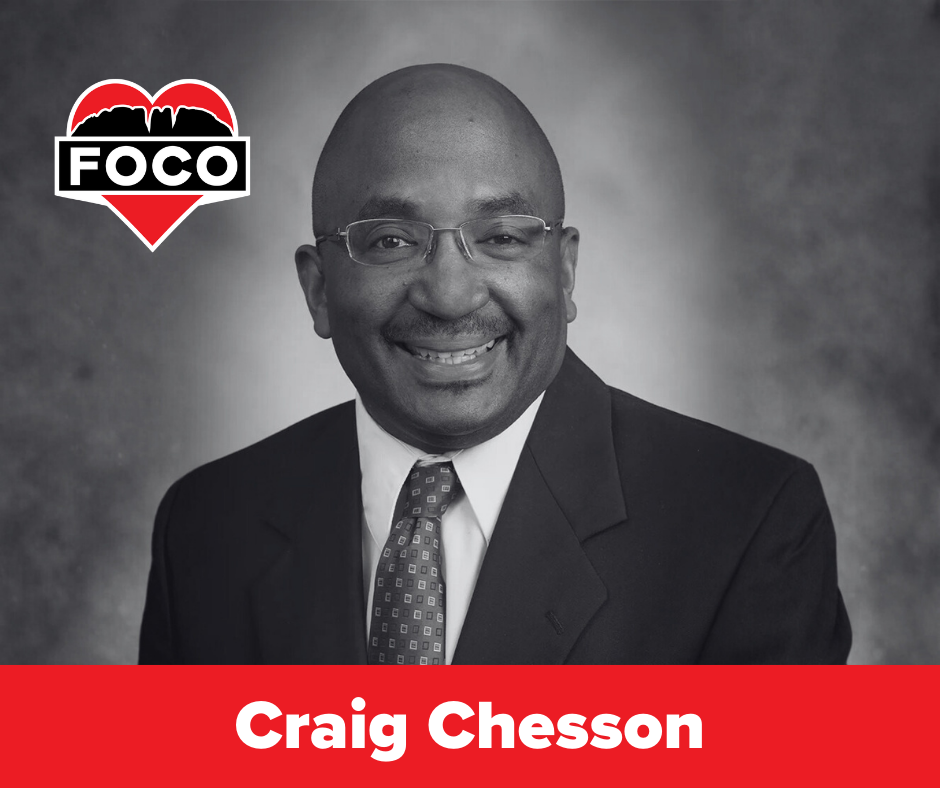

Craig Chesson is Assistant Vice President and Dean of Students at Colorado State University. Originally from New York City, Craig moved to Fort Collins in 1992 and has since become a key figure in student support and campus inclusion. At CSU, he champions initiatives that address food insecurity, student mental health, and first-generation college success. Beyond campus, Craig is deeply engaged in community-building efforts that help make Fort Collins more welcoming for all.
Higher education doesn’t just educate students; it helps shape the identity, diversity, and future of a city like Fort Collins. As Colorado State University grows, so do both the opportunities and challenges of supporting an increasingly diverse student population. What does it take for students and the wider community to truly thrive together amid rapid change and generational gaps?
In this episode, Dean of Students Craig Chesson shares why student success depends on strong support systems—on and off campus. He talks about helping students navigate academic pressure, food insecurity, mental health, and the search for cultural connection, highlighting how intentional community, inclusive faith spaces, and city partnerships help students feel seen and supported.
In this week’s episode of The Love FoCo Show, host Jeff Faust sits down with Craig to discuss belonging, diversity, and student well-being at CSU. Craig reflects on his journey from New York City to Fort Collins, raising a family of color in a predominantly white community, and how CSU is evolving to meet the needs of today’s students—from digital overwhelm to the power of inclusive campus–community collaboration.
Narrator: This is the Love FoCo Show.
Craig Chesson: One of the things that I also share, and I hear this from students too, Fort Collins, you know, it's labeled the Choice City a lot of times, but I also challenge back in the sense of choice for who because we also have segments who feel invisible. And they don't feel like they've been represented depending where you're coming from. They're like, I feel great on campus because of all the support, but once I leave here, there's a different dynamic that's happening.
Narrator: Welcome to the Love FoCo Show. Our podcast highlights the incredible people who make Fort Collins the place we're proud to call home. Each week, your host, Jeff Faust, sits down with local leaders, community champions, and change makers to share their stories, what they love about our city, and how they're helping it thrive. So whether you're out on the trail, at a brewery, or walking through Old Town, thanks for tuning in.
Jeff Faust: Hey, everyone. Jeff Faust here, the host for the Love FoCo Show. So grateful because today's conversation is with Craig Chesson, the dean of students at Colorado State University. You know, we live in a city, where our university is such an integral and important part to who we are becoming as as an area. And Craig has an incredible amount of influence in the lives of students on campus and then consequently in our city because those students are a part of our community.
The conversation today covers all kinds of different things like race and raising a family, moving from New York City to the front range to backgrounds and what it means to find your home. That resting posture where you can thrive and grow into everything that you are created to be. I'm so excited because Craig's influence and leadership will hopefully inspire you and also open your eyes to what it means to be a college student in today's era. Thanks for listening in.
Jeff Faust: Well, Craig, thank you so much for joining us on the Love FoCo Show. I'm so excited to be here with you. I mean, I I've I've enjoyed getting to know you. I'd love to talk about all kinds of different things professionally, how you're loving our city and and what you love about Fort Collins, how you found yourself here. But I I always like to start with kind of this first initial question. What is your Fort Collins origin story?
I mean, all have know, some of us were born and raised here and and that whole lot of people have moved here. That's that's my case. What's your like origin story? How did you find Fort Collins? How'd you grow up? What was that like for you?
Craig Chesson: Well, Jim, thanks for the invite to participate in this Love FoCo story. My story I'm I'm not from Fort Collins. I grew up in New York City in New York.
Jeff Faust: K.
Craig Chesson: Was raised born, you know, family roots there. And in 1992, decided to go west and come out to Fort Collins, Colorado. Matter of fact, it was not my original intent at that time. I followed my girlfriend Lisa. Okay.
Okay. Story.
Jeff Faust: Yep. Yep. Yep. We should probably talk about that.
Craig Chesson: We should probably because so many of our lives have been following someone we're in love with. So there was a lot of risk going on here because I had my roots and I wanna really describe the community that I really left
Jeff Faust: Yeah.
Craig Chesson: To come to Fort Collins.
Jeff Faust: Well, I mean, yeah, we've got because I have to imagine New York City Mhmm. To Fort Collins. There couldn't hardly be a different greater amount of change.
Craig Chesson: Yes. I mean, was in Chelsea, Manhattan and that's in Lower Manhattan. And I was working at that time, I was in the hotel business working for Grand Hyatt, New York.
Jeff Faust: Okay.
Craig Chesson: That's where my undergrad when I studied, but I was miserable.
Jeff Faust: Yeah.
Craig Chesson: Between being miserable in an employment area, and I was tired of New York City where the pace is about 25,000 faster than Fort Collins.
Jeff Faust: I can't imagine. Yeah.
Craig Chesson: The cost of living, the the fast pace of it, I just needed to leave. And it was Yeah. You know, my father, you know, raised everything there. He loved it and his family members who loved it, I just couldn't
Jeff Faust: do it. It's a specific kind of person that like loves New York City and wants to just grind it out Yes. For eighty years in New York City. I mean, what I'm curious, what how did you land at the Hyatt by the way? So what did you was it like business hospitality, like where did you land and how did you get into the Hyatt role?
Craig Chesson: I studied at Rochester Institute of Technology, Hotel Resort Management.
Jeff Faust: Okay.
Craig Chesson: And that's where actually, now my wife and I studied together. It is Western New York. And after receiving the degree, I worked with Stoefers. I worked with all suite chains, and it was miserable. The goal was to be owner of hotel properties Okay.
And have that that field. Yeah. And I was prepared for it, and in the beginning, I loved it. And the only piece that I really enjoyed was part of my job was introducing the industry to students. And I'll connect the student piece
Jeff Faust: Interesting.
Craig Chesson: Yeah. But and I coordinated programs with the five boroughs from Brooklyn, Queens, and I hosted a whole day. And I and I coordinated with marketing, business, housekeeping, sales Yes. Introduced the industry Yeah. To disadvantaged youth, young people who could see it as a profession.
So that was really, really fascinating. And the community was extremely, extremely diverse where I could walk down my block for where there were millionaires working on the stock market to people who were houseless, who were just insecure food wise on my block.
Jeff Faust: Yeah.
Craig Chesson: And that was just, you know, like, incredible. Or you could see famous people who are actors, who are in the film industry, and then you could also see people who just basically immigrants who just got here Yeah. From all over the world.
Jeff Faust: Right.
Craig Chesson: Which was just
Jeff Faust: Someone whose name carries great weight and someone who is largely nameless and faceless in this fast-paced society.
Craig Chesson: In our society. Yeah. And and and there were components, you know, where in this community that I didn't realize this till I got to Fort Collins where I was spoiled because it was culturally rich.
Jeff Faust: Yeah.
Craig Chesson: And I didn't have to be intentional about finding foods, cultural products
Jeff Faust: Yep.
Craig Chesson: Hair products, cultural my my faith community, I had options galore
Jeff Faust: Right.
Craig Chesson: To explore. Yep. So other parts of my southern heritage too. So my dad's side had access to that too. And entertainment, social events Yeah. Cultural events.
Jeff Faust: Like all of your senses.
Craig Chesson: Yes.
Jeff Faust: I mean, sights, sounds, tastes.
Craig Chesson: Everything.
Jeff Faust: I mean, there are sights, sounds, and tastes in the front range, but maybe not as diverse and our listeners can I mean, you're so our listeners are they're just listening to us? They They don't know you grew up as a black man in New York and you move Who? Still a black man
Craig Chesson: That's right. Into the front range.
Jeff Faust: So the geography changed. Changed. And those sights and sounds and tastes and senses. Those experiences changed.
Craig Chesson: Yes.
Jeff Faust: And your cultural desires, background, you know, your loves.
Craig Chesson: That's right.
Jeff Faust: I have to imagine, I don't wanna speak for you, so just tell me where this is right or wrong. I have to imagine there was a sense of loss even from going from New York City to like you had to maybe even grieve some of the things you truly loved that were just naturally there?
Craig Chesson: And that's just a great question because where I was gonna share is when I first came out to Fort Collins, I immediately left. Really? I left. I said this place is not for me.
Jeff Faust: Even though your girlfriend was still here.
Craig Chesson: We're still here. And I said, this is not gonna work out. Fort Collins just seems so distant. At that time, Prospect there was nothing on Prospect Road.
Jeff Faust: Okay.
Craig Chesson: When you're in Denver, when you get to the airport, there's no signs to Fort Collins. And signs to Cheyenne, Wyoming.
Jeff Faust: Wow.
Craig Chesson: So it's like, what is this place that I'm going to? Yeah. And then, you know, it didn't help. I had friends back in New New York who were giving me the jokes about, do you gotta milk the cow.
Jeff Faust: Yes.
Craig Chesson: What's going on there? Yeah. You're the only black person here. You know? Yeah.
Probably one out of, you know, million. How can you do that? And it was tough because we would we had a a church we were going to, which is a predominantly African American church. If it wasn't for that, the only African American person I would see the whole week would be at that time my fiance.
Jeff Faust: Really?
Craig Chesson: So top that dynamic. Yeah. So I was like, I need to get out of here. So I went back home to New York City and my father was just like, son, this is the the poorest decision you're making. You're rushing it. You're judging. I want you to go back. And stay for it here and go back and he's like, Lisa’s the best thing for you, you better go back.
Jeff Faust: You know, we just need some voices like that in our life. Right? Like, hey, you just got like, this is going to develop some grit, some perseverance. We all need that. We all need some voices in our life like that.
But, you know, I mean, a white guy here in Fort Collins, I mean, it's just an interesting thing to to learn from parts of your story of there's not a room really in Fort Collins where I walk into where I'm not the majority.
Craig Chesson: That's right.
Jeff Faust: You know, where I I mean there's not a room where I walk into and I think am I the only person that's gonna look like me here? Right. That's just like a burden that I don't live with on a daily basis that tell me about that journey because I mean I I think there's just a lot there's a lot that I don't know there.
Craig Chesson: Right. And when you, you know, coming here back in '92 when I first got here and and to your question, you're right. Fort Collins is a white community, and you get reminded of that constantly. And whether you walk in a grocery store, whether you explore the faith community, whether you go into the school district and even finding educational opportunities, you get reminded of it constantly. Yeah.
And a lot of times, the reminder can come in forms of questions from community members. And a lot of times, some of the questions is really coming from a place of innocence, lack of understanding, just don't know.
Jeff Faust: Yep.
Craig Chesson: But for the person, particularly as an African American man and as people of color, it's a reminder of, woah, how distance and how, wow, disconnected you can be in this community. Yeah. And one of the things that I really enjoy about Fort Collins too is the friendliness that comes with it. But there's also, like I said, a place of ignorance. And when you go to a shopping mall, when you go to our mall, and you could just look you you're looking for certain things, and it's just not gonna be there.
Yeah. And but what you're reminded of are clothing styles that could be Eurocentric. It could be
Jeff Faust: Yep.
Craig Chesson: A a very even the the piece I remember shopping for my daughters and even, you know, talking to to my wife, our physical bodies are different.
Jeff Faust: Yeah. So Yeah. Just even physiologically. Yeah.
Craig Chesson: Yes. It's not gonna be present.
Jeff Faust: So Yep.
Craig Chesson: A lot of people especially when we first arrived here, we spent so much time in Denver, a larger city Yeah. Because it was more accommodating and we found the needs.
Jeff Faust: Yep.
Craig Chesson: And it was just like after a while that got old.
Jeff Faust: Yeah. Well, mean there's there's a there's sometimes even a subconscious cost I would imagine of like the energy
Craig Chesson: Yes.
Jeff Faust: That you have to put out to always find your space
Craig Chesson: Yes.
Jeff Faust: That maybe I don't have to exert Right. Because my space is already there.
Craig Chesson: Right.
Jeff Faust: That can be taxing. Not only on an individual, but it can be taxing on a family too. Yes. And so you had mentioned, you know, raising your family. We know each other enough to know that you've got kids and tell me a little bit about what it, you know, what it was like raising a family here in Fort Collins.
Yes. Predominantly white community, African American family versus maybe what you experienced yourself growing up as a as a young black man in New York and Yeah. And just some of the the blessings as well as the challenge. Because I'm sure there's blessings and challenges both.
Craig Chesson: Absolutely. And, you know, the the the blessings were and this is something that I talked to this day, even to families and and students today about in Fort Collins, the educational system, the quality there. Where from for in my background, we didn't have, you know, even the playgrounds, the the parks, the even some of the technology and books. Whereas here, there is not a bad school.
Jeff Faust: Yeah.
Craig Chesson: Whereas back in my home community, you're talking about stay away from districts because you're not gonna have to go there or you're going to a Catholic school or a private school. Yep. That's your education. Yeah. If you go to the public
Jeff Faust: You either gotta pick the right district or you gotta pay money.
Craig Chesson: That's right. Yeah. Versus coming here when we're selected for our kids, it was just like, oh, man. There are good schools all over. But I tell you a story, you know, before we spent some time in Loveland and before we moved up to Fort Collins, and I remember I never forget this day.
I was, you know, in my office, and my wife calls me because she went looking for schools. And she told me, she's like, we're either gonna do school of choice to Fort Collins. We're not going to the Thompson School District because she did an interview with the school, and it was so harsh culturally. She was asking about just the history of the demographic school and not that we knew it was gonna be low, but they couldn't even answer the question. Yeah.
And she said, no way my babies are coming here. Yeah. We either coming up if we can't get school of choice to be in Fort Collins. We're leaving.
Jeff Faust: We're moving. Yeah.
Craig Chesson: We're out of here. And that's, you know, the the hard part is that I I Jeff, I can I remember, you know, I've been here, you know, thirty three years, and how many families, particularly black families who have left, not because Fort Collins is a bad city, but they've never made the cultural connection? And what is paramount to be successful here, and we were able to do it, is you need to find your your core community of likeness, people who look like you
Jeff Faust: Yeah.
Craig Chesson: People who experience things like you. And we found it. It was a predominantly African American church with an African American pastor where that was finding refuge.
Jeff Faust: Right.
Craig Chesson: To build that community for our kids, for us, and to be honest with you, without that, I don't think we will develop the strength as a young couple.
Jeff Faust: Well, I think paramount is the right word. Yes. I think paramount is the right word. I was just having a was just having a beer at at Odell's the other day with a guy who moved here from Taiwan. Yeah.
And he he he goes to a Taiwanese church Yes. With his son because he wants his son to be able to worship
Craig Chesson: Yep.
Jeff Faust: In the language he grew up in and and to experience worship in a familiar sound and with a pastor that's even interpreting scriptures and preaching scriptures that's very tied to his cultural experience and I think that is really really rich. Now, as a white guy, I would actually love to find myself in some of those communities because I have noticed as I'm sure you have it, there is a distinct style of worship that is different, you know. And sometimes a white church and an African American church. My wife and I moved here from Kansas City and we just miss some of the the gospel choir, the even the preaching, the beautiful illustrations and the application of the preaching. Absolutely.
That was so good for us and rich for our hearts. I I totally get that it sounds a bit different. Yes. Maybe in your your average kind of, you know, white church in Fort Collins than than what you're used to.
Craig Chesson: Yes. And my family, particularly from my father's side, you know, talking about Pentecostal, you know, going to church all the time to Episcopalian on my my my mother's side. So the faith it's same thing with my wife. It was always grounded there. And then to come out here, the journey for in Fort Collins, on one side, the beauty of Fort Collins, it seems like every other block, you come up faith.
I mean, there's churches all over the place here. Yeah.
Jeff Faust: Some great churches. Yeah.
Craig Chesson: Yeah. Absolutely. But then then again, when you have a family, particularly African American family with this history from New York, urban trying to seek, it's a huge challenge. And one of it took us a long time, particularly when COVID happened and we transitioned to church. Everyone was social distancing.
Yeah. They went to online, and it's already hard as a family of color. Then you add that dynamic on it. It's just brutal. Yeah.
And the beauty was and I remember, you know, the first time we came to Vineyard, it was very refreshing because it was just so natural and the flow of the service. And I remember I said, I was like, this can't be real. This is just a special Sunday. A special Yeah. Kindness and everything and Yeah.
We returned and it was again. It was just like, wow. And it was the uniqueness being there too of not seeing seeing other international pieces in there too. It was just like, wow. That's really neat.
Yeah. And that's something I know we needed. And that's great for Fort Collins community to have those different dimensions to make up a strong
Jeff Faust: Well, that's sweet that that's been your experience at the vineyard. Obviously, I'm I'm biased towards the vineyard church as well as well. But, you know, I I still recognize that there is probably still a bit of a cost. And I you know, you had mentioned even raising your kids Mhmm. And having a place of refuge for their faith.
Yes. Know, mean, there's a degree of your heart that if you're gonna go to a place of worship, you don't wanna have to work that hard. Right. You know, like, can I just wanna worship?
Craig Chesson: Right. Right.
Jeff Faust: And so, yes, it's a different church than maybe the one you started at here in Fort Collins. But I will say, mean, was really sweet. Just even this last week, got to celebrate every tribe, every nation, which is a celebration of God's diversity in the kingdom and 20, I think 22 nations represented at the vineyard church with not a lot of different sounds quite yet.
Craig Chesson: Not
Jeff Faust: yet. But some different tastes.
Craig Chesson: Yes. Yes. And so we're and so
Jeff Faust: I always call it the tastiest Sunday of the year because everyone's bringing in something from their heritage and background to share with everyone and that that can be a beautiful thing to celebrate and it was fun to to do that with you. Absolutely. I'm I just am curious then. I'd love to ask as you kind of continue to raise your kids here, at what point did or maybe it was, you know, maybe it was early on or just a growing sense. Did you and your wife and your family start to say things?
I mean, hear it a little bit in the education. Like, man, we this what this city offers in education. We love that. What are some other things that you've come to really appreciate and love about Fort Collins and our in our area?
Craig Chesson: Well, the biggest piece I think is the physical, the outdoors Yeah. That it offered our children and family experience that my wife and I never had in a urban, into the concrete jungle. Here, we have horse tooth reservoir who could go up there and spend, what, weekends up there.
Jeff Faust: Yep.
Craig Chesson: I I tease family members. I'm like, my backyard, I have parked in a Rocky Mountain Natural Park. Talking about this. Yeah. Nothing.
I mean, I said, you wanna you want beauty? So when family comes up there, they're just taking away and just like, oh my goodness. Yeah. The beauty of here, just nature, sustainability. I mean, it's just incredible.
Just education around natural resources. This city, there's there's there's there's food. There's different you know, we we we have tons of restaurants and things like that, which, you know, it's funny. I think our family turned into little foodies here and enjoy experiencing the different tastes and things like that. We also enjoy, you know, the the Poudre River, the the whitewater rafting.
So there's so much of the outdoor element is huge that we really enjoy being here. And Denver's not that far away if you want that urban experience. Right. So we have connections with over the years if we want that in the Denver area community. But what was crucial for our kids here is that we have to be intentional about creating a cultural foundation in all the kids.
And you create that by exposing them to film, history, museums, whatever you know, a lot of times that you know, you talk about family vacations. Some people, if they're able to do it, they may pack up the car, we're gonna go up to South Dakota and things like that. Our experience, we're intentional about cultural dynamics, has to be there to explore that foundation. So when we come back to Fort Collins in this community, they're gonna feel confident and secure about who they are.
Jeff Faust: Yep.
Craig Chesson: And and and once you have that foundation, whether you're exposed to predominantly white environments, you know you're gonna be able to survive. It doesn't mean you're not gonna feel uncomfortable Right. Or it could be exhausting to be the only black person in this theater or in this event, but you feel comfortable. You feel confident. It's it's funny because now our kids, you know, who are adults now, they come back here and they're like, wow, I go to the store now and there's way more people of color than when I was, you know, 20.
And it's yeah. You're you're right.
Jeff Faust: It is changing. It's changing.
Craig Chesson: Yeah. Now it's changing. Yep. And Why do you
Jeff Faust: think that is? I mean, I I you had mentioned the kindness of the community. Mhmm. You had mentioned even the hospitality, the welcomeness that you experienced at Vineyard Church. Hopefully, that's analogous to some degree of of the city at large.
Sure. I think that helps a little bit, there's gotta be other things that are happening that are maybe increasing the staying power of folks of diverse backgrounds at at one point that you know in the nineties you were like no I'm out.
Craig Chesson: You're right. You know what mean?
Jeff Faust: But now maybe there's what do you think is happening that's helping grow that diversity? Maybe some,
Craig Chesson: you know, some industries and some employers are recruiting and bringing people here. We also what I've noticed, no military, particularly up in Wyoming, Cheyenne, there connections there. And I was at a networking event on Tuesday, and a lot of the people from Cheyenne came here because they had they say Fort Collins, that's way more to offer.
Jeff Faust: Interesting.
Craig Chesson: So they're like shopping, networking, technology, other needs. Fort Collins is the place to do it. Yeah. So I think you're seeing more of that the educate people going back to school. And because of the economy right now and because of right now as far as not many jobs out there, come back to get your education and then enter the workforce later on.
So with all that, I think you're seeing more and more people from more folks of color.
Jeff Faust: What I have to imagine we can transition into into kinda because I wanna get into your work here.
Craig Chesson: Sure.
Jeff Faust: How you're loving our city professionally and individually. I know you play a big part because you're the dean of students here at CSU which is I mean, you you've probably seen even the diversity on campus Mhmm. Change and merge and then it's such a big part of our city.
Craig Chesson: Yeah.
Jeff Faust: I mean, you're talking about an influx of thousands of students every year and last time I checked, enrollment is is growing and it has been I think since I've moved here. Mhmm. And so I I imagine you've ever seen it's gotta play a huge part and a role in that too. And and if you come to school here, there's probably a fair amount of people who'd like to stick around here. It's just a beautiful place to live.
Craig Chesson: It is. And it's it's a it's a blessing and a curse to work with students because, you know, as you said, no. We've had record enrollment, and, you know, this is our most diverse class this, you know, coming in here this fall. And Fort Collins, you know, it's a big recruiting piece for students to come here. It's a beautiful place to study.
Yeah. But we can we don't have employment afterwards for everyone to stay.
Jeff Faust: Right.
Craig Chesson: So that's the the curse there too. Yep. And professionally, for for students in this community, what I really enjoy is first, the many partnerships we have with the city because we have to do it together because we have a major piece with the top, you know, employer up here and Yeah. You see a drastic difference on the breaks. You know, community members tease all the time like like a tell when it's winter break because the traffic goes down Yeah.
Drastically.
Jeff Faust: Right.
Craig Chesson: Or the summertime, it's just like, wow, I could, you know, get on that side of the campus because Yeah. There's not as much traffic here. But the the the institution plays a huge role here. The part I love the partnerships with the city, whether it's the Landmark County Food Bank, whether it's a partnership with the city of Fort Collins working with our students. Because the reality is the majority of our students are living the city and they're not on campus.
We may host about 6,000, but
Jeff Faust: That's right. Yeah. They're spread all over. Apartments, condos, houses. Yeah.
You enable.
Craig Chesson: So they are community members.
Jeff Faust: That's right.
Craig Chesson: And part of our role, know, that it's our responsibility to spend time educating our students how to be a good community member because Yep. They don't have any experience. They're just thinking student, study, eat, They're local ordinances, you know.
Jeff Faust: You have
Craig Chesson: to shovel.
Jeff Faust: You have to take care of you. You're on.
Craig Chesson: You just can't, you know.
Jeff Faust: There are HOAs around it.
Craig Chesson: That's right. There are noise ordinance. You can't blast into in the morning.
Jeff Faust: That is so funny. Yeah. That's I mean, that's really true. And like, especially if you're moving maybe from out of state or from a concrete jungle type city as you had mentioned. So I moved here from Kansas City.
So much smaller than New York City, but still metro about, you know, two and a half, 3,000,000 people. Mhmm. Lot of concrete, lot of hustle. Maybe not to the degree that you would see in Manhattan, but definitely it's it's metropolitan influence. We moved here and I I mean, just even looking out the window as we do this interview in the process, podcast here.
The oval is beautiful. There's these amazing mature trees. There's students walking around outside. And I remember when I I think one of the first news stories I read was about a black bear hanging out in one of those trees out in the oval. And I was like, oh, this is not Kansas anymore.
Like what has happened? There's black bears like potentially in our backyard. Like you gotta put the dogs in at night. This is such a huge part of our campus. You play a really big role here at the university.
I'd love to I'd love to have you talk a little bit about, you know, how you're loving our city just by holding this profession of yours and and caring for students and and caring for your team. Talk to us a little bit about the life of a young adult, the the life of a college student. I'm I'm only 40 years old now, but I already have forgotten exactly what it was like to be a college student. And and I had a different kind of deck of cards. I mean, I I didn't go through COVID
Craig Chesson: Yes.
Jeff Faust: In my, you know, final high school years. I I I just had a different growing up experience than maybe the college students on your campus today. So tell me a little bit about that and and fill us in on like the life of a college student today.
Craig Chesson: Yeah. It's it's fascinating and and even I in my work professionally, work with college students and as an administrator and even have my own children who are college students, I still get the moments. It's still a learning experience. Today's college student, you know, one of the biggest things, you know, they they're overwhelmed from the process even to get here before they step foot on campus, what they have to do from the studies, the applications, trying to secure finance, trying to do college visits. And then once they get here on campus, particularly at CSU, a large, you know, public state institution, it can be very overwhelming.
Yeah. There's so many choices. On one hand, you know, the beauty of coming, why they selected here is all the resources and support that you can be successful here. Yep. But at the same time, a lot of our students today, they way they've been socialized.
Technology has just, you know, you know, these tablets and phones and just zap them. That drives their life. Yeah. And they they they tell us that in all that a lot of the studies, you know, that that we do. But the technology piece they rely on, whether it's to date the social apps.
Jeff Faust: Yep.
Craig Chesson: To to social media where it's like
Jeff Faust: Yeah. I I bet you didn't meet your wife on a dating app.
Craig Chesson: No, did that.
Jeff Faust: You probably didn't even
Craig Chesson: Did you don't
Jeff Faust: wanna date you too much, but did you have even a cell phone When you met you up? No. I mean, it's a different one. Like, you actually had to go and talk to a girl.
Craig Chesson: Hold a conversation. The part part is a lot of our students got social skill and we were intentional about it. We have to do a lot of building around that. Yeah. Because talk about networking and fear comes over them.
Like you want me to engage in a setting where I don't know these people and actually go up to them, introduce myself and say more. Some students have that down, but there's a lot of anxiety. And the biggest piece that I've noticed over time is just the mental health of our students. Anxiety, when I first started depression was the number one. Anxiety has exceeded the depression for our students now.
Yeah. And if they're experiencing it before they get here, and they look at our campus with the resources, like, yeah, I can go here because there's a lot of support. And what's changed too is the stigma around mental health for our students. When I first started, did not talk about it. Families didn't wanna talk about it.
Jeff Faust: Stuff it down and keep grinding and just keep calling. Right
Craig Chesson: now, you have students coming to orientation saying, this is my diagnosis. I I see this therapist, and my meds are so and so. How can I transfer up here? And it's like, woah.
Jeff Faust: Yeah. That
Craig Chesson: forthcoming. They will go to faculty members and talk about their anxiety and for tests, and this is what I'm doing. This is how it could be, which is great, but today's college student to interact with them, you have if you don't have that foundation, you're like, why is this person behaving this way or Yep. It just seems off.
Jeff Faust: Well, I imagine it's gotta be challenging because inherently in a university campus, have generational gaps.
Craig Chesson: Yes.
Jeff Faust: Right? You have college students who are a particular age
Craig Chesson: Mhmm.
Jeff Faust: And you have professors and leaders of the campus who are older. They've they've already gone through that age. They've started a career. They've lived Mhmm. And so I have to imagine that there's a learning curve for students but also for faculty on how to engage with students.
Craig Chesson: Yes.
Jeff Faust: To not be yeah. Yeah. Yeah. Yeah. No.
I know you're anxious, but you still have take the or like Yeah. Yeah. I mean, there's there's employers out there that are gonna be more compassionate or less compassionate. That's right. That that's that's real.
Craig Chesson: That's real.
Jeff Faust: But at the same time, they're not employees yet. They're still students. And so how can we navigate and shape? Because these are formative years. I mean
Craig Chesson: Absolutely.
Jeff Faust: I was shaped so much Mhmm. From '18 to '22 as so many of us are. Right. And I was shaped by people who really invested in my life. Yes.
And really care.
Craig Chesson: And when I talk to students, tell them all the time, you know, college experience, it's it's an academic growth, a personal growth, a social growth. And you're learning in those three dynamics about yourself. Yes, you're coming in, there's a discipline you signed up to study, engineering business, whatever. Yep. But a lot of times, there's so much about yourself, you are learning in that first year when you go home for Winterberg, a lot of time family members like, who
Jeff Faust: this? That's right. They come home and like, this you've changed so much. You've changed so much.
Craig Chesson: Yeah. Because the beauty of it too is the exposure you get from people in state, out of state, across the world. Yeah. People in Fort Collins. And the university, what I love about it, it loves connected back to Fort Collins.
It's a city within a city.
Jeff Faust: Yeah.
Craig Chesson: So Colorado State University is a city.
Jeff Faust: It really is too. I mean, you got doctors, you have counselors, you you've got restaurants, you you've got house, it you have security. You've got the whole thing.
Craig Chesson: It's a city with That's a
Jeff Faust: great way to put it. Yeah.
Craig Chesson: And then once you step out on college or or or exterior circumference here, then you have another level of exposure to navigate. Yep. So it's a lot. And one of the things that I also share, and I hear this from students too, Fort Collins, you know, it's labeled the Choice City a lot of times, but I also challenge back in the sense of choice for who because we also have segments who feel invisible. And they don't feel like they've been represented depending where you're coming from.
They're like, I feel great on campus because of all the support, but once I leave here, there's a different dynamic that's happening. And that leads into I wanna really share that we've really been working with basic needs for a lot of our students because we have several several last about 25% are food insecure and on our and
Jeff Faust: we So I just wanna make sure everybody captures that because I I think if if you're if you're listening to this podcast at two times speed, you you might you might miss that. You just said 25% of the students here are food insecure.
Craig Chesson: So when you look at I have my tuition paid, my house paid, my rent paid, my utility, but look at sacrifice to make it here. You you don't get the food. Yeah. And we we have uplifted you know, we have rants against hunger. We have food pantries.
We have a program where students can apply for meal swipes. And right now, the challenge with a government shutdown with SNAP benefits that help a lot of our students, we have to be creative in stepping in to find options for our students to meet that need. And it's students, we have even some staff and family members as well. So that's another one I talked about the overwhelm. Thinking about your studies.
Right. What about my basic needs? Are they Well,
Jeff Faust: there's a there's a litany of secondary and tertiary challenges when your pantry just doesn't have food in it. I mean, you're you're not going to your mind you are going you know, overwhelmed, the anxiety, whatever you want. Like, you are going you're just gonna have different struggles. I mean, whether it's with studies, whether it's with emotional health or mental. And then let's say your transportation breaks down.
Well, am I choosing between buying tires or buying I mean, are these are real life challenges that I think quite honestly, I just didn't have to deal with when I went to college. Right. For a variety of different reasons. Some of it was my family background, but some of it was also the the campus that I was on. It was a it was smaller, it was tighter and and it was a different generation.
Right. You know, but 20 I mean, that's pretty alarming actually. 25% of the students are
Craig Chesson: off these And we define that, for example, if you have to choose like, you know what? For the whole day, I I know I have to skip breakfast because I can't get all
Jeff Faust: three Yeah. Yeah.
Craig Chesson: You're food security.
Jeff Faust: Yeah. And then you have to test high enough to keep your placement here at this college or whatever you you know to pass this class or whatever. I mean, yeah, we often think. I mean, I think it's just true that we often think about food insecurity as maybe a global problem, not so much like in our own backyard. Mhmm.
So I'm I'm curious, average community member, how could the average community member be part of making a difference? Be be part of joining your guys' efforts
Craig Chesson: and supporting people. We, you know, one of the the the biggest efforts, you know, we we get community members who come who wanna help with our whole ramps against hunger campaign. Yep. Who wanna besides just, you know, writing checks, they're like, we wanna do more. Yep.
And we'll host different events where we may need volunteers to organize the pantries or organize Yep. And things like that.
Jeff Faust: The Rams for Humber, is that like when my kids, they're at their local school here and they're bringing all Yes. Yep.
Craig Chesson: Yep. And it's tied to the kids.
Jeff Faust: Yeah. Kids love that because they're competing classroom versus classrooms. So it's nothing like a little competition to get your kids to bring up. Yeah.
Craig Chesson: It's a great partner with the Learning County Food Bank and we've we've you know, that's one of the reason why I love Fort Collins with all these partnerships and with the institution helping our students. Yep. So that's, you know and and it's also one of the the the biggest things too. I sell to say to people once again with that stigma, you know, college students and checking in with them, they they say they're like, you know, how you know, I'll take you to lunch or what's going on? Yeah.
You know, are you available? And a lot of them, you you you bring that down? Like, absolutely. Yeah. Let's go get a bagel.
I mean, doesn't have to be anything big and for them it's just like, oh, that's nothing you just took away. Don't have to think about it and Yeah. I could do well in my classes because it's a basic need. Yep. Yeah.
How can you perform academically if you're hungry?
Jeff Faust: It's just yeah. I think that's incredibly challenging. Yes. Yeah. Man, mean, it's such so interesting.
I think it's easy to as a parent, as a pastor, as a community member, even for my kids to come home with like the Rams for Hunger and and like the flyers. Like, yeah, sure. I mean like you can raid our pantry and but to connect the dots clearly in a conversation to say, but like what you don't realize is we're talking about 25%. Which you know, off the top of your head, do you have any idea how many students are are hanging around CSU?
Craig Chesson: Right. We're about our total is about 32, 33,000 Okay. We have here that's on and off campus. Yeah. So
Jeff Faust: 25% of that is, you know, multiple thousands.
Craig Chesson: It's a lot. It really is. It's a lot. And you know, one of the things too, you know, there's a housing piece too. And we we our students were really active, you know, with some of the ordinances to help with u plus two so they could live
Jeff Faust: Big deal.
Craig Chesson: Big deal.
Jeff Faust: Big deal.
Craig Chesson: That was a game changer.
Jeff Faust: Yeah. When I get where it came from, you know, I mean like Absolutely. But also there's there's tension there. City, university, growing population. Infrastructure can't keep up with the just the humans.
Right.
Craig Chesson: That are long term residents and then you have, you know, there's no reason traffic congestion, get all that.
Jeff Faust: Yep.
Craig Chesson: But that helped a lot of students where it's like, okay, my rent's a little lower. Well, you
Jeff Faust: can just divide it by five people instead of of four four people
Craig Chesson: instead of three or Yeah. So your rent is high.
Jeff Faust: Which we all are aware that
Craig Chesson: the rent is already high. I mean, it's interesting though you came from New York.
Jeff Faust: Yeah. So you actually probably came from because I I came from the Midwest where I was like sticker shocked and like what
Craig Chesson: What is going on?
Jeff Faust: Is going to happen. But those those prices are still high.
Craig Chesson: Still high.
Jeff Faust: Still high. Yes. Oh. Well, let's talk a little bit about just the diversity on campus. We've we've been kind of having this conversation on and off.
I I think one of the most beautiful things about being in a university town is that you are drawing not only, from different states in The US Mhmm. But there's a strong international component Mhmm. Particularly with some of the graduate work here. I mean, I just met someone the other day from India who's out here studying bovine something another. I mean, she was way smarter than I was.
She's working with cows and medicine and all kinds of different things and there's such a rich education opportunity.
Craig Chesson: Yes.
Jeff Faust: And it pulls international students in. I mean, has to offer a depth and a richness to the campus too. Tell me a little bit about Sure. Like the international students and how they're interacting just in our in our city and and on campus and what that looks like.
Craig Chesson: And and what's really neat too is that you're right, you know, we we we pull from China, India, all around the world and they they have a significant component they add particularly socially, when Ramadan comes. You know, a lot of them, they wanna share their culture with other students and faculty and staff. So the invitation's here. There's other what we're seeing in the community, there's other restaurants and foods and stores beginning to pop up more and our students will tell you quickly, this one here is really up that tick. This is where
Jeff Faust: you need to go. Oh, you've got the inside tracks. Yes. Like that's real types. This is real.
Yeah.
Craig Chesson: Is this is the real deal. Yeah. It's it's great because our students really, they want that. All of our students, as far as that learning, that diversity piece, a lot of them don't know how. So having the international component come serves that.
And we don't wanna tax them saying the burden is the burden to train all, but it's Right. Pride that they make up this university in and out of the classroom
Jeff Faust: Yep.
Craig Chesson: Which is really great. And it even goes you know, the the demographics of our community too. I wanna just share a little bit even with our first generation students, which is just significant. Yeah. And, you know, we've been a we've been one of the the leaders in first generation work for years.
We were supposed to have a first generation scholarship.
Jeff Faust: Yep.
Craig Chesson: We were the the first into the mentoring programs and just how important it is to our land grant mission.
Jeff Faust: Yeah.
Craig Chesson: We also invest in our adult learners, students who are older who come back, who, you know, it's an opportunity for whatever life circumstance to come back to get their degree. Yep. You know, we have our veterans are one of the top programs Yeah. In the state.
Jeff Faust: But I have a good friend of mine who is getting he's finishing up his degree. Now he's older than I am. Yep. And he's hanging out with teenagers. Teenagers.
Sometimes. But he's working with a lot of vets. Yeah. He's working with a lot of adult learners.
Craig Chesson: Dislearners.
Jeff Faust: Yes. And he he could be more excited to be here.
Craig Chesson: That's right.
Jeff Faust: And and and really he got a lot of help. I mean, really did. Got a lot of help and resources to make it happen.
Craig Chesson: Make it happen. Yes. So that's, you know, the the beauty of our campus as far as the once again tied to our land, right, mission of serving all people.
Jeff Faust: Yeah. Yeah. Well, doesn't surprise me that CSU was one of the first, you know, to to step in that way. The more I get to know this city, the more I learn about its history. They like being the first in things.
Craig Chesson: Yes.
Jeff Faust: You know, they like being the first in innovation and excellent services that they can provide to the city and and doing things at a university level, even a utility level here in town. We wanna be on the front end of all those things. I I I'm curious maybe we can kind of wrap our our conversation here. Because I wanna go back to something you mentioned earlier. You you had used the word overwhelmed Yes.
A few times and Mhmm. That is a word that comes across my, you know, proverbial desk quite often. Overwhelmed at the current stat, overwhelmed with society at large, overwhelmed with the decisions and the choices. Yes. What do you think some of the next steps are for some of those college students to navigate some of those feelings of being overwhelmed and yet still move forward step by step.
Not at an a torrid pace that's going to drive them into the ground. Yep. But what does it look like for those students? And then even your role and and your faculty to come alongside some of those students
Craig Chesson: Right.
Jeff Faust: In those formative years and say, there there actually is a hope. There actually is a future. There is there are some key things that you can do to navigate that sense of being overwhelmed. I mean, how how do you guys
Craig Chesson: I think it's no, Jim, I think it's a partnership. I think both sides. I think the university and students can do some things. I think for students, and we have to teach them about self efficacy and being able to make decisions about, do I really need to do this right now? Yep.
Can I just really wait? Or do I really need to engage and put this on my plate right now and prioritize Yeah. And back to the time management? Because a lot of them never had to do that before.
Jeff Faust: Yeah.
Craig Chesson: So I think we have to really engage in providing some tools in for the students to be able to self select and really pinpoint what I really need to do now versus looking at a big funnel. All this is happening and I I have to do all of this. So that's pressure and overwhelming. Yeah. The institution has to do a better job of maybe we heard from the students.
They're saying, okay. I have to open 10 different doors. Can we have them just open one?
Jeff Faust: Yeah.
Craig Chesson: And they just go through for this experience and have the support that they Yep. That I think will help a lot.
Jeff Faust: Well, it's it's really interesting because I the amount of times I've used overwhelmed to describe my life. Mhmm. You know, plenty of times. Mhmm. And I've also lived more life.
I've had more experience and, you know, like I mentioned, you just you forget. You forget. It's easy to forget. Easy. And I think it would do our community a service.
I think it would do our students a service. I hope it would create more hospitality as hospitality as students maybe leave the city within the city and explore the greater city of of Fort Collins to find themselves in hospitable places to try and remember what it's really like to be 19. 19. Drops off. The world is in front of you.
Yes. Exciting.
Craig Chesson: Yes.
Jeff Faust: But overwhelming.
Craig Chesson: Overwhelming. Yeah. And it's, you know, and as this institution, we have to remind ourselves too because we're like, we wanna be creative like, this would be great for our students. Oh, we could do this. This.
Yep. Wait. Slow down. You're still overwhelming them.
Jeff Faust: Yeah.
Craig Chesson: So we also we we can't put it on students. We need to do a better job of Yep. Really assessing how much we're putting on
Jeff Faust: it. Yeah. Well, it's it's interesting. I just had a conversation with my kids last night about decision fatigue. Oh, And and like how real this is.
And I'm not throwing anyone under the bus or anything, even like retail stores Yes. Know that decision fatigue is real.
Craig Chesson: It's real.
Jeff Faust: And so by the time you spend thirty minutes going through a grocery store or shopping or whatever, what do they do? They tempt you with the pop and the candy and the stuff at the end. And my kids always want it. I'm like, hey, listen. Yeah.
What just happened for your brain is you got overwhelmed. Right. You experienced decision fatigue and someone's trying to to win some cash off of that moment. And so even that picture ballooned out by multiple years and like way more important decisions than do I get the Pepsi and Skittles or not.
Craig Chesson: That's right.
Jeff Faust: This is it's just a good reminder for all of us. So, Craig, thank you so much for your time. This has been a great conversation. Enjoy it. I look forward to just watching the campus, being engaged in the campus, helping my students be engaged, and even it it really is a joy to be in a university town.
Craig Chesson: Yes.
Jeff Faust: I've always dreamt about living and leading in a university town. Yeah. And I will confess and admit that there are times I exhale when the roads are a little bit less packed.
Craig Chesson: I think we all do.
Jeff Faust: But for the most part, I I couldn't imagine living in a in a non university town and the way that this campus influences our city and and hopefully our city receives the campus really well and the students, it's grateful. I'm grateful. And it was a great conversation with you. Thank you so much for giving me some of your time. Thank you.
Sharing your life and also, you know, the way that you're loving our city, one life, one student.
Craig Chesson: That's it.
Jeff Faust: At a time and I'm I'm greatly appreciative to you.
Craig Chesson: Thank you.
Jeff Faust: Thanks for joining us.
Narrator: Thanks for listening to the Love FoCo Show. If today's conversation inspired you, share it with a friend who loves Fort Collins as much as you do. Don't forget to subscribe so you never miss an episode, and leave us a review. It helps more people discover us. To learn more about Love FoCo and find opportunities for loving our city one life at a time, visit lovefoco.com.
For now, keep loving Fort Collins well.

