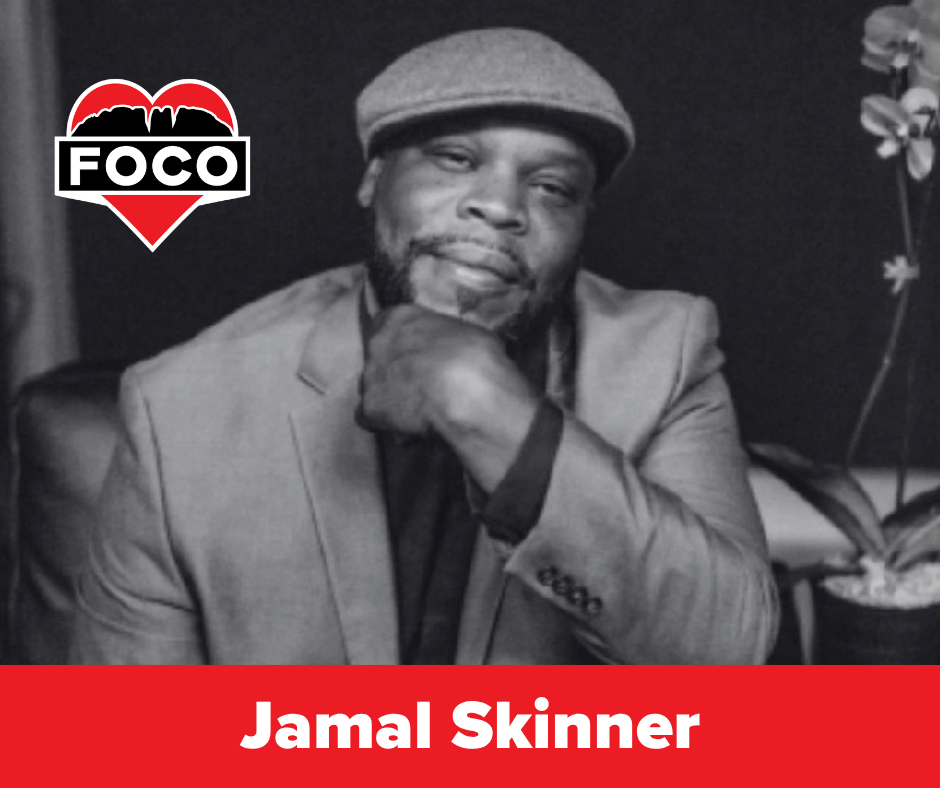

Jamal Skinner is the Founder and Executive Director of the Cultural Enrichment Center of Fort Collins, an after-school and summer program that creates safe, identity-affirming spaces for Black middle and high school students in Northern Colorado. A longtime Fort Collins resident originally from Long Island, New York, Jamal brings together his background as a community organizer, youth liaison, reggae vocalist, and student of Black history to offer programming that blends arts, music, tech, civic engagement, and African American studies through a Black lens.
Narrator • 00:08
This is the Love Photo Show.
Jamal Skinner • 00:10
>> Here in Fort Collins, it was easy for me to envision what was needed or what I thought was needed. I don't know everything, but I said the first objective is to create. We always say these safe, brave spaces. But for some folks in this community, they don't understand what that is. Even when we think we're not causing harm on other folks, we don't know what they're experiencing based on sometimes our ignorance. And ignorance is not always something that you're doing to harm someone. You can just not know.
Narrator • 00:49
- Welcome to the Love Foco Show. Our podcast highlights the incredible people who make Fort Collins the place we're proud to call home. Each week, your host, Jeff Foust, sits down with local leaders, community champions, and change makers to share their stories, what they love about our city, and how they're helping it thrive. So whether you're out on the trail, at a brewery, or walking through Old Town, thanks for tuning in.
Jeff Faust • 01:13
- Hey everyone. Today I am sitting down with Jamal Skinner from the Cultural Enrichment Center of Fort Collins. Jamal's story is amazing. It dates back to some time growing up on Long Island in New York and transitioning out here to Fort Collins, Northern Colorado, making this place a home not only for himself but creating hospitable environments for all kinds of different folks in our community, particularly doing some great work with African American teenagers in and around Fort Collins. I loved this conversation with Jamal. I learned a lot. He shared honestly and transparently about where our city can grow, how we can improve. And I hope you love this conversation as much as I did. So with that, let's just go ahead and jump in and introduce Jamal to you today. - Well, Jamal, thank you so much for giving me your afternoon. I appreciate you being here in the Love Focal Resource Center and looking forward to this conversation. We were introduced to each other from someone else that I've interviewed Gloria Kapp from La Familia. And I've come to learn that if she's gonna recommend something, I'm gonna knock on those doors. And so I'm grateful that you are here with us. And looking forward to hearing about how you're serving our city and loving our city one life at a time. But I wanna start our conversation the way I start every conversation on this podcast. What is your Fort Collins origin story? Did you grow up here? Did you move here? When did that happen? And what has all of that been like?
Jamal Skinner • 02:52
- First, I say it's a pleasure to be here, to talk with you. And Gloria is a wonderful person to recommend me. My origin story in Fort Collins, Colorado, starts in the fall of 1996. I'm a New Yorker born and raised in New York. I moved here to Colorado when I was young. And the reason most people ask was to play professional soccer. That did not go the way I wanted it to, but I did not want to move again. I was at a transition point in my life. Not only was I playing soccer, I was also doing investment banking work in New York, and I needed the mental space to get away from what that drive for money was all about. And so I picked a place that was the exact opposite of it and ended up here in Fort Collins.
Jeff Faust • 03:47
- I have so many questions already. You must be like a super, a super high achieving guy. If you were in the financing bank world in New York and you were pursuing professional soccer, you were used to accomplishing things and setting high goals and hitting them. So you must have some kind of high capacity to just pull some of this stuff off.
Jamal Skinner • 04:09
I do, I think it was just, I don't wanna put myself in some category that I'm something special, 'cause I'm not, I think we're all special, and I know that's not what you're saying.
Jeff Faust • 04:20
- Yeah.
Jamal Skinner • 04:22
- Well, it's just not every day that I interviewed
Jeff Faust • 04:24
a financial banker from New York who could have also played soccer professionally.
Jamal Skinner • 04:28
- It was also something that I was watching, one of my older brothers doing, I guess that's part of my story too. I'm the baby of nine children. So it was a drive that was implemented by my film, but I think being the youngest, I was always trying to keep up with everyone else that I grew up faster in certain things than most of my siblings. I took things on quickly. Soccer was a love, something I fell in love with early. It got me to college. I went to Howard University. I left after two years to play professional soccer. So it was always a part of my life, But the finance thing was, it's really interesting. It was, I was trying to use it as a means to an end. My desire was, I said, I could give my soul to it for six years. And I wanted to open a preschool was really my goal. I wanted to find a remote place, two acres, open a preschool that was really focused on art and music. And that would have been good enough for me for the rest of my life, like to live on the space. I love this so much.
Jeff Faust • 05:38
Jamal, you are such a well-rounded guy. I mean, I did not expect us to start the conversation with financial banking and professional soccer and then get added to that music, art, and preschool. - Yeah. - I mean, you're just a man of many talents. Really, it's what I'm learning.
Jamal Skinner • 05:55
- Maybe I've tried, but my mom worked for over 40 years in daycare sort of work, and I watched her in her work. And I was always around it and obviously being the youngest that had nieces and nephews, you know, starting at the age of like 12. So I was always in that space. My family, coming from a big family, even cousins, so we were always around each other. And that thing made me have this need, I guess, for providing space for others, and mainly young people. - Yeah. - Even when I didn't want to do it or wasn't doing it, it was always in my mind and my heart. And then I moved to Colorado, like I said, in '96. I lived in Denver for two months. I was doing a really weird sales job there. (laughing) And I moved out with a good--
Jeff Faust • 06:54
- About how were you like 20?
Jamal Skinner • 06:57
- I was 25. 24, 25.
Jeff Faust • 07:01
- Yeah, I mean that is the time of our lives that we have weird jobs.
Jamal Skinner • 07:05
- Yeah.
Jeff Faust • 07:05
- Right, I feel like every 20 something needs to have something that was just a bit odd and didn't work out.
Jamal Skinner • 07:11
- And it seems odd now, but it was revolutionary then because I was working for a company that was selling credit card machines to small businesses to allow them to take credit cards. - Yeah, yeah. - It seems in this world now, it's everywhere, but in '96 it wasn't. And I moved out of New York with a good friend of mine, I went to high school with him, he just was not a sales guy. So after like two months, you know, they pulled me in the office and they were like, Hey, we really want to keep you want to promote you. Yeah, you're great at this. You know, I'd come from a world of hard sales and your friend is just not produced.
Jeff Faust • 07:47
We want to keep you and cut your friend.
Jamal Skinner • 07:49
And we moved out together. And so, you know, we were living as mom lived in sort of South Denver, not really South Denver. She's like in Cherry Creek area. Okay. And my, where our objective was to get our own place, you know, and I didn't have the soccer thing until the spring. And so I was like, let's go up to four columns and visit a friend for the weekend. And we came up here and never really technically left. It was just running into the right people, found a house to move into. And I stayed here for four and a half, about four years, you know, post my decision to not play with the Rapids. They wanted me to play a year underneath that with their old professional team, the Colorado Foxes. And that was a quick conversation for me. I told them I wasn't going to go backwards to go forward ever again. So I stayed to figure out really it was about a life journey. You know, I don't know if it was a crossroads thing for me, but it was. Just figuring out what I really wanted to focus myself on. Music had always been a part of my life. So I am a couple of us formed a band here in Fort Collins. We played till like 2000 left 2000. We all were going to move out to LA, you know, this big idea of playing music. And we all kind of split up and I'm happy with the keyboard player in our band was getting his degree in classical piano and jazz at UNC Greeley. And I was like, dude, don't come do the thing you want to do. Yeah. He ended up getting a PhD in both and playing and loves we still talk. And that's amazing. I'm happy for him.
Jeff Faust • 09:39
Yeah.
Jamal Skinner • 09:40
So we all kind of split up and then I ended up moving to Las Vegas again. another sales job sort of work, did six years of that and send city and knew that that play. I don't have any vices, but that place was just eating me internally and I wanted to play.
Jeff Faust • 09:57
It's a different kind of atmosphere, isn't it? Yeah, I'm not even if you're not plugged into all the different things that it has
Jamal Skinner • 10:02
to offer. It's just there. Yeah, it's around you. It's just literally buzzing. And so I came back here in the year of 2006. Okay.
Jeff Faust • 10:12
I've talked with so many people who were like, "We're here for a bit and left," and somehow found their way back here again. - I think Four Collins does that.
Jamal Skinner • 10:22
I think it does. I think there's--
Jeff Faust • 10:24
- Is it the pace of life that's attractive? Is it relationships that grow strong and-- - I think it's both.
Jamal Skinner • 10:31
I think it's both. I think, and I always say Four Collins is four degrees of separation instead of six. So as a result, it's connections people make. I think quickly, which is great. And then I think a lot of people, over the years that I've talked to, after like a four years, five years, it's like an itch to get out because it becomes, for some it seems small.
Jeff Faust • 10:58
- Yeah, especially if you come from like New York, right? And New York is, I mean, I moved here from Kansas City, that's part of our story, but even Kansas City is like a fifth of the size of New York.
Jamal Skinner • 11:08
- Yeah, and I'm honest, people always want to hear New York, everyone thinks New York City, you know, New York big place. I grew up in a really small, I would call it small, but I grew up in Long Island. So I grew up, it was very strange, I guess we just have a conversation, I'll tell you, it was very strange dynamic of living in the projects, but surrounded by extremely affluent people. That's Long Island. particularly the town I grew up in. Long Island has that. We talked earlier before we even started this podcast, this general conversation about segregated neighborhoods. New York is full of it. I mean, every city is, I think, for the most part. You have your Italian section, your old Polish sections, you have your Greek towns like they have in certain areas. You have black neighbors, you have your Latinx neighborhoods, some intersect and interweaving crossover, but they exist. Long Island is built on an old history of real segregation, you know what I mean? So the housing projects I grew up in, in this small town, which was a peninsula, you know, so it was three quarters surrounded by water. I would say even three quarters of that peninsula
Jeff Faust • 12:27
was private beach. Yeah. Well, that's what people don't always realize. I mean, at least it was from growing up in the Midwest. I didn't even, you can read about in a book, it's one thing, you can experience it in a city, it's a whole other thing. But just because a law is passed, for instance, doesn't mean that the generational patterns automatically go away when a law is passed.
Jamal Skinner • 12:52
- Yeah, it's--
Jeff Faust • 12:52
- I like, there's still a bleeding of that injustice or that segregation or economic disparity, whatever, you know, there's a whole category of things that we can list there. It has a way of bleeding into the fabric that doesn't just get eliminated if a law is passed.
Jamal Skinner • 13:10
No, and it, and it even laws don't necessarily disregard policy. Yeah. Policies that get put in place intentionally that run underneath a grandiose law, for instance, redlining, you know, when people talk about Levitt Long Island is the hub or epitome of what redlining is in the creation of suburbs that we see across America. That's 20 minutes from where I grew up. So all the GI Bill stuff that was never offered to black soldiers coming home from war, they would deny opportunities to purchase homes in Levittown, Long Island. That was the birthplace of the creation of suburb idea GI Bill loans right there where I know my own family members didn't reap the benefits. So some of those homes were bought as low as no money down because some of them didn't even have the money and it was offers that way. Those homes now are well, any range between 900,000 to 1.5 generation. That's generational wealth.
Jeff Faust • 14:22
That's huge. opportunity to take a heat lock out, opportunity, you can leverage that asset for educational purposes or whatever. I was just talking with Kristen Candela who runs Habitat for Humanity here in Fort Collins. We had this great conversation about how home ownership is one of the premier ways to build asset wealth generationally.
Jamal Skinner • 14:43
Of course.
Jeff Faust • 14:44
Because those things get passed down.
Jamal Skinner • 14:45
Yes.
Jeff Faust • 14:46
And all the different ways that even before the house is totally paid off, you can leverage for the future. Absolutely. and your grandchildren and that has a way of impacting not just one person but multiple generations. Yeah, families. Yeah, plural. You grew up around all that. And I'm talking like super
Jamal Skinner • 15:06
affluent folks is where I grew up. For instance, maybe a 12 minute walk from my apartment growing up right now to a certain village is what it's called to this point is where Chris Rock lives. Okay. So we're talking that kind of money. Yeah. Okay. Yeah. So that's what I grew up around. So understanding that the dichotomy of going to school and it was predominantly white school from K through 12, but going home to black folks and next folks. Yeah. There's a lot to be learned
Jeff Faust • 15:43
there early. What kinds of things stand out to you from your upbringing there? Because it's almost patterns of behavior are almost different in those different places.
Jamal Skinner • 15:57
Yes. To answer that, yes. I never did what, because the patterns sometimes can become what they call code switching in order for folks to exist. I never had that. I'm thankful. I've always had this sort of activist revolutionary resilience resistance thing in me. And I've told this story, I don't know, probably a million times, but I know that it changed. It was one of the first moments in my life that it sounds wild to be in third grade, that it changed my life trajectory, just tension with a teacher that I knew had these sort of racist prejudice tendencies in her. I could recognize her and we battled. And it set me on a mission in my own mind from that moment, third grade, I was a baby, that I would never allow anything like that to determine how I navigate and function in this world.
Jeff Faust • 17:04
And so that stayed with me my entire big thing for a third grader to be confronted with and also like embrace as part of. This is like part of who I am. This is part of how I am going to lead in this world.
Jamal Skinner • 17:21
And that's what it became. That's the truth. And I had great support for it. not just at home. Um, my church at that time, there was some elder women, man, who beautiful. You know, the cat, me and in a certain group of young men, you know, we get a little bit off and they sort of lean us back into where we needed to be.
Jeff Faust • 17:47
Um, but not only, not only directly to you, but probably behind the scenes, praying like crazy, everything, because these churches that are filled with these elders who are just spiritually mature and rich. They just pray until things change.
Jamal Skinner • 17:59
Yeah.
Jeff Faust • 18:00
I mean, it's amazing.
Jamal Skinner • 18:01
That's who I grew up underneath. And it's interesting. Two of the three friends that I'm still that close to are on my board. Yeah. That grew up underneath the same thing. Yeah. So they know why I'm doing what I'm doing, right, even here in Fort County.
Jeff Faust • 18:25
- Well, it's just, it's fascinating to me because I get to have a lot of conversations like this with different people around all kinds of different things. But it doesn't surprise me that there are some childhood memories that kind of position your heart in a particular kind of way. What's so interesting to me, and I'd love to hear your thoughts on this, what's so interesting to me is, I could have a conversation like this with someone else, maybe not the exact same situation you went through, but something that rhymes with it or something that's similar, and they can end up in different space. - Easy. - Why do you think, I mean, I heard some, I heard some ingredients of like community and some mentorship kind of pouring into you and almost creating an atmosphere for you to continue to grow and be challenged. But what are some of the other things that helped you take that moment in third grade that could have been derailing You turned it into some rails that you ran on and have actually created a wake behind you and in its price.
Jamal Skinner • 19:32
I think a couple, it's going to sound, a piece of it is being competitive.
Jeff Faust • 19:38
Yeah.
Jamal Skinner • 19:39
I know that. Looking back, I was extremely competitive kid.
Jeff Faust • 19:43
Yeah. Just like, "Deadgon, this is not going to take me down." Like I'm like, "He's on four."
Jamal Skinner • 19:47
I almost wanted it. It's strange as that sounds. And it was to prove things to myself as well as those around me. The whole point of that classroom was I wasn't being afforded the opportunity to participate. And like in that time they had like different levels of, I guess, study within the class. Like you had your highest level math, highest level reading, writing all those things. And then you had like mid-level, then you know, so it's really strange that we just do it that way. kids were sectioned off in class based on that, the amount of homework that they would do, or they would be given certain work that they could handle. And this teacher just would not see that I could handle all of it. And I'd never had that prior, you know? So it was a battle. And I remember, and I've told this story, my mom said, "Find someone in the classroom "who's doing the highest level in both, "you do that homework and your homework." Cool, mom, I got you. So I did both. Lady was still grading it, but would not move me up. It was just this thing she had. And we had our moment. And I remember that day, I got thrown at a class. The whole long story short, I ended up in what they called a Elb. The accelerated learning program. So half the day I got to go where there was supposedly the super smart kids for the day. So it was like, I won. - Yeah. - I won, you know, and that's what it was about. Like you're not ever going to take this thing from me that is innately in me, I know it is, but also that I have a drive to want. - Yep. - And so that has, it's been a barrier at certain points in my life, but it's also been a driving force for things I know and doors I've opened up, because I'm just straightforward and honest about what I want and why I think it should be given.
Jeff Faust • 21:55
- It's interesting, isn't it? Like how sometimes these core strengths as a, you know, I was telling you before the podcast started, my day job, I pastor town. So faith is obviously just a really big part of who I am and how I lead. And I like to think God has wired us in certain ways and even deposited us into us some giftings that will carry on in our life for years to come, how those things can be such a blessing. And at times either because of our, like needing to mature or because other people just can't handle it, they could also be overplayed strengths in a time or in a season. But at the core of what it is inside of you, like it's been a blessing for you. And I have to imagine that's impacted
Jamal Skinner • 22:48
people around you as well? I think so. In many different ways. There's a lot that comes with that. I've had a lot of men and women probably two years ago is when I realized the impact. I think it was three years ago they started doing a community reunion in the apartment complex where I grew up. And I went two years ago and I took my son, he's 15, he was 13 then. And him getting to hear all the stories about me. And it was a lot of friction with people trying to determine how someone's supposed to live, act, whatever it is within the neighborhoods, you get that. But seeing the maturity now and people saying, "Hey man, I see the work you're doing and it's beautiful and I'm watching from afar and we always knew that was you. That was you. So, yeah, it took me a long time, a long time to come back, I think, to who I am and what it sounds weird. I always tell people what I know I owe on this earth before I'm gone.
Jeff Faust • 24:08
I feel like that. That's in me. But we're just getting to know each other. So I know, you know, it's hard for me to maybe recognize something and speak it into your life in such a short amount of time. But that just sounds to me like what leaders talk about. You know, like there is just a weight. There is even maybe a burden to my skillset, my gift set, the DNA I've been given, the nature of who I am, what I've seen, what I've been exposed to, what I've battled through on the other side. And therefore I'm gonna take those things and there's like a responsibility then to leverage that for others. I just, that's just like leaders speak to me. - Yeah.
Jamal Skinner • 24:53
I don't know if you have gonna lead into what I do here. - Yeah, we gotta get there. - But I'll do it because this is a good segue into it. My mother, watching my mother who was a servant to everyone was hardened and there was a lot of wisdom and gifts that I would see. So and it was a God of money was 2019. Like seven years my mom battled all time was dementia bad like bad but last three years were horrible. So I was flying back from here for Collins to I would try to get home like three or four times a year, at least like five, six days. One of my older brothers, that's what I was talking to outside before I came in, why I was late, took care of my mom for five years, 24/7, but he did it for seven years. My mom's passing was the moment for me. You know, the shift kinda needed to happen.
Jeff Faust • 26:00
- Now it's in 2019? - Yeah.
Jamal Skinner • 26:02
- Yeah, well, she was right before. So she was the summer before we swung around into 2020, I think was the heart of the kid. - Yeah, yeah, yeah. - So thank goodness, I am thankful that my brother didn't have to deal with that and everything. Long story short, my mom did really incredible things and secret for folks. You don't get to giving clothing, young girls who were having kids early, helping always. But no one would ever know. Only select few, new. So yeah, when I went back to New York to have funer, I came back, one of my closest friends growing up, he lives in Colorado Springs. Like, I mean, we are brothers. You know, we spent sleeping the same pullout couch, you know, overnight hangouts. And it was mostly at my apartment. His mom was a single mom, but he was like my brother, you know what I mean? And it's strange we're both here in Colorado. He moved here like two years before I did. So it's great having, it's like family. You know, his mother was my Sunday school teacher. You know, so it's like his mother and my dad went to the same high school. I don't know if there's anybody closer to me than him, besides my own family. And it was like a year of the week anniversary of my mom's death. It was, now we're in the midst of COVID 2020, I think it was June, and his mom passed, right? And we knew it was coming. So, you know, we stayed, we'd always talk about it. As I drove down to Colorado Springs to help him start Just support also he had to start packing up his mom's apartment. You know, they get you and get you out 30 days. You're going to get that. You know, it's like the woman just passed and it's like, gotta get her stuff out. You know, that's, that's the world we live in. So I was down there and it was emotional for both of us. You know, it came up when my mom passed, we had good cries together. Same thing going on there. So I'm driving back and I think I've told the story a million times, but it's like the realest reason I am here in Fort Collins. I'm driving back, I didn't go the normal I-25 way 'cause it was like Castle Rock was always backed up. He's like, "Oh, you could take this scenic route around that." I had never done it all the years I'd been here. And I pulled over when these little scenic overlook spots and I cried like a baby, you know. The rest of the drive, it was like both women in my ears. Jamal, you gotta do more where you are. That was it. Wow. I literally walked in my door in Fort Collins.
Jeff Faust • 28:55
Yeah.
Jamal Skinner • 28:56
I didn't even, I didn't take my luggage out. Nothing out of the car. I got on my couch. I got on social media on Facebook and I had two spaces. I was never thinking about doing any non-profit work. Nothing. Yeah. And I don't want to bring this part into the story. I'd been playing music with a band for 15 years just traveling the country, singing reggae music. - Yeah. - That was fine. My life was simple. I didn't need anymore. I was good. I had my job that just living my life. And I got on the couch and I had these two spaces in the basement of this building on Linden Street here in Fort Collins. And I was thinking about it. I had friends that might wanna do a little chiropractic work on one side of that friend who was gonna have a barbershop. I was like, cool, take the rent. I'm gonna make little extra $500, $600 a month and continue doing what I'm doing. Right? And I said, I'm gonna open an after school program for black kids here in Fort Collins. - Yeah. - And I'm gonna take that small space and I'm gonna do it. I put it on Facebook, put it out in the world. Like it was just at that moment, like that's what you do. - Yeah. - Right? And yeah, it was crazy 'cause it was Two weeks later, I met with a gentleman here who had, it has a non-profit still, Treeswater people, Sebastian, good dude. And I asked him, I came to him with Humilius and I don't have any idea how to get this really going. I need you to tell me everything you know.
Jeff Faust • 30:35
Yeah.
Jamal Skinner • 30:36
He sat in City Park for two hours and he just... Just downloaded. Yeah. And I think it was a couple of days later, I met with his attorney, started the 501C3 process in that September. I was up and running. I'll never forget them and I love them for it. I didn't even have the status yet. And it was that August. So things happened in a month and a half. School was starting in August. I got some computers donated. Some kids were still doing hybrid, so I knew I had to offer that possibility for kids who were doing full time online. Music City Hot Chicken gave me my first large check, you know, then, which was insane. They had a full fundraiser day during COVID-4 and they had to store it and gave 100% of the proceeds to me. Wow, that's sweet. And I was like, I don't have my status, so like, you'll get it. Yeah. And I was like, cool. - September we got it, but I was up and running mid-August at a month.
Jeff Faust • 31:44
- Yeah, that is a quick turn. Anyone who's listening, who's started a 501-2C3, you know, that is a quick turn. - Don't do it that way. - And that is a quick turn. - I was telling you, don't do it that way.
Jamal Skinner • 31:55
But I sat in my backyard for two weeks and I literally envisioned what it would look like in four years. I did, like I thought four years ahead, I thought about everything I wanted to have in it. I thought about how I wanted my bylaws to look. I thought about the classes, the curriculum, everything. Like literally everything. And I didn't sleep. I mean, I don't think I really slept for like two weeks. I was just honed in on that thing.
Jeff Faust • 32:26
- Well, there's that high achievement guy with a little competitive edge and you sprinkle in some like real purpose admission behind that then it's like fuel, man. It's like fuel for your heart and it can just get you going.
Jamal Skinner • 32:37
- Yeah, that was it. And I am six years in, I saw the need because I've lived here longer.
Jeff Faust • 32:44
- Yeah, so tell me about that. Obviously there's a need around, but let's just get real practical, but also really clear about what it is you're leading and what it is you're doing. So you said an after-school program for Black teens in Fort Collins, what does that look like? What does that mean? How do you kind of create that space and what do you lean it into these days?
Jamal Skinner • 33:06
- Well, initially the thought, which is still our mission was to provide a space for middle school, high school youth who identify as being black or African-American. And that's a tricky thing because we have tons of conversations around identity. And some of the students that have are biracial or multiracial and understanding that you can carry many identities. So I just saw a need living here of how many young black kids exist in this community. I always thought about Jamal myself and how I grew up and what, 'cause I had a community center in my projects. And it was a, 'cause you asked me there had to be people and things. That was a major hub and space for me to evolve and grow. And I'll never forget the gentlemen, the men there. Mr. Haynes was one. You know, we had a little library. It was a tiny room probably the size of that little toy room you have growing in there with the toys. And most of the kids would come in there doing whatever they didn't want to do. The homework after school, Mr. Haynes would pull me in there saying, "No, I want you in here." and every time you'd hand me different books to read.
Jeff Faust • 34:36
- He saw something in you.
Jamal Skinner • 34:37
- I just was, that was part of me too, but he wasn't gonna allow me to be pulled somewhere else. So we would have these great conversations. I was the head of the Nassau County and then all of Long Island in NAACP youth council for like four years. So I've always been in this activism thing. To go back to hearing for Collins, It was easy for me to envision what was needed or what I thought was needed. I don't know everything, but I said, the first objective is to create, we always say these safe, brave spaces, but for some folks in this community, they don't understand what that is, even when we think we're not causing harm on other folks, we don't know what they're experiencing based on sometimes our ignorance, and ignorance is not always something that you're doing to harm someone. You can just not know. - Just not know, yeah. - Right, and sometimes that's okay, and for me it's not okay, because if things are coming from the life experience of these young people, it's not fully accepted based on someone's own ignorance. It's not, that's not an equitable exchange of dialogue or even existence. It can't work. So the space was created first for that and it still exists that way. I know the sense of belonging that the kids feel there. Not because I say it because they tell me. There's nothing to do with what I say. So everything that's designed there is from things they desire and want. Now just listen and I tell them my job is to go out sometimes do the song and dance to get the funding to have the things. So we do right now we have music production classes, video production classes. We do what people want to call STEM or STEAM. Our main focus now is like 3D printing, digital design, as well as this summer we're trying to, we're running, going back to running this drone camp. We, I don't know, Foco Cafe, the here in town, those raised beds, I bought them three years ago, so we steward those gardens. So it's always about that side of things, the sustainability of food. We've done projects with renewable energy, mainly solar energy. We built a solar greenhouse. My thought always was to give them a buffet.
Jeff Faust • 37:18
- Yeah, I hear kind of a liberal arts approach there. I mean, there's all kinds of different. You started with some creativity and some music and stuff, but then you started throwing in some tech, and you started throwing in some engineering, and now you're talking food,
Jamal Skinner • 37:32
and I mean, there's all kinds of different opportunities. - The focus in part of it too, my expertise is in black history. - Yeah. - Period, that is 40 plus years, I'm still a student. I, if there's something I haven't an addiction with is reading. Like I can't stop. I have, I have a serious problem. I joke with people and they know, like I can't, I can't live without it. Yeah. So I'm constantly in study mode. Like I don't sleep because I'm constantly studying. I don't know if it's good or bad, but it's just me. So that piece I give to them and that is the strength identity piece. I know that I had growing up and I think that not think I know When we're talking about how people navigate, that is the central thing. My compass, my force, my strength, that has always kept me in a space of knowing I exist in all spaces, no matter what anyone thinks. I can walk in any space and I know I'm going to take up space respectfully, but I'm going to take up space because it's my space as well. And that is what they're getting. A lot more civic engagement for sure. They've done the proclamation with the mayor for recognizing Black History Month. They've done presentations on the city hall. They have now their little music group. They're performing all around town. I've watched so many who come in and build connections in the space. Again, I say it a sense of belonging that not just there, that they're realizing how they belong in their schools. I mean, black population of four Collins is barely over 2%. Barely, if depending on how you look at it, but how many of those are teens, we're talking a very small number. So that was what I decided I felt I could contribute to the city because it was time. - Yeah. - Especially coming out of COVID.
Jeff Faust • 39:53
- Why do you say especially out of COVID? What, how did COVID has asked for exasperate some of the...
Jamal Skinner • 40:00
- Just because I think even earlier we were talking, you were like, you know, KC Moe, right? Kansas city. - Yep. - All these big cities, we talked again about it. We have neighborhoods. Fort Collins is the first city I've ever been to where there is no black neighborhood. And most people don't think that that's a big deal. It is a big deal because it's hard to build community when you're so spread out. Very difficult, very, very difficult. I can't go knock on someone's door and support or do the things I need to do if it's a collective community like that. We're talking subcultures that exist within the bigger culture. So as a result, you have to create those spaces. So...
Jeff Faust • 40:47
- And I think it's hard. I mean, I think one of the things that's so interesting about that, that man, I got taken to school and when my wife and I were raising our kids in Kansas City, even in the church world, you know, I've got some friends that pastor in either a multi-ethnic church or a predominantly black church, but they didn't always, like when they were growing up, maybe when they were in college, they were going to a predominantly white church. And conversation with one of my buddies is like, dude, they were just some cultural needs that weren't met in this particular church. And it's not a cultural need that's better or worse, it's just what's the resting posture of my heart. And it just felt like there was always something that wasn't being ministered to. And it was really interesting to be friends with this guy learn from this guy because those are some questions or maybe even not even questions. There were just some like the resting posture of my heart didn't have to deal with some of those same kinds of things because I was always surrounded by my own culture. And so it was it was good for me to learn and I probably was ignorant to those things. I tried as best as I could to not stay ignorant of those things. But tell tell me just a little bit more about that because I I think sometimes the moniker or like the narrative people say in their minds is, "Oh, we're not segregated. That's ultimately a good thing." But actually what you're saying is, "Amen." This is not all cracked up what it's meant to be because there are some things that, like I do want there to be some cultural identity that can be celebrated and championed. And when there's not a black community, that's not always, you're not always going to be able to find - Find that space.
Jamal Skinner • 42:32
- Exactly. And the easiest way is for me to even express what I'm listening, when I'm listening to the young kids in our program, we circle up every day that we come in. We talk about the day and what they're experiencing. For Collins, and I'll be honest, you know, I've lived here long enough to see for Collins in all of what it is. I tell anybody, I think 25 or 30 years is long enough to get some idea. Folks are confused in my opinion about what inclusion looks like. Someone may want to include me in something they're doing because they think they're doing this righteous or right thing by including me. And never come to me to ask me how I would like to be included. And that's the best way I can describe that that's what the feeling is when you walk into spaces and you're the only one. When you're consistently existing like that, it takes a toll on you where you might be looking for that thing that just might make you feel secure in yourself and that has some familiarity. And that is as simple as I could say it, you know, because the kids tell me when they come to space, like, I feel like I can be myself here. I don't need to tell anyone that that isn't real. Well, if you don't join these things, if you don't come over here, then we can't understand what you're going through. Maybe they need a space to call their own. Maybe they need a space to heal. Maybe they need a space to work those things out without being interfered. And I've had, believe me, I've had, and this is not talk about negative things, but I've had, when I first started the program, I had plenty of emails I received. - Well, by the way, I'm fine talking about negative things
Jeff Faust • 44:46
'cause I don't think everybody always knows these things.
Jamal Skinner • 44:48
- And now no names, but, and I'll be honest, there were from religious institutions here in Colorado, in Fort Collins, saying I was creating a separatist program by creating this thing without ever having the humility to understand what it would be like. And I met with a woman from the women's group in that particular church. And like I said, I won't say what the name is. I have no problem having a conversation. And the best way I could say it was I said, "Have you ever been a part of a women's group or women's program in your church?" 'Cause you said, "That's what you're coming from." Yes, yes. I said, "Okay, so as a cis male, if you create this space for women, I would have the understanding that I have no place in trying to suggest how you do it, how you run it, and what the benefits are." I said, "I learned that lesson early. I tell those people over and over again, I learned that early from my mother. I'll never forget today, it was in the bottom of my church. And my mom's having a conversation with three elder women, you know, and I'm, I think of seven or eight years old. And I come up and say something, my mom said, hold on a minute, and I asked her, she said, hey, she said, ladies, hold on a minute. When women are talking about women things, keep your mouth shut. (laughing) - Cool. - Yeah. - I got that lesson at eight. - Yeah. I don't need it anymore. Like, got it, I'm gone. That's in me for the rest of my life. That's not my place. - Yeah. - But somehow I think folks just can't seem to really understand the necessity of it. That's one of the main things we're working on and hopefully we get it done this summer. It's been a very unfortunate and bad luck run for these kids finishing this documentary because I don't want to tell the story anymore. And I don't mean it like that. I want them to tell it because it's their story. - Yeah. - I'm someone who was called to do this. And I tell people that like from the bottom of my heart, I was told to do this. So I'm just acting on what I was told to do. - Yeah. - You know, and it, for Collins has to come to the realization that no matter how wonderful we think this city is, there's a lot of growth that needs to happen. And it definitely needs to happen in those areas. I'm one of many voices, but I know the reality of having a black community, a neighborhood, what that changes for young black kids, for example, you can build, even with chaos, you can build a greater sense of trust and connection, even if it could be chaotic from then, sometimes beautiful things come. But my example would be like, I would know some young person's mom from seeing her daily that's in my program. I might know her sister. "Oh, that's your auntie?" And then, "Oh, that's your cousin?" Now we're understanding how we are connected without like one offs here and there, need ups and some big events where we get together and then every time Black folks get together before coming to think, "Man, we should do this more often." But if it existed, I think a lot of things could get worked out. I think the trust and building of community some of the kids who feel really isolated would have less of that feeling. So asking a young person who's seven, eight years old, I go back to my third grade, to be the only black kid in the classroom, sometimes two or three in an entire school, is asking a lot. And everyone's like, well, why does it have to be about race? I'm like, it just is.
Jeff Faust • 48:55
Well, there's just, I mean, even the way you're talking about your afterschool program where kids can come in and just be themselves, someone was intentional with the space that was created for that, I don't think people always realize that there is an unforeseen cost that you are consistently pain that maybe I don't have to pay. And you alluded to it, but I just, I think it's worthwhile saying out loud that that is a cost that I don't necessarily know about, but it's something that you're navigating emotionally, mentally. It's just energy that you're having to put out to fit in in those spaces, even though you have a secure identity, even though you know you walk into a room and you're not gonna be less than who you are, you're gonna be fully who you are, it's still a, there's still a price to that. - Yes. - And I guess I just wanna look you in the eye and say thank you for bearing part of that because I have to trust that just like a boat creates a wake in an ocean or a lake or whatever that some of the waters behind you, not perfectly calm, but maybe a little bit more calm that someone else can ride. And I just appreciate the weight that you've been able to create to a degree. I hear there's still work to be done. But that first person in create some space and I'm thankful for that.
Jamal Skinner • 50:35
- And I don't want to sound like I don't get it and I appreciate you saying that. I know when I get out of my own way, I step back and I can see and I smile because I have three students graduating high school this year. One has a full, almost full ride to CSU, been accepted to quite a few universities. Not that it's just about that, but I've watched her develop. I have a young man who came to me three years ago ago? Was it three years ago? And he was a sophomore. When he just started sophomore year, he said, Hey, um, he always wanted to act when we would have our little improv video production, because he loved it. He shined. Right. And other than that, very quiet introverted kid been through a lot. Lot. And he came to music. Do you think I could, I should like join a theater program at my school and whatever you think I'm good I said absolutely you are and I knew when I wasn't just like be yes in them I was being sincere. Yeah. And I said one day I'm gonna see you on the big screen. He's like you think so? I said I know so because I see it. It's clear. Yep When in he's now and I wrote one of his recommendations to actually he got full ride to Academy of what is it arts and theater dramatic theater and arts in New York City Wow? Right that's from being in the program. Yeah, and having a place where he felt okay. Yep And the biggest thing I teach the kids in my space and I tell anybody is I don't care what space they create Reiterate to the kids that that's the place to make mistakes If there's one thing they know about me that they hear from me over and over and over again I tell them hey, this is the place to make mistakes There's no judgment in here. There's nothing Let's make them together. Yeah Whatever it is. So they don't have this fear of trying to be Okay in their skin all teams are going through it. Yeah, all of them, you know, and so I'm one of many I created a niche space But I'm more focused on all the youth in the city. That's any conversation I haven't been better. I'll be real I don't really care about adults. (laughing) That's just where I'm at at this point, you know?
Jeff Faust • 53:14
- Well, man, I feel like we could have like five, six, seven more conversations about all this stuff. And I look forward to getting to know you more and more. But I am curious as we think about kind of wrapping the conversation up a little bit, how can people learn a little bit more about you? Obviously we'll link you and link your website in the show notes and everything. but what's kind of on the docket for you moving forward in the next seven months, I guess. It's not to date the podcast, but as we look towards from now to the end of the year, what are some funding goals that you might have, people that can get, ways people can get involved with you and just support what it is you're doing.
Jamal Skinner • 53:54
- Yeah, I'm gearing up for about a two week break, 'cause that's all I get. (laughing) I didn't get about four, I'm being honest, like four weeks out of the year, maybe five total. We're getting ready, we do a summer program. So we stop May 14th, we start our summer program, June 2nd, we run all June through July. I'm sure you'll put our website up, so I don't need to plug that. My main objective is being sustained, and I'm honest and real about that. I think Fort Collins, and I'm sincere calling Fort Collins out, has an obligation to make sure whether I'm involved in this space or not, that something like the Cultural Enrichment Center exists in the city. I don't, if it goes away, I don't think it will exist again. And that is my biggest fear. And being sustained is simple monthly subscribers. I mean, my goal when I started and I got away from it, and that's what I'm saying, moving so fast, starting a nonprofit, I got away from my focus. My focus was to get 1,000 subscribers. It seems like nothing, but 1,000 folks, and it really isn't, it's, you know, we have 180,000 people in the city. If you get 1,000 people to give $10 a month, would be exactly what we would need to be to have our entire overhead sustained per month. That allows a major possibilities and flexibility to really dig into programming that I know is beneficial as kids. And I've only talked to you about some of the stuff that we do. - That's what I'm saying. I can learn a lot more. - There's a lot of other things we run and it's not just for kids, it's community things. We have a parent circle once a month that is focused on non-BIPOC parents or guardians who are raising BIPOC kids, what that looks like for them. We have another program we sort of work hand in hand with called Dan DeLion's program. That's all BIPOC youth and adults that come in once a month. We do different programming once a month. It varies on what it is, but every summer we combine a camp week and we do it this year. We're doing it again at the Colorado, the university's outdoor camps. - Yeah, they're mountain campus then. - Yeah, mountain campus, yeah. Which is wonderful because some kids have never been out anywhere near anything like that. I'm watching kids who are scared of heights, go up the rock walls. - Oh my God, all the stuff up there, yeah. Rock walls, ropes courses. - It is awesome, you know. I would say the biggest thing I've always tried to say is people always tell me, Jamal, this is wonderful. It's wonderful what you're doing. And I'm just straightforward. I'm like, well, I see other things sustained in this community. And I'm saying people spend more on, you know, a really fancy latte in the morning, three days a week is probably three times what they could give to make sure that this place doesn't go anywhere, that it's not a fight or struggle to exist. - Yep. and I'm, this is the last thing I was gonna say, the most honest thing I've said the whole time we've talked, if Fort Collins does not support it in that way, and again, I'm seeing this whether I'm involved or not, if it does not, then Fort Collins is lying about who Fort Collins is. - Yeah. - And that's just the truth from the bottom of my heart.
Jeff Faust • 57:45
- No, totally, you can have, we talk about this all the time in my circles, Like it's one thing to have a stated value. It's a whole other thing to have an actual value. And actual values are proven by what gets put into your checkbook, your calendar book, your whatever it is. Otherwise it's just, anybody can state values, but gotta make them actually real. Takes work, sacrifice.
Jamal Skinner • 58:13
- And I don't think that's a big one. - Right. - I don't. I don't think $1000, I mean $10 a month is anything. And it can seem like people are gonna say, "Oh, it seems like it's about money, "but it is at the end of the day." Because that's what makes things go. If you wanna give it to Netflix, you go right ahead. Or you wanna give it to Hulu and everyone else. That's fine, I get it. But I'm saying at this point in 2026, that human capacity we have to really care. I'm not asking folks to come out and volunteer all the time or do whatever. I'm saying here's an easy way to trust that someone like myself and those young people know what to do with the finances and know what we're doing. And that's the piece of thing Forkons has to come to the realization an honest conversation with itself. Are we really moving in that direction in the city to say, hey? And I think from the partnerships that I have created from years of being here, before even creating this, has allowed for it to move the way it's been moving. I'm always open to any conversation with anyone around it or about it. That I will say. But my hope is to not have myself or any of these young people which who are already unsure and very distrusting of a lot of things in the city. And they have their reasons why that they could trust that their space is something that people are making a commitment to.
Jeff Faust • 01:00:04
- Yeah.
Jamal Skinner • 01:00:05
- I know.
Jeff Faust • 01:00:07
- Well, it's been a great conversation, man. - Absolutely. - I appreciate your honesty, your directness is what people need. And man, it's just, it was great to have you share part of your story. - I appreciate you having me. - I think it's just, it's a, it always fascinates me how God weaves our lives in all kinds of different directions and we take things and they get added to our life and added to our heart and added to our mind. And I always believe that, I always believe in stories of redemption and reconciliation. It's definitely my story. But I also believe that we are in a way, a product of all these different things that have been placed in our life from years before. And you've got some really good ones, some good people and some good things that have happened that have shaped you and happy that you're able to share that with our city. - I appreciate it. - Thank you so much for the time. And now I look forward to getting to know you more. - Absolutely. Alright.
Narrator • 01:01:06
Thanks for listening to the Love Foco Show. If today's conversation inspired you, share it with a friend who loves Fort Collins as much as you do. Don't forget to subscribe so you never miss an episode and leave us a review. It helps more people discover us. To learn more about Love Foco and find opportunities for loving our city one life at a time, visit lovefoco.com. For now, keep loving Fort Collins well.

