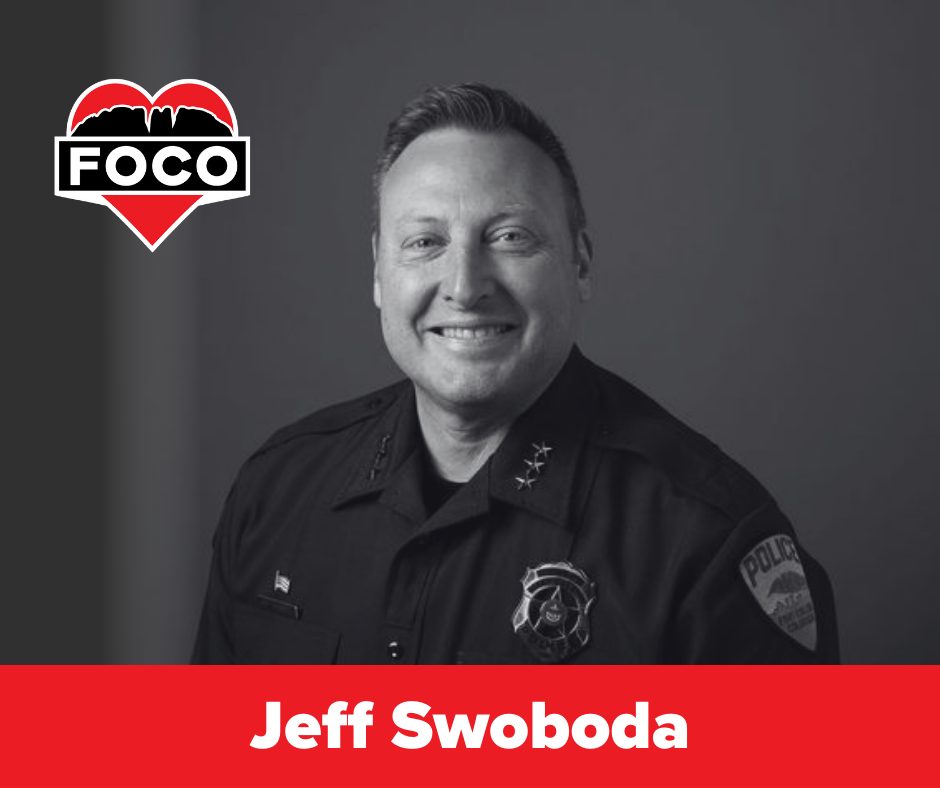

Public safety is evolving alongside the growth of cities, and Fort Collins is no exception. Community collaboration, mental health services, and proactive leadership are shaping a new vision for law enforcement. How can a modern police department stay rooted in service while preparing for future challenges?
According to Jeff Swoboda, who leads Fort Collins Police Services as its Chief, the answer lies in intentional listening, slow and thoughtful hiring, and deeply human leadership. Drawing on nearly three decades of law enforcement experience, Jeff shares how embedded teams, peer support, and neighborhood trust can build a safer, more resilient city. From mental health co-response units to community-policing innovations, his team is redefining what modern policing can look like.
On this episode of The Love FoCo Show, Jeff Faust welcomes Chief Jeff Swoboda for a conversation about police culture, compassion-driven service, and how Fort Collins is planning for the challenges of tomorrow while honoring the legacies of the past.
Jeff Swoboda is the Chief of Police for Fort Collins Police Services, where he leads efforts to build safety through community collaboration and proactive service. Before moving to Fort Collins in 2018, he served for 28 years in Elgin, Illinois, including eight years as Chief of Police. His approach to policing is rooted in servant leadership and early life experiences that showed him the impact an officer can make during moments of crisis. In Fort Collins, he focuses on compassionate policing, mental health outreach, and preparing the department for a rapidly changing future.
Narrator: This is the Love Foco Show
Jeff Swoboda: People look at Fort Collins and what an amazing place to live and work and oh, it's it's it's in a bubble, it's perfect. And I'm with you. I mean, it's it is an amazing place to work. And there are still a lot of people here who are struggling, who are trying to figure out life, who need assistance on a variety of things. And if you just read the headlines, you might not know about that.
Narrator: Welcome to the Love Foco Show. Our podcast highlights the incredible people who make Fort Collins the place we're proud to call home. Each week, your host, Jeff Faust, sits down with local leaders, community champions, and change makers to share their stories, what they love about our city, and how they're helping it thrive. So whether you're out on the trail, at a brewery, or walking through Old Town, thanks for tuning in.
Jeff Faust: Hey, everyone. Jeff Faust here, the host for the Love Foco Show. Today, we sit down with Chief Jeff Swoboda. What a great first name, by the way. He is the police chief for the Fort Collins Police Services, and we cover all kinds of different topics.
I'm so excited for you to catch a glimpse of this conversation. We talk about his origin story, not only to Fort Collins, but even his early exposure to policing in a suburb of Chicago and how childhood memories can influence and impact passion and calling. We also talk about what makes Fort Collins great, the growing complexities of a of a city that is seeing incredible growth and expansion as well as the leaders who came before us with the foresight and how we can continue that long legacy of looking into the future of our great community. So excited to share this conversation with you, and so let's jump right in.
Well, Jeff, thank you so much for giving us some of your time.
Welcome to the Love Foco Show. For our listeners out there, I'm sitting with chief Jeff Swoboda. I'm so excited to be with you. Just so grateful and appreciative of your time. Thanks for being on the show with me.
Jeff Swoboda: Thanks for the invitation. Looking forward to a thoughtful discussion about Fort Collins and right here in the beautiful Fort Collins Police Services headquarters.
Jeff Faust: Well, it's an incredible place to live and even where we're at right now, mean, can just look out over the city. There's people walking down the sidewalk, traffic is going, it's a beautiful fall day and you know, a lot of the the safety, the protection, the services, it it's just run out of this place. So I'm just I'm grateful to be able to sit down with the chief of it all and would love to to jump into this conversation. At the beginning of this podcast, I open it the same way almost every time. And it's just simply by asking folks, what's your Fort Collins origin story?
Like where did you come from? How did you land here? You know, there's a wide variety of stories. Some are native, some are transplants. But how did you get here? What's your origin story here at Fort Collins?
Jeff Swoboda: Yeah. So I am not one of those native Fort Collins people. Yes. I just passed my seven year mark, I've been here since 2018.
Jeff Faust: Alright.
Jeff Swoboda: Came here June 2018, and I come by way of Illinois, a town outside of outside of Chicago called Elgin.
Jeff Faust: Okay.
Jeff Swoboda: And it's about 45 outside of Chicago.
Jeff Faust: I'm a Midwest guy too. I know mean So does that make you a Cubs fan?
Jeff Swoboda: I do. Yes. I am a Cubs fan. Yes. Wife is a socks fan, so it's interesting.
But, yeah, I've been here so a little over seven years, and in Elgin, I got into my policing career back in 1992. So 1992, I became a police officer with Elgin, and I was there for twenty eight years. Wow. And was the chief of police there as well for the last eight years of that twenty six years. And then really was looking around the country, thinking about just a move, and loved my job where I was at, loved the community, things were going fantastic.
And but I was like, you know, I don't know that I wanna be in one police department for, you know, forty years or however long I'm you know, God lets me stay in this in this career.
Jeff Faust: Yep.
Jeff Swoboda: I don't know how long it'll be, but I kind of wanted to try another area. And so I was looking around the country and found Fort Collins from a recruiter actually who talked to me about it and I didn't really know much about Fort Collins. I brought it up to my city manager at the time and and he said, are you kidding me? He's like, they're the apple of cities. Yeah.
Meaning that they're super innovative.
Jeff Swoboda: If you take that You're gone. That's what That's what I'm be early. Exactly. But he was like, it's a great city. And I flew out here at just was about to be in the process or maybe just started the process.
I went to a a boys and girls club event. At 7AM, there were a thousand people in a ballroom, and I'm like, this is my kind of city. So I was blessed to go through the process and it was a long process and the community involvement and it was just every step of the way I just became I felt more and more in love with the city. Here I am.
Jeff Faust: Yeah. I would I I wanna I wanna dig into that in a moment Cause it sounds like even your early introduction to the city was one of a community that gives back. I mean, thousand people at 7AM for boys and girls club. That's incredible.
Jeff Swoboda: It was.
Jeff Faust: So we'll we'll put a pin in that for that. We're gonna circle back to that in a moment. I I find myself at least a little bit curious though. You were chief of police for eight years in Elgin. Before that, you were serving in in the police department, you know, in a variety of capacities.
I'm twenty eight career. Twenty eight year career there. That's incredible. How how did you first get into police? I mean, this part of the family history?
Did you have a a father or a mother who was in the police? Like, did this desire come from? And how'd you first jump into this line of work?
Jeff Swoboda: Yeah. You know, over the years, I've been asked that a lot and I actually did some really deep searching in myself to kind of see if I could answer that question. Because my initial response was always, I was always thought it was interesting. I thought I'd go the federal route, FBI or something. And then a neighbor became a police officer and so I was able to go on some ride alongs with him.
He was older. He was my friend's older brother. So I went on some ride alongs and you know it was something originally when I was younger I thought maybe military. So always kind of like public service but I wasn't sure where. And then local policing opened up and I did that.
And then as I was kinda thinking back to my childhood, there was one instance that really, I think, shaped what I believe police officers can be. And my father had a heart attack and I was coming home with my aunt and uncle and we saw ambulances in front of our house or an ambulance and fire trucks and everything. And so ran in and they were working on my dad. And the police officer kind of grabbed me, he pulled me away a little bit, started, I was only probably, you know, 10 years old. Yeah.
And so really just like, you know, obviously you're nervous. Was home alone and they're working on my dad and this police officer was amazing and he talked to me, hey, what are you doing? Where do you go to school? Everything's gonna be okay? Here's what's going on.
Do you know where you're this is before cell phones, obviously. You know Right. And so it just it was something I kind of always remembered because it's not something you forget. But really, I think it was as I've been in this profession. I think I drew a lot of from because whenever I'm asked about why I care so much about being a police officer and what it can be, I kind of realized, I think a lot of it stemmed from that call for service and just knowing that at your one of your worst times in your life, a police officer can make all the difference.
Jeff Faust: It is really interesting, isn't it? Like how so many of us in our adult life, wherever line of profession we're at, the people we're around, the things that, you know, burn within our hearts when we're when we're line awake at night or whatever, They do have some like you can follow that thread back somewhere.
Jeff Swoboda: Absolutely. Right?
Jeff Faust: It's interesting to me to hear I mean, it's just not an uncommon thing as a a five, a 10, a 12 year or whatever kind of age some of those core memories can have happen influence your trajectory forward.
Jeff Swoboda: Absolutely.
Jeff Faust: And and you know even you had mentioned service. Obviously so because there's a lot of ways you can serve a community. I mean if you had this instilled in your heart, this is just part of your temperament, personality, whatever, you could have gone other routes. Like you could have gone Peace Corps, for instance, you know, is an incredible thing. Or you could have done Teach for America.
There's all kinds of different ways that you could give back. But maybe one of these early memories with a police officer in a time of crisis in need steered you that way. I mean, there's still something about that space that's really really special. But also there's there's a protective measure to policing that's different than maybe some other areas of service. And so as you grew up and as you looked into policing, I mean, were you like an active guy?
I mean, you play sport? I mean, there's an element of policing that I think is also synonymous with like, you gotta be you gotta be fit. You can't be scared of things. I mean, there's like an element of I'm willing to take a risk and take a challenge to protect someone else. Where do you think that came from?
Jeff Swoboda: Yeah. Absolutely. So growing up, yeah, I was very active with sports and, you know, neighborhood where we all all got together and played sports. And I think there's always just with me, always had kind of the, like looking out for the people who are less fortunate, you know, and just seeing people, you know, who are in some tough times and just need kind of need a hand, need to be need some assistance. And so I've always been kind of like sensitive to that because in my life I've needed that.
And so I think the policing really allowed me different than the FBI because kind of fast forward through this, after I was already a police officer for a little while, the FBI did call me to hire me. Okay. And, but I was loving what I was doing and I already got promoted to sergeant and so there was a a variety of things happening. And I already had this connection with the community. I mean, it's where the rubber meets the road.
Right? Like, you hear in government, they talk about all the time. You know, what happens at your city council meeting has more of an impact than what happens out of the White House. Like Right. And people are so in tune with what's happening nationally.
Sometimes I don't even know what the heck is happening in their own backyard. And so I've realized that with policing. You know, are able to show up and and help people on their worst day of their life. And it's an honor to be there and actually make like a bad day maybe just a little bit better or at least it went as good as it can it could have gone because, you know, depending on who shows up to help you, you know, just in life, things can get better or worse. Right?
We all have those friends that give you different advice or help you in different ways and you're like, okay, I'm gonna go this way instead of that way. And so when you do this job right in policing and you're helping people at a at a difficult time in their life, it could just be a traffic crash, and I say just, you know, an officer might go on ten ten different traffic crashes a day. It might be a snowstorm and people are, damaging their car all over the place. But for that individual, how that day goes and what happens to their car might make the difference of do they have a job tomorrow? Can they go to the grocery store?
Not everybody can just has a second car or can go rent a car. So I've just it's like where the like I said before, the rubber meets the road. You're interacting with individuals at a very human level when they're needing some help and in policing. If you do this job right, man, at the end of the day, it's just it's so fulfilling even on really hard days. You feel like, well, know what? I'm glad I was the person that was there for that even though that's you know, I'm not gonna sleep well tonight because of what I saw today. Yep. If somebody needed to be there, I'm glad it's me.
Jeff Faust: Yeah. No. That's incredible. Know I mean, me personally and so many of us are grateful for for guys like you, men and women who work at this department. So thankful that that's, you know, part of our community and and that's the heartbeat of it all.
I I am find myself somewhat curious. You had mentioned FBI police policing and things like that. Do is this like a common thing? I mean, I'm not trying to throw anyone on the bus. Don't don't throw don't throw the FBI under the Do do FBI commonly recruit officers who are doing a great job?
Or were you just like a knockout candidate? We’re like, we just need this guy on our team. I mean like, is that a Do people get recruited away from local police departments to go work for federal agencies?
Jeff Swoboda: They do. Sometimes it's recruiting or sometimes it's the officer looking to go. Like if you are in a a local police department and, you really want to work hard to take fentanyl off the street and so you do a lot of drug cases, there's sometimes a natural calling to say, you know, wanna do this at a higher level, I'm gonna reach out to the DEA. And then they love having people who've already been through academies, they know what policing is all about. So I think there's a little bit of that.
At the time I was going through it, the FBI was going through a hiring where they were hiring white collar crime, you know, this is the nineties. White collar crime was the biggest thing. And so they didn't they really weren't looking for police officers. They were looking for lawyers. They were looking for people who are accountants who can go into a business and figure out where the fraud is.
So FBI does so much they need different specialties. And at the time, think they were kind of full, of police officers and they were looking, for, again, these white collar crime investigators. And as I continue to evolve, I think then they looked back through their records and say, okay, here are some police officers and and they reached back out to me. I don't know how they reached back out to me again because it's been a couple years since I applied with them. And then they reach back out and I was already then at kind of on a good ride at the police department.
Things were going well. Know, an interesting piece on, you know, especially kind of my take on policing. When I first got hired after a couple years on patrol where every officer goes, I went into what was called the resident officer program. And so in this program, you live and work in a neighborhood that's been deemed, you know, quote unquote troubled. There's something going on or stressed is actually the word we used to use.
Could be overcrowding, could be a lot of people. So there's a bunch of cars, traffic is difficult, kids don't have a place a playground to play in, so they're playing in the streets, could be drugs, could be could be anything going on, other crime that's occurring. And so there's a calls for service are elevated in that area, and so they wanna bring it it was the brainchild of chief Chuck Gruber, who was my police chief, had this idea if a police officer was there and didn't just come into the neighborhood and address an issue and then leave, actually became part of the neighborhood, kind of a throwback to the cop on the, you know, cop on the block who's walking, you know, walking, their beat and talking with people. Yeah. And so I did that for almost five years and that really Falls In Love community. And you realize everyone's really in the a similar similar place in that they want to make a living. They wanna raise their kids. They wanna be safe. You know, regardless of what race you are, regardless of how much money you make, at the end of the day, people want to, you know, be safe, you know, and without that nothing else really works.
And so I realized, boy, just going into this neighborhood and, working with the community that when police and community work together, there's truly nothing they can't accomplish. I mean, did some amazing things in reducing crime and building playgrounds and getting kids off drugs and helping with some marriage counseling and with certain families that were dealing with some tough stuff. And it was things that normally a police officer would never do, but I was blessed to be able to experience that. So then I just realized that, again, if you work on some of the root problems, many of these other big issues take care of themselves.
Jeff Faust: When I hear you talk about that, the phrase that comes to my mind, just from my line of work, we would call it incarnational living, right? Or or even incarnational listening. This this ability to be one with, to enter into their space and and really plant yourself in that community. It has a way of even I mean, just proximity Mhmm. To the problem helps you become aware in such a a deep way and be part of a different kind of solution.
Yeah. You're always just looking from the outside looking at it.
Jeff Swoboda: When I was there, you know, this is back in my running days when I got up and went for a run first thing in the morning and dealt with things that the other community was dealing with, and then sometimes they would call the police and sometimes they wouldn't. As an officer coming into it, you look at it differently than if you're experiencing it as well. Right. You know, even just the back in the days before you text somebody to say, I'm outside your house, we used to do the, you know, honk the horn. Yeah.
And so, you know, horn honking for picking people up at work at, you know, four or five in the morning, because there was a lot of blue collar workers there that went up, you know, went to work before the sun rose, and people were always beeping their horns and then waking up kids who were trying to go, you know, to school. And so it was just and when you're in a very crowded it was this was an apartment complex, actually multiple apartment complexes all near each other. The amount of horn honking starting at three thirty four in the morning was a lot, and it would wake everybody up. And so dealing with that but if somebody just called the police about horn honking, an average officer would be like, what? What are we why are we going here?
I don't know. They're already gone by the time I get there. But I was able to educate people on, you know, hey, here's what's happening. You know, we're not just gonna go out and write tickets. You're waking people up.
So because just being out there and viewing it, you'd be able to figure out who's who's getting picked up. So it wasn't like a who done it. Yep. I mean, so it was a matter of educating people and explaining, hey, there's a better way. Pull up, sit there, somebody get out of the car and knock on the door if you're not ready.
You're better. Yeah. Be ready and be waiting outside so you don't to honk the horn. But simple problem, but when it happens day after day, year after year, it was really weighing on some people. Know, I live in a neighborhood they couldn't get pizzas delivered to because the pizza delivery guys were getting robbed.
Yep. And so working with the residents, working with the pizza delivery people so that people could order food and have it delivered. So some of these just very minor things were the stresses that we're building in this community that we were able to address and solve that again never would be a really a police issue. You know, if you can't get a if you can't get your pizza delivered, go pick it up yourself. Like, there's just these little things, these neighborhoods that I I have found and we still see today.
Certain neighborhoods just forgotten about. They don't have the clout. They don't know the mayor first name. They can't make a phone call and have something happen. They don't have the power that many other neighborhoods and people have.
And so that really just resonated with me. It was like, you know, working with people who don't have you know, whether they're disenfranchised, whether, you know, they're working two or three jobs, so they don't go to city council meetings. They don't go to, you know, neighborhood meetings on Saturday morning because they're working. And so how do we continue to interact with them? Because they mean just as much as anybody else who has a house and who knows
Jeff Faust: Well, it's really interesting too because I mean, you move from I mean, Elgin, but you know, Chicago Metro Area, there's a lot of exposure to different crimes and different demographics, all kinds of different complex problems on a metro. But I I moved here from Kansas City as well, living in the inner city, working primarily with gang members before we moved out here. Really unique challenges to that neighborhood as well. When I first moved to Fort Collins, I was well, it was a little bit of a culture shock because it was such a completely different community. And I think in the midst of my first six months, I just thought, you know, just in Pleasantville compared to where I was.
And and, you know, don't get me wrong. I haven't had a single drive by shooting since I moved here and we had plenty of them. I'm almost on a weekly basis where I moved some. So so there you know, my kids walk to school. It's a lovely place and of course this is an incredible community.
But there are still pockets of incredible struggle. There are still pockets where there are disenfranchised folks. There there are folks who can't make it to those meetings and and they're still dealing with a complex set of problems that your, your entire team can probably lend your hand to, lend influence to, empower, and I love that that's part of your history because then as you come into Fort Collins, I would imagine you don't see these things as insurmountable but they're they're absolutely they're problems that can be solved.
Jeff Swoboda: Yeah. And and it just it opens your eyes too when you hear terms like, you know, hard to reach members of the community. It's like they're not hard to reach. Yeah. We know where they they live, and we can go into neighborhoods and talk with people.
You know, it might be a different than again, they they don't show up to council meeting some people, but their opinion should matter just as much. And so you have to work a little harder sometimes to get opinions of the entire community. And sometimes, you know, people look at Fort Collins and what an amazing place to live and work and oh, it's it's it's in a bubble, it's perfect. And I'm with you. I mean, it's it is an amazing place to work.
And there are still a lot of people here are struggling, who are trying to figure out life, who need assistance for on a variety of things. And if you just read the headlines, you might not know about that. So getting out there in the community and showing that you're engaged and you care mean a lot. And so, yeah, our officers get that and we many times have to go to the community to have community meetings, you know, in a park that's right by, you know, their house at a time that makes sense for them. And use other third parties to help us kind of get our foot in the door in certain neighborhoods to address issues.
So, yeah, it's just it's it's the part of the job that I love. It's also the one of the hardest parts of the job too, but it's it's the part that I really enjoy the challenge.
Jeff Faust: Well, me ask you about that because I mean, full disclosure, this is the first interview I've recorded with someone who is armed. So this is a new it's a new experience for me. But, you know, I think it would be easy from someone on outside looking at would imagine many of our our listeners even, having even put together the reality that's not the Fort Collins Police Department, but it's the Fort Collins Police Services. And even as I hear you talk, I hear a lot about this servant leadership. I I hear a lot about this, you know, I I mentioned incarnational living where you're part of the community.
You know, it's not lost on me that there are police cars and residences all over our city. And people know if they're living by an officer and talk to me a little bit about the difference between you know Fort Collins PD versus Fort Collins Police Services because that has to be an intentional change in the name. And I think sometimes we can think it's just it's policing, it's forceful, it's aggressive, it's protection, but I hear a lot more of the softer side when I hear, just your stories and even the title Fort Collins Police Services. So just, yeah, fill us in on on some of that history and and what the heartbeat behind that is.
Jeff Swoboda: Yeah. The city made this change prior to me being here and just looked at all their service areas and police were one of them. And it is a it's a service that we provide to the community. It's a it's a service we provide with the community. And so I think, the name kind of also signals the way in which we go about doing our business.
And so I was struck by two when I came because I I'm used to calling things departments. It's a police department of police and and it is. It's FCPS, Fort Collins Police Services. And so I think that the signal is that how we continue to reduce crime and make sure that people are safe and make sure people have a say in how their police department is running, is that signal is there because it's like it's not done at all costs. Like if we talk about a department, it's more of a structure, it's a a thing and in places it's like, oh, if something bad is going on, we tell them and they come and they fix it.
Where the service area in my mind is a service in cooperation with our community. So it's a small change fort collins police services vs fort collins police department, But the city said that is a service that we have just as we have many other services, and we wanna make sure our residents know that we can utilize them. It's not just the, you know, the, the police officers are gonna go out and find things to address. Yeah. It's that if we have a cooperation, we have an agreement that we we're all in this together, when you need help, at a low level, we'll come in, we'll help you, and we'll solve some problems together.
So it's a, like I said, a small signal, but it's not we're we don't we're not here as part of a a a movement and a a way which we work with our community to solve problems at low levels, so they don't turn into big problems that need a whole different set of solutions to attach to them. So kind of more just a shift in in thought process that, again, happened before me, but, I'm proud that, the city was thinking that way.
Jeff Faust: Yeah. Wasn't lost on me when I moved here. Because, you know, mean, whether it's hats, whether it's tattoos, whether it's, mantras of different cities are so proud about, you know, NYPD or KCPD where I came from or Chicago PD. I mean, it's even in Hollywood. Right?
There's TV shows. But then moving here, Fort Collins Police Services. It just it perked my interest and I was like, man, I as I learn more and as I see the operations even within our city, I I feel that and I imagine many of our citizens do too. I wanna I wanna ask you a question because our city, you inherited this role. Obviously, were there were police chiefs before you.
There was police services before you. But you come at a really interesting time because our city is seeing growth. And with growth, it's not like crime just magically goes away because you have a police services I or mean, as cities grow and as population increases, as there's, you know, disparity economically and different hardships in the city, crime has a way of of sneaking around too. And so as you think about how can we morph and how can we grow with our city, I imagine you're aware of, you know, complexities will also follow the growth of our city. And so how are you thinking about that the next year, the next five years, the next ten years as you position our city to maintain that beautiful, safe environment that we've all come to love.
Mean, that's gotta be a challenge.
Jeff Swoboda: Yeah. It is. And as things grow, it doesn't we talk a lot about the growth and the city does a lot and the council meetings we've been to with, you know, how how the city can grow and land use codes and what can go where. You know, those are very those are big conversations that city has. And what I love is that at every step of the way, people are thinking about, okay, what does this mean to us as a community?
And when I when I say that, I love that the police are thought about in some ways almost as an afterthought. Like, it's it's we're gonna be having these issues, we're gonna be having more people, but we're not gonna accept that more people means more crime. It's the understanding that if you're gonna come to fort collins and live in fort collins, there's a relationship between neighbors amongst themselves, between elected officials with their police department. And so as we are growing, yes, we have more traffic which means more traffic crashes and things like that. But at the heart of many of the issues we're dealing with, it's the same issues that every city, at least most cities are dealing with.
Mental health, it's a big driver of a lot of the crime that we're dealing with. And addiction, Addiction is a huge one that, you know, is again, you take those two, you know, mental health and addiction. You know, they have tentacles into probably, you know, more than half of all the crimes we deal with, the calls for service, whether it's retail theft, whether it's people breaking in, again, when someone is potentially not thinking clearly for whatever reason that is and are making decisions that could jeopardize themselves or other people, we get involved. And so what I love is as as the city continues to grow, it's not just let's get more cops and let's add more cops just to respond to calls for service. It's let's think about what are the the issues that are gonna come with growth and let's make sure we're solving problems.
And so for instance, we kicked off a mental health response team going back a few years. As we were looking at this, one area where we're responding to calls for service, but we weren't really well equipped as a as a police agency to address those issues that the city council, the city manager afforded us some mental health officers. So they get additional training. We team them up with clinicians who, when we're on a call for service, were someone, a, yep, they might have committed a crime, but b, there's more to the story and we need to kind of unpack this a little bit. We have officers that can take the time to actually go in there and with the persons, you know, address the issues and hopefully give a warm hand off if they need more resources.
But then the bigger issue is to is to, establish a relationship so that if that person is, you know, having some troubles again in the future, they can reach out and they know the police officers are gonna be there to help them and not just there to arrest them. So it's a way of kind of thinking that way. So mental health, our homeless outreach proactive engagement team, which is called our HOPE team. You know, recognizing that with growth, we're also seeing an increase in the amount of homeless that are in our in our city. And they're still residents of this city, you know, and and they might not have the address that that we can send them a piece of mail to, but they're here.
They're providing the serve or they're expecting services. Many times they need help in various ways. And so how are we responding as a police department in that space as well? So we're looking at it from a police department. We're now doing something with our transit, to make sure safety on the transit line, the max line, and others that people feel safe when they're doing that.
So we're looking at having a police department that understands what are the issues that are coming and how do we solve problems and not just hire more cops to to respond to those calls for service and either write tickets or make arrests. It's we need officers to show up and kind of find out what is the root problem and then how do we address that so it doesn't reoccur.
Jeff Faust: That root problem is so interesting too and I I've actually I've had to call, you know, the police services a couple of times where it wasn't just an officer that showed up, but one of your mental health, leaders or agents came along with and what I witnessed was I was what led for me to call the police services at that point was what I felt was an escalation of aggression to the point where I no longer felt safe.
Jeff Swoboda: Uh-huh.
Jeff Faust: And what I experienced was a complete de escalation when the mental health agent came who just knew more than I knew and knew how to engage and knew how to respond and had way more resources than what I was able to to offer. And so I can just say firsthand. I mean, was a gift to me and and even the organization and people I'm around and I think that's a huge add because like you said that whether it's addiction or or the mental health crisis that we're just squarely within, those things have a greater impact on behavior and responses from folks that we see, you know, on a daily basis.
Jeff Swoboda: Yeah. I'm glad glad you had a positive interaction with it. That's what we're seeing and and we hire really first of all, we hire slow here, and it's by design. You know, we're seeing police departments all over the country need to fill spots. And we're not immune to that as well.
We we have openings from time to time. But what we make sure is we're putting the right person. We're allowing the right person to wear this badge and wear this patch and and represent our community and work with and cooperation with our community. And so when you hire the right people and you give them good training, when we have calls for service like this, the officer shows up and doesn't make it worse. And we've all seen the videos where the officer shows up and all of a sudden it went from, you know, five to 10 immediately.
And so what we're constantly talking about and our officers do an amazing job with is how do we show up at a call that's five or maybe even a 10 and start lowering the 10.
Jeff Faust: That has got to be such a challenge. It is. And I and I like I I would hope our listeners can have deep empathy for your officers because that is hard work. Because you have to protect yourself, you have to protect the people who who called on you to come and and relieve a situation. Mhmm.
And you know, what looks like force on the front end isn't always need to be with force and yet sometimes it does need to be.
Jeff Swoboda: Right. I
Jeff Faust: mean that is a challenging space to be. Again, so thankful for for your entire team because man, I I don't think people always realize how hard of a situation that can that can sometimes be. It does make me wanna ask because you had mentioned earlier earlier in a conversation, you're you gave the example of maybe a police officer who had 10 traffic accidents that he had to he had to walk up on on a snowy day or something like that and I'm here to serve, I'm help, I'm happy to serve, I might not sleep well tonight because of what I saw but I'm happy to serve. Now that's an interesting little tag on and I'm curious if you could talk to a little bit about how not only you're serving the community but even your team. Because PTSD is a real thing and you know even chronic exposure at lower levels, in the in the ministry, in the nonprofit world, call it death by a thousand paper cuts and it's just the day in day out grind of people barking at you and what you're exposed to, that does make it sometimes hard to fall asleep or fall asleep and stay asleep.
How are you thinking about like the overall health of your team And how are you caring for that?
Jeff Swoboda: Yeah. Thanks for asking that because that's a it it is one of the biggest challenges we have in in policing. And many times you get people who wanna, you know, be a police officer and get into it for the right reasons. But then after six months, a year, two years, five years, they say, you know, enough's enough. It's starting to affect me personally.
Because again, police officers by design, you don't see things, hear things, feel things that other people just you you won't be able to understand, and you don't have to see because you pay for people to to deal with that. You know? You don't have to walk up and unbuckle someone who was just killed behind in behind the wheel of a car, and, you know, it's a family that's in there. And and you're dealing with things and you don't have to check pulses on people. And so it is something that absolutely stays with you every call at some level is, you know, stored somewhere in your brain when it comes out, you don't know.
Does it come out for your own family? Do people, you know, see their kids in the calls for service they're going on? So all of these things. Right? It's a tricky space.
What I'm really proud of is Fort Collins, you know, than thirty years ago now, hired a psychologist on staff. Wow. So we have a psychologist. Right now, it's Doctor Seals. It was Doctor Dworkin for a long time.
But they said, you know what? We want to make sure we have services for our, you know, not just police officers, dispatchers, community service officers. The people who are out there on the street working and doing and seeing this, all the things that they see, they need a place to come in and decompress and talk to someone from time to time. And we shouldn't just refer them out to their own, you know, go find a doctor type of thing. So the city, you know, thirty years ago had this idea and it's working splendidly right now.
I mean, it's the the amount of people that talk with, our psychologist, the amount of people that, when they come in are surprised early on to realize even when they're we have our own police academy. When they're in the academy, the psychologist is is built in. They they get to know that person. So that mental health is seen from day one. It's not a weakness.
It's we're all gonna have times where we need to talk with someone, and it's completely expected. It's completely normal. In fact, we have somebody on staff because it's that normal. Where in the past, we had to go through your own insurance and go out and talk to somebody, might become a little bit trickier with who pays for this and all of those things. So so that's number one.
The second part of it, we're really strong peer support team where the group of officers and professional staff come together and they are watching and listening for issues within the department about, hey, I hear that call for service was difficult. Okay, let's call a meeting, let's go reach out and talk with this person. Then they're talking with peers. So we're all looking out for one another. And then we've just you know, one of the reasons to love Fort Collins is such a supportive community.
People appreciate the job that we're doing. And it doesn't mean that we're perfect and that we don't fall short from time to time and officers need to be held accountable if they they do something inappropriate or you know whatever that is. An officer was rude to me and he should get in trouble. Absolutely. I mean we deal with human beings.
But the I mean it's it's unbelievable the amount of work our officers do at such a professional level where force isn't used, people are able to get the help that they need, the community feels supported that the officers did it right. I mean, we're going on a 100,000 calls a year and people might know of a call or two where they heard something or I saw a video or this officer I didn't like, Like, it's just the numbers are so small and they happen. I mean, the human beings have bad days. And so I I think working and living in a community like fort collins where people just get it, that life is tricky, the job is hard for police officers. And so we wanna support police officers, also know that it's being led in a way that we're gonna hold ourselves accountable.
And so, we stress that here in the police department that, hey, there's help, there's resources for you, it's gonna be a difficult job. But just know that if something's going on and it and and you're feeling like, you know what? This call is really sticking with me longer than it should. Know that you can talk to people, you can take time off of work. I mean, there's just it's just a a in policing, I've been doing this over thirty years now.
It's just a new way of thinking about policing that it's just instead of saying, you know, it's gonna happen, deal with it. You know, we still need you at work tomorrow. We we just want people to know that, hey, you're a human being, and if you're having a tough time, talk to someone, take some time off, and if we fall short of expectations, yeah, we're gonna hold you accountable, but we get it. Like nobody's perfect, and so we're gonna welcome you back after you, you know, and so I just it's a I love this this question because we can go on and on about it. It's just it's it's great to live and work in a place that cares about their people and so it makes it easier to be the police chief because the care is expected by I'm not looking like I'm I'm doing something extra for my people because our community wants our officers to have You
Jeff Faust: don't have to fight for that to be more than what you do
Jeff Swoboda:. Exactly.
Jeff Faust: It's just it's yeah. It's here.
Jeff Swoboda: We're well paid. We have great resources. We have great equipment because our council and our city manager wants our officers to have that. You know? Because they recognize how important this role is.
So I'm not fighting for those things because it's everybody gets that in this town.
Jeff Faust: That's one of the things I I hear not only from you, but from so many people that I've talked to is someone before we were here had the foresight for this. So thirty years ago, they're like, we need we're gonna need a psychiatrist on the team. You know, thirty years ago, someone made this plan for the city. Eighty years ago, they started thinking about utilities underground. All these different there were so many great leaders that that came before us that had this foresight.
It's definitely one of the things I love about our community. I'm fascinated by more and more the longer I'm here. I'm just just grateful.
Jeff Swoboda: And so I just I love that. And then and I know you'll get this as well. And so the challenges now is like what are we setting up so that in twenty thirty years people are saying wow they thought of that you know because it's great to inherit all this but a part of inheritance is that you pay it forward like you're preparing the next one. So we talk about that a lot. Like, how are we setting up the next generation?
That's gonna be different. It's gonna be more drones. It's gonna be AI. It's gonna be people behind their their you know, does anybody drive to work anymore? Is everybody gonna be on their computer and on their phone?
I mean, we're on it now, but even more so where it's a virtual world. And then how do you make relationships as a police department? So we're having a lot of discussions in that space about, you know, what are we setting up? So that thirty years from now when they you know we talked about thirty years ago they thought about psychologists what are we doing so that thirty years from now they're saying wow they were they were ready for it and they really put they set us up for success.
Jeff Faust: Well chief I would love to circle back and have that conversation with you at another time. Mean, because that that sounds like it could be really interesting. I wanna honor your time. I'm so grateful that you were able to sit down with me. I look for this feels like the beginning of maybe a couple conversations with you and with other people from your team that I could come back and have.
But again, Chief, thank you so much for spending time with the Love FoCo Show. Grateful for what you're doing for our city and I know you represent so many people that are on your team just from one and from many others in our community. We are so thankful for your leadership and so thankful for your entire team and yeah appreciate you taking some time to share your story with everyone.
Jeff Swoboda: Well thank you for the invitation and for your support of the men and women that are out there doing this difficult job and and telling the story of of of this. So appreciate it. And, yes, because I think each one of the topics that we kind of breeze through, we could probably spend another Oh. Hour or so.
Jeff Faust: There's chapters still to be written for sure.
Jeff Swoboda: Well, I'm available, and I would love to continue the conversation. And thanks for all your goodness. We appreciate you.
Narrator: Thanks for listening to the Love Foco Show. If today's conversation inspired you, share it with a friend who loves Fort Collins as much as you do. Don't forget to subscribe so you never miss an episode, and leave us a review. It helps more people discover us. To learn more about Love Foco and find opportunities for loving our city one life at a time, visit lovefoco.com.
For now, keep loving Fort Collins well.

