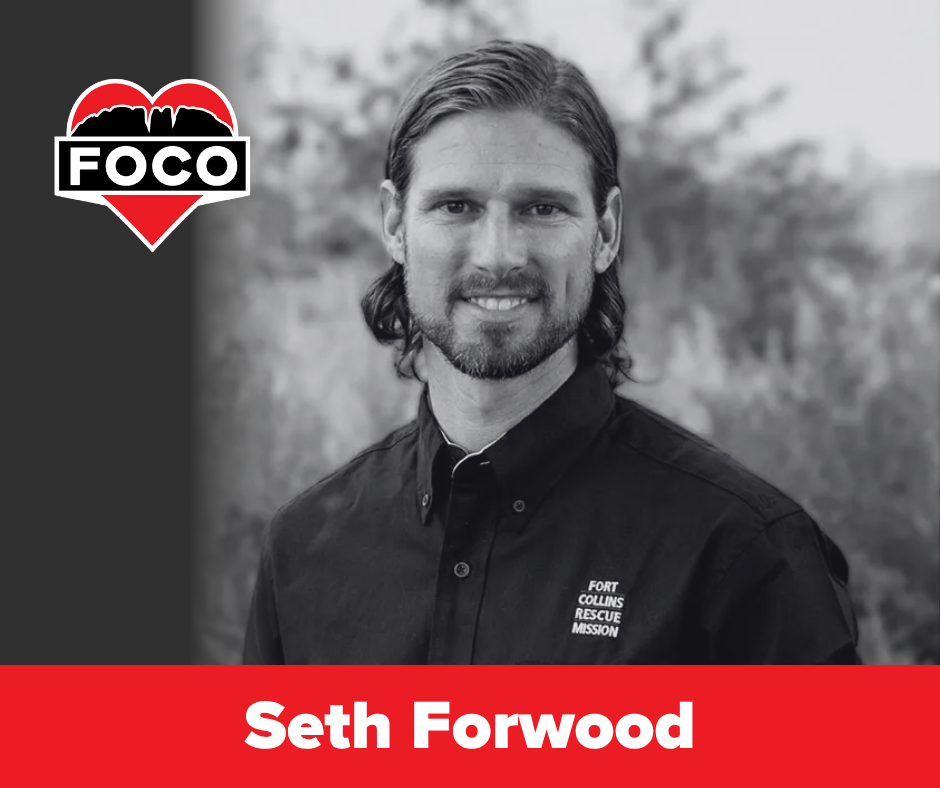

Seth Forwood is the Director of the Fort Collins Rescue Mission. With over two decades of experience in nonprofit service, Seth began his career at Harvest Farm, a long-term residential rehabilitation program. He holds a philosophy degree from Colorado State University and combines his personal journey of grief, faith, and healing to lead with compassion and innovation. Through his leadership, Fort Collins is on the cusp of opening a groundbreaking Homeless Resolution Center that blends trauma-informed design with comprehensive care.
Homelessness continues to challenge cities nationwide, testing how communities care for their most vulnerable residents. With winter approaching and rising housing insecurity, cities like Fort Collins must rethink how they provide support, dignity, and long-term solutions for those without shelter. What does it look like to truly resolve homelessness rather than just manage it?
According to Seth Forwood, who directs the Fort Collins Rescue Mission, lasting solutions start with trauma-informed care, relational support, and hope for a better future. He shares how his personal journey through loss, healing, and faith deeply informs his leadership and why Fort Collins’ upcoming Homeless Resolution Center is more than just a shelter—it’s a transformative model for cities across the country.
On this episode of the Love FoCo Show, Jeff Faust welcomes Seth Forwood for a conversation about redemption, compassion, and the future of homelessness response in Fort Collins. Seth shares his vision for a trauma-informed homelessness resolution center, reflects on how personal tragedy shaped his life’s mission, and invites the community to help close the final fundraising gap.
Narrator: This is the Love Foco Show.
Seth Forwood: I took a day off of work and I took the Max bus to downtown, for my daughter's birthday. And I run into a client and I'm like, ugh, on my day off of work, no. But he has grocery bags on his feet and he just got a haircut. And when he heard it was my daughter's birthday, he reached into his bag and he got out a roll of Sacagewea gold coins. And he dug his thumb in and he peeled off a coin to get to my daughter.
And people even in the lowest parts of our society could become somebody who can go around the community and give out gold coins.
Narrator: Welcome to the Love Foco Show. Our podcast highlights the incredible people who make Fort Collins the place we're proud to call home. Each week, your host, Jeff Faust, sits down with local leaders, community champions, and change makers to share their stories, what they love about our city, and how they're helping it thrive. So whether you're out on the trail, at a brewery, or walking through Old Town, thanks for tuning in.
Jeff Faust: Hey, everyone. Jeff Faust here, your host for the Love FoCo Show. I'm so excited to share this conversation with you today. I'm sitting down with Seth Forwood, the director of the Denver Rescue Mission up here in Fort Collins. He has an incredible story.
One marked with, you know, faithfulness, but also a mixture of tragedy and just growth and continued progress both in his own life as well as in his service to the community around us. And bonus, there are some really exciting things that he is leading in our city to bless and care for so many individuals that call our city their home. You're not gonna wanna miss this conversation, and I'm so thankful that Seth sat down with us for a conversation today.
Jeff Faust: Well, Seth, thank you so much for making time for the Love Foco Show. Grateful that you're here with us. And I've been looking forward to this conversation because the work that you're doing in our city is it's so needed, so impactful, and I know it will it will just touch a lot of people's lives directly and indirectly. And so, thanks for making time to sit down with me.
Seth Forwood: Yeah. Thanks, Jeff. It's good to be here with you.
Jeff Faust: We like to start these conversations the same way. We all have a different story. We all have different things that brought us to Fort Collins and Northern Colorado area. And of course, of our lives are kind of being weaved together in some kind of interesting way. And so, would love to just hear from you, like, what is your Fort Collins origin story?
You know, how'd you get here? Where'd you come from? What what are some of those things shaped you even to be into the place that you find yourself today?
Seth Forwood: Yeah. So, I'm not a native, not technically a native for those that are sticklers about that…
Jeff Faust: There's not there's not a lot. That's what I'm learning. There's not truly a lot.
Seth Forwood: It's true. So I was born in Manhattan, Kansas.
Jeff Faust: Okay. Wait. Is that is that Wildcat territory? Like, K-State?
Seth Forwood: Yes. I believe so.
Jeff Faust: Yeah. Okay.
Seth Forwood: Yeah. Ag University. Yep. Moved to Columbia, Missouri.
Jeff Faust: Okay.
Seth Forwood: Another Ag University. Yeah. And then moved to Fort Collins in '89. Okay. To CSU, another Ag University.
Jeff Faust: Wait. So how old were you when you moved here? I was
Seth Forwood: right around eight or nine years old.
Jeff Faust: Okay. Yeah. Okay. So you had a couple of moves early. I mean, you remember Manhattan at all?
No. Okay. No. What about Columbia?
Seth Forwood: Yeah. Remember Columbia.
Jeff Faust: You remember Columbia?
Seth Forwood: Yeah. Because we had we had this gorgeous property with sheep and a hill and a lake, you know, all that kind of stuff. But my dad was an agricultural researcher for the federal government. Okay. And got a job here in connection with CSU, but not for CSU.
Was still for the federal government. And so, yeah, we moved out here when I was eight or nine. Yeah. A little bit after moving here, my dad died of a severe heart attack that no one saw coming. Just one Saturday morning, it was like he was gone.
And so there's there's some grace actually in being in Fort Collins and not in Missouri where we had all this property and my mom would have had to, you know, figure out what to do with all of that. So even though that was tragic and it and it's been very definitive in my life, losing my dad so early.
Jeff Faust: How old were you again?
Seth Forwood: I was 10.
Jeff Faust: 10. And he died.
Seth Forwood: Yeah. And he was 41 years old.
Jeff Faust: Yeah. Like, I have a 10 year old.
Seth Forwood: Yeah. Know.
Jeff Faust: I mean, that's kind of surreal. Yeah. Just brings it home to a personal level on my end of it.
Seth Forwood: Turning 41 a couple of years ago was was quite a trip. Yeah. You know, that experience with my dad. But we stayed here, you know, after after that and I went to CSU, you know, so I grew up here and I I pretty much stayed here ever since. Okay.
You know, about thirty three, thirty four years ago.
Yeah. Yeah. That's how I grew up here.
Jeff Faust: Well, me ask you just a couple of questions that and Yeah. You can pass out on many of these questions as you wanna pass on. Okay. But I I find myself just kind of curious as a 10 year old, I mean, was was what began to kind of fill some of the the aches of your heart or even maybe even some of the gaps of like, man, I I had a dad for these really formative years and now my dad's passed. I'm 11, I'm 12, I'm 13, I'm gonna go through a growth spurt at some point.
Seth Forwood: Sure.
Jeff Faust: How did you find yourself even like emotionally navigating some of those spaces? Is it okay for me to ask that?
Seth Forwood: Yeah, sure it is. And I have a lot of answers to it. A real quick one is, I I didn't I didn't handle my dad's death well at all. I I really like I I started to get migraines and I would like pull on my hair. I just couldn't absorb it in any kind of healthy way.
And so I really like numbed out on it for a long time. And so I I might I can go back and tell you about how that got resolved early in adulthood. But so that was one factor.
Jeff Faust: And that's like the stress and the pain coming out in like really tangible physical ways.
Seth Forwood: Physical ways. Yeah. That I just
Jeff Faust: Because our bodies are connected to our minds. Right. Connected to our and so Yeah. It seems like it was just being expressed as a 10 or 11 year old in ways that maybe you couldn't articulate
Seth Forwood: and Yeah. Yeah. I I just couldn't understand it, you know, and I couldn't handle it. So I kind of just locked it away. Yeah.
But we were part of a church locally here and I did have several really great father figures. You know, the friends my my friend's dad, who was friends with my dad, was he was a really important, you know, guy in my life. And then, also a part of that church, we're part of a a small group, you know. So my parents would bounce around to other families’ houses for like their weekly bible studies. And
Jeff Faust: And this is like one of those things where the kids tag along and eat a meal together and hang out and Yes.
Seth Forwood: And just like, live feral in the streets, You know or you know, in in not so great times, ding dong ditch, you know, other neighboring houses Yeah. During bible study.
Jeff Faust: Well, I'm 40 years old and I ding dong ditched the other day and left my wife on some which was hilarious because she didn't see it coming. So you're never too old. You're never too old.
Seth Forwood: Family in that group of small that small group collection of families. There was a lady who had cancer on and off for a long long time and she shared after a really bad prognosis that it was it was basically terminal now. And they they really tried everything that they could. And she wasn't afraid of dying at all, but she expressed to the small group like I'm afraid of being alone. Because nobody wants to be around somebody who's actively dying.
You know? Where where cancer is like taking from them until they lose their life. And my mom was a nurse and she worked at PVH. She was a NICU nurse so she worked a lot with infants but she was super comfortable in
Jeff Faust: Yeah.
Seth Forwood: That environment..
Jeff Faust: Around pain and tragic anxious moments.
Seth Forwood: Yeah. And so she said, you know what? I let's just schedule a standing, you know, date where we can hang out on like Tuesday afternoons or Tuesday mornings, whatever it was. Because I I would be thrilled to be with you as you go on this journey and we can just be together. And on one of those times, this lady and my mom were out to breakfast and this lady looks at my mom and she says, Rosemary, I really think I found a good match for you because this was after my dad died.
And she said, I think my husband would be a good match for you after I'm dead.
Jeff Faust: Woah.
Seth Forwood: And my mom just kinda I don't know how you gracefully respond to that Yeah. Kind of statement.
Jeff Faust: I mean, I'm sitting here and I did not expect that during the conversation.
Seth Forwood: I know. And so I think she just said, wow. Yeah. Wow. But Linda did end up dying shortly after that. And this was probably over a year after my dad had died. And then, you know, maybe eight months, nine months after this lady had died and my mom ended up dating this lady's husband.
Jeff Faust: Really?
Seth Forwood: And ended up marrying him.
Jeff Faust: Stop.
Seth Forwood: And so I I had a stepdad and he wasn't my dad, you know? But he he just died in April and he was my dad longer than my biological Yeah. Father And he was such a kind, gracious guy. He was a local family physician here, so he he was part of healing many people. He he even helped my wife because she went to his practice before we got married.
You know, she was a little child and so he was also a a huge gift from God in my life. Not having my father, but having an amazing stepdad that I called my dad Yeah. For the majority of my life. And and that was just he was such a… you you realize how much you need these people and how much you miss them and how much you depend on them once they're gone. Yeah.
But I'm so grateful for the thirty years that I had him as my as my dad.
Jeff Faust: Well, it's it's really interesting. I mean, thank you for sharing that. Mhmm. That's an incredible story to hear and and to share with our listeners. One of the things that really I mean, there's a lot of things I would love to to talk about around it.
But one of the things I hear in that story is like really maybe what I would call social or like relational economy. Yeah. For lack of better words. Like when your mom was grieving and your family was grieving, this community centered around faith.
Seth Forwood: Yeah.
Jeff Faust: In this in this faith community really circled around you and then your mom who experienced that comfort was able to offer that comfort to someone else who's grieving. Yeah. That's right. And and then even after another person passed that this kind of relational network and community that then even merged together and became one family unit. Yeah.
That is so important. Yeah. I mean, we're gonna hopefully I I no. We are going to very soon talk about your work with Denver Rescue Mission. I'm very excited for that conversation.
But anybody who's worked in this space or anybody's worked in in like the human space, human services, we all know financial things are important. Mhmm. And there's a bunch of other economies that are important in someone's life to help them thrive.
Seth Forwood: Yeah.
Jeff Faust: Emotional health, financial health of course, but also this relational and social support system is so important and it feels providential that you are surrounded with older men and different members that could keep pouring into you in your formative years.
Seth Forwood: Well, and it's you you will find it no more precious to have that that network of support and you know, mutual giving and receiving, it becomes precious when you hit suffering, you know, when you encounter suffering like death, like unexpected disease or, you know, a medical emergency. You know, that is when something that you take for granted all the time. I know I take it for granted all the time. But that's when you really realize that it is what forges grace out of suffering in life. That's really…
Jeff Faust: But that’s not natural for everyone. I mean, because you you've probably been around enough people who've experienced suffering have gone in a different direction than where your life has gone. Mean, I I've seen people respond to suffering in a lot of different ways. How what do you think allowed you to respond in the midst of that suffering in a a positive way? I mean, you go back to your 10 year old self, you fast forward to I mean, you're probably in your forties at this point.
Mhmm. I'm sure there are ups and downs and false starts and retreats, all kinds of things, but the knowing enough of you, your heart has stayed alive. And you still have this desire to give back to the community. I mean, how did you what do you think allowed you to navigate that suffering in such a grace-filled way?
Seth Forwood: Well, I mean, the community carried me for a long time, you know, just in the ways that we just described.
Jeff Faust: Yeah.
Seth Forwood: There's this there's this fantastic poet named Christian Wyman, and he wrote a memoir called My Bright Abyss, and I'm gonna tie this back to my life real soon. But I just wanted to mention it because I think everyone should read him. In his memoir, it's it's about his time where two things happened to him. He was a poet. He grew up West Texas, Southern Baptist, left the faith for a long time and poetry was his religion.
And he was a editor of Poetry Magazine, the biggest and oldest poetry kind of journal in The United States for a long time. So hugely accomplished there, but two things happened to him. He fell in love like deep true love, and he was diagnosed with a rare bone marrow cancer right after falling in love. And those two events are what brought him back to the Christian faith. Because one, he would sit down with his wife before his diagnosis and they'd be so happy that they just want to give thanks to the universe, you know.
They just wanted some huge target to be grateful for because that was their experience of love. And then when he's confronted with death, he must find some meaning in life, you know. He has to have something to help him navigate this awful cancer diagnosis and the treatment. So for me also, the experience of my dad's death and then I fell in love with my wife and in my late twenties and as soon as I fell in love with my wife and I'm like, oh, I wanna live with this person for the rest of my life. The next thought in my mind was, oh, crap.
I have some stuff I have to figure out. Yeah. And all the stuff that I locked away
Jeff Faust: Yep.
Seth Forwood: From my dad's death, I knew was still there. And I knew that as as much as I had that contained, it would contain how much joy and love and full living that I could share with this woman that I wanted to share it with. And I knew I had to give her more than what I was capable of giving at that point. And so, that's when I just started going to counseling. Yep.
And I went there to like it wasn't pre marital counseling, but it was like, I wanna get married and I can't get married like I am right now. Yeah. And so that was really helpful to finally have somebody help me unpack something that I had worked really hard to lock down. And it it was hard work. There are a lot of times where I just kind of stared at my counselor and tried to access these, feelings of grief and loss and, regret. And eventually, you know, I got there. But it was…
Jeff Faust: It’s a big tragedy.
Seth Forwood: A long process over a year of going to counseling. But that helped me be able to fully engage with life. There's a a Buddhist writer on John Cabot Zinn, I think is his name. And I I love one of the phrases he has. It's called full catastrophe living.
And I wasn't I wasn't able to to do full catastrophe living, you know, because I had contained some pretty big things. Yeah. So that also led me into my career, you know, I I I went and eventually did social work because I had such a good experience with counseling, and it helped me so much. A lot of times you see that, you know, counseling, counselors are counselors because they receive from counseling Right.
In pretty pivotal times in their lives. Yeah. Yeah. Yeah, so counseling and the counseling process. And really, the love that I wanted to embrace but couldn't embrace was the motivation to actually get me over the hump of the fear of encountering all this loss that was like this gaping black hole in the middle of my life.
Jeff Faust: Well, sounds like you've done a lot of work, but man, anybody who's been through that and tried to do that work knows it's hard work. Yeah. It is not easy work. Yeah. But I can't I can't think of a a better I mean, we'll put the show notes for that poet and maybe Mhmm.
We'll try to find that that poem and that memoir to put in the show notes as well. It sounds like an incredible little read, but even can't think of a a better way to encourage young men to just Yeah. Do the work. Yeah. Because those untended to tragedies really can they just linger on.
Seth Forwood: Yeah.
Jeff Faust: What what I mean, and they I like how you put it. They they put a cap or they put a ceiling on even your ability to experience like the full human nature.
Seth Forwood: Your emotional and be registered. Across the board. Yes. Is limited because of even one area of your emotional development being stunted or contained or you know, not developed fully. Yeah.
So, yeah, I would say, counseling has been one of the most important things. But, you know, to kind of veer over, into my professional, career also, I went to, kind of a, a large evangelical church as a youth, you know, where my parents met and Right. And we were given pretty great gifts.
But as a college student, like a lot of college students Yeah. I was super frustrated with my experience of my church. Yeah. As a more balanced, less reactive adult, I realized that a lot of my complaints were probably more about me than the church.
Jeff Faust: But but in your twenties, only can see it one way. That's right. You're 20.
Seth Forwood: That's right. And really, just to put a fine point on it, I felt like everybody who went to church put on a mask before they entered church, you know, that everything's great and okay. And we don't have any problems. Things are just doing fine. And then as soon as they get out of church, they take off the mask and they are their real selves.
Jeff Faust: And there's a lot of even I'm thinking even about like the songs that are sung Mhmm. The conversations that are had, a lot of them are around and and rightfully so. Some of them around they're around joy, they're around victory, they're around living your best life, know, and things like that. We haven't written as many songs about lament. Yeah.
Right. Grief. I mean, don't sell. Yeah. And I you know, anything that's good in America right now tends to get monetized.
And like, you know, songs of lament probably aren't gonna sell a lot of copies. It's really interesting even even that you bring up kind of an evangelical background. Mhmm. We just had a speaker come out and spend some time with with me and my staff and he said, know, the problem with words is you just never know where they've been.
Seth Forwood: Yeah.
Jeff Faust: And so evangelical, even that word evangelical sixty years ago meant something very different than it means today.
Seth Forwood: Yeah. That's right.
Jeff Faust: And even the expression of that in our churches can mean something different today than it than it used to. And I think it's a common journey for a lot of young people who want to take their faith seriously, but have had maybe had one background or one particular way to really wanna strengthen some of their faith experience, their understanding, even the way that our faith encourages to engage with the world around us. Yeah. Sounds like there's been some of that in your journey as well.
Seth Forwood: Mhmm. Yeah. Well, I I'm glad that you brought up the the word evangelical because I I don't want to paint with too broad of a brush. Yeah. Because even the evangelical in the nineties, you know, or or the two thousands that I'm talking about is not the the evangelical church of today.
Jeff Faust: Right.
Seth Forwood: You know, I went to a meeting just a couple of months ago that it's called the order of the common life. Have you heard of this? Oh, Started by evangelical vineyard Yep. Pastors Yeah. Who are taking the rule of Saint Benedict and the daily office
Jeff Faust: Yeah.
Seth Forwood: Prayer Yep. And saying, let's let's talk about Yeah.
Jeff Faust: Formation. Who are you who are you hanging out with?
Seth Forwood: This was just like an informational gathering
Jeff Faust: Okay.
Seth Forwood: In Downtown Denver
Jeff Faust: Okay.
Seth Forwood: With I I forget the guy's name who started it, but he was there.
Jeff Faust: Jared Boyd?
Seth Forwood: That might have been it.
Jeff Faust: Maybe?
Seth Forwood: I I don't remember.
Jeff Faust: Okay. Trendy looking guy with
Seth Forwood: Yeah. Yeah.
Jeff Faust: Tattoos. Yeah.
Seth Forwood: All that stuff. Yeah. But it was great. And and there's an Anglican priest who's also involved in the order of the common life. And I come from I I now am in the Anglican tradition named Roscoe, who his last name is Roscoe, who is there also.
And that's how I got kinda connected
Jeff Faust: to it.
Seth Forwood: But anyway, I so I don't wanna paint with too broad of a brush about evangelicalism. But suffice suffice it to say that I was in this church as a young man. I was really disaffected and disillusioned. Thankfully, I was also, getting my, bachelor's degree in philosophy. I went to, front range and got my, general studies degree, went to, transferred over to CSU and got my degree in philosophy.
I was delivering for Pita Pit, which used to be on Elizabeth. Wow. And they stay open until like god awful hours, like 2AM every night. You're just delivering pitas to drunken high college students and getting tipped in bottle rockets
Jeff Faust: Yeah. And like in
Seth Forwood: the globe ultra.
Jeff Faust: Yes.
Seth Forwood: And and then I'm like, I had this epiphany where I'm just about to finish up my degree in philosophy and I'm like, what am I gonna do with this? Yeah. I can upgrade to Pizza Hut maybe, but that's not much.
Jeff Faust: This is not the kind of Yeah. Job training that I had anticipated.
Seth Forwood: Well, I I just don't have any career prospects
Jeff Faust: Yeah.
Seth Forwood: Whatsoever. And I didn't wanna go back to school and do more philosophy. But I'm having this experience at church. We're gonna be at pita pit and I'm I don't have any idea what I'm gonna do. I find out about so I think I've one semester left.
What am I gonna do with my summer? I find an internship for a place called Harvest Farm, and I I actually live on the farm with the men that are going through a long-term residential drug and alcohol treatment program. Yep. And I find out that this is a Christian community where the prerequisite to be a part of this community is that you have to admit that you don't have your stuff together.
Jeff Faust: Yep.
Seth Forwood: That you are broken and that you need other people to kind of hold your brokenness with you. And that staff, that's participants in the program, like everybody who is involved with that showed me a different Christian community than what I was able to see at least in my home church. And that it kind of it it broke me wide open, as far as, really finding that there was a home for me in Christianity, and it filled that gap that I really needed as a young man.
Jeff Faust: Yep.
Seth Forwood: And and that was that was hugely important. I graduated with my philosophy degree, ended up. And a month after, I just went back there. And I just said, hey, give me any job that you got. I wanna I wanna work for you guys.
Yep. And I started as like a part-time instructor.
Jeff Faust: They take philosophy majors with with the pita pit on their resume.
Seth Forwood: That helps that I had like a three month interview with them, you know, just the year before. And yeah, I got two entry level positions. I did volunteer coordination. I taught guys how to use a computer and some finances and stuff. And that was next February, just a couple of months from now, that was twenty years ago
Jeff Faust: Wow.
Seth Forwood: That I started working for. Denver Rescue Mission's the parent organization
Jeff Faust: Yep.
Seth Forwood: And Harvest Farm was where I started working. Harvest Farm absorbed the open door rescue mission
Jeff Faust: Okay.
Seth Forwood: About twelve years ago and so that now is the Fort Collins rescue mission. Yep. And that's that was the other like hugely definitive occurrence in my life that set me on a track that I really I'm still on.
Jeff Faust: Yeah. I know. Man, it's so interesting how all of these things can intertwine and I mean, I I can just imagine, Seth, you driving around at one in the morning with your philosophy books and professors in your head just delivering to
Seth Forwood: Listening to Tom Waits. Yes. Yes.
Jeff Faust: And and musing, you know, about what your life is going to be and yeah. Man, interesting thing. I don't know if if Jared Boyd is the guy that you spent
Seth Forwood: time That's him. That's totally.
Jeff Faust: Down in the the life of of common order or the order of common life.
Seth Forwood: Yeah.
Jeff Faust: Interestingly, and I, you know, I didn't know this about how our lives intertwined. But Jared Boyd was a key mentor in my life
Seth Forwood: Oh, no way.
Jeff Faust: When I lived in Kansas City Uh-huh. And was entering into my own discernment process about whether or not I should move to Fort Collins.
Seth Forwood: Oh, really?
Jeff Faust: And so he was a a spiritual director that I was connected to and he was in my corner but someone not in my church So I could process freely with and with and it was such a gift
Seth Forwood: Oh, that's great.
Jeff Faust: To be able to say, here's what I'm thinking, here's what I'm praying about, here's, you know, where I think God's leading my life. Yeah. And he would ask the right questions and listen so well.
Seth Forwood: Wow. And That's crazy.
Jeff Faust: Really, really important part of my life for about a year. So it's just interesting to learn that about Yeah. About your journey here today.
Seth Forwood: Well, I really like what they're doing. I I hope it I hope it just takes off. I think it's what the American church really needs.
Jeff Faust: I I yeah. I agree. And I I think there's there's a sweetness to it. And even here, you know, your journey with Denver Rescue Mission and Mhmm. And Harvest Farm in particular.
It kind of this this merging, like, if we really take our face serious, we believe what we read in the scriptures, then God is more interested in just whether or not we can answer a few theological crush questions correctly or incorrect. He's actually interested in transforming our whole self.
Seth Forwood: Mhmm.
Jeff Faust: And he's interested in transforming communities.
Seth Forwood: Yep.
Jeff Faust: As well. And so I I I would love to take this as an opportunity to just even kind of pick your brain on a little bit about, you know, what you love about Fort Collins and and how you're loving our city because this is ingrained in your history and who you are as a as a leader in our community. These, you've also personally experienced it. Just with their community coming around you in the midst of tragedy, then helping you move forward. Now, you're part of that on a pretty consistent basis as well.
So tell me a a little bit about, you know, gosh, what do you love about our city? Why'd you stick around? And then I'd love to I'd love to give you a chance to talk about Denver Rescue Mission and where you're currently at and and where you're headed in the future.
Seth Forwood: Yeah. So, I mean, I I have kids now and you were we're raising our family in Fort Collins and one of the things that I love about Fort Collins is it's just a beautiful city. Yeah. You know, beauty is something that we might take for granted for in our town. And that's, you know, that's that's the natural areas, the parks, it's Horsetooth, it's it's downtown.
There's just so much. And I I love imagining the kind of nostalgia that I have for rural Missouri, you know, the deciduous forests of Missouri or the the rolling hills. I love thinking of my kids forming those core childhood memories around the beauty of Fort Collins. Yeah. There was one Thanksgiving or Christmas Eve or something like that that we just took our kids to the square in Fort Collins.
Yeah. It's actually just block away from Fort Collins Rescue Mission. And with the Christmas lights, it was freezing cold.
Jeff Faust: Yeah.
Seth Forwood: But my kids just ran around, you know, in this this beautiful little town square. And so as a father, I'm super excited to be able to give my kids these a really privileged experience of living in a beautiful city.
Jeff Faust: It really is a nice place. Yeah. And if you don't believe that, like, probably haven't gotten out much. Like, all you have
Seth Forwood: to do
Jeff Faust: is go spend some time in a couple other cities and you'll realize, oh, wait. This is a pretty incredible place to live.
Seth Forwood: Yeah. And it's intentional. I mean, I I have spoken with Darren Atteberry, our former city manager in my role and personally because he he went to church with me when I was a kid
Jeff Faust: Okay. As well.
Seth Forwood: Yeah. And he's given me a lot of time that I'm super grateful for and he he talks about being a world class community. Right. That's I think that's really evident in a lot of what we see in the the beauty and the accommodations, the public accommodations of Fort Collins. And to to connect that with my work, I am eager to inspire Fort Collins to be a world class city, a world class community when it comes to addressing the issues of homelessness.
Yeah. And, we are on the cusp of opening a new homeless resolution center in North Fort Collins that I really think is a flagship for that work. And it's not I I I don't wanna make this just about Fort Collins Rescue Mission and Harvest Farm or or Denver rescue mission, because it was a community effort to get us our to to round out our capital campaign, to get, you know, the funding for this, or even just to set up the conversation around where to put a a new homeless resolution center because no one wants it in their part of town. But for the Fort Collins City Staff and leadership really had the forethought to create a diverse group of citizens who rumbled through those topics and set us up to be able to take that content. It it was a a group called the Homelessness Advisory Committee.
And they they did a whole bunch of work over several years to really set up our work as providers really solidly. Yeah. And so, yeah, being world class community in regards to homelessness response means just having adequate shelter for people that need shelter who don't have anywhere else to go. It's starting to get cold right now, as we're recording this at the end of October. And the lives of a community are sacred whether they're housed or whether they're unhoused.
And the fact that people in such a beautiful city can be struggling with their life and limb on cold nights is just unacceptable. And the solution is is right on the cusp, but we're not quite there yet. We started we broke ground. It's about a year of construction, so we're hoping to open right around this time next year.
Jeff Faust: Okay.
Seth Forwood: And we saw some really significant hurdles, some big barriers that are coming up this winter before we have that long term solution. That's taken years to develop, but it's it's almost there.
Jeff Faust: Well, I wanna take about, I definitely wanna take some time to talk about some of those hurdles and some of those kind of immediate needs. It's great to hear that maybe within one year's time
Seth Forwood: Yeah.
Jeff Faust: We'll be having a different conversation about how we can handle the winters.
Seth Forwood: Yep.
Jeff Faust: Let's talk about that in a moment. I wanna I wanna go back to a couple of things that you said. One, what an incredible phrase. I mean, if we're gonna be a city of excellence, we're gonna offer excellent services, we we have to do that for everyone who calls this place home.
Seth Forwood: Yeah.
Jeff Faust: Every life is sacred.
Seth Forwood: That's right.
Jeff Faust: And I just feel like that's worth repeating again and again and again that every life is sacred. You know, as a pastor here in town, as someone who shares faith, you know, with with so many others, We're all created in the image of God and we want to honor, and create hospitable environments for everyone even if they have different walks of life and and backgrounds than us. And so that's really really sweet to be a part of. You had mentioned about how this future space will I I don't know if this is exactly what you said, but almost will will kind of serve as like a flagship opportunity or like a model of what could become.
Seth Forwood: Yeah.
Jeff Faust: So for those who are who are, you know, maybe they know a little bit about this, they don't know the details of this. What are some of the distinctives or what are some of the differentiators that will make this space part of Fort Collins offering of excellent services? Yep. That would maybe be different than a shelter in another city. Sure.
What would set you apart in this upcoming space?
Seth Forwood: That's a great question. The well, the first thing is you you sent me up perfectly because the last word that you used to describe it is a shelter and I'm careful not to describe it as a shelter. It's a homeless resolution center.
Jeff Faust: Yep.
Seth Forwood: It will have 250 shelter beds inside of it.
Jeff Faust: Okay.
Seth Forwood: But shelter comes with a lot of baggage when you're just throwing it out there. A lot of people assume things about shelter that it's like three hots and a cot. Yep. That it's putting a Band Aid on a problem or that it's enabling bad behavior or people to stay kind of in the churn of homelessness.
Jeff Faust: I I would imagine those are like real things people have wondered Yeah.
Seth Forwood: And I don't I don't judge people or begrudge them for having those assumptions. Let's just work around it. And this isn't gonna be a shelter. It's a homeless resolution center, with 250 shelter beds inside of it. It was designed by a architectural firm called Shopworks Architecture.
And they specialize in a very niche type of architecture and it's called trauma informed design. And trauma informed design means that before they started their design process, they came to our current facility and they interviewed people experiencing homelessness, they interviewed our staff, they went to another local homeless facility called Murphy Center and they interviewed, people who are experiencing homelessness there. They interviewed the Homeward Alliance staff. They just did tons of gathering of information from the people that will be utilizing this place. They've also done their homework.
They they've hired several people who've worked in the field of homelessness. They they have a PhD level social worker who does research on trauma as part of their staff. And all of that informs the design of the building because the highest likelihood is that the people that will step foot in this building have had a traumatic event in their life. They say these might be a little bit outdated statistics, but, you know, eighty four percent of men who are homeless have had a traumatic event. Ninety eight percent of women who are homeless have had a traumatic event.
So you assume that people coming into a homeless resolution center have had trauma. They designed this building to address all of the symptoms of PTSD, reduce the barriers that somebody with a traumatic history would have in entering a new unfamiliar building and had the layout to disarm, comfort, and make a welcome space for people with that experience. So one example is they they put they've forgotten more about sound suppression devices and materials than I will ever know in my life. Yeah. Because sound is a really important thing and if we're gonna have a lot of people in this building, having a lot of sound is something that will make it untenable for somebody who has trauma in their history to be in it.
And so they've designed like a PA system with something called gray noise that dissipates sound and all of these surfaces that absorb sound so that it's not a trauma trigger for them. And that's just one small detail of an example.
Jeff Faust: Well, when you stack multiple things like that and you do the work behind it and you create the hospitable environment, I mean, know, when anxiety is running high internally or you're even externally around you, it's really hard to like care for other parts of your life and help people take a step forward because the anxiety can it has a way of crippling that. It can actually, you know, restricting you from being able to experience the healing and transformation that you need.
Seth Forwood: Or it's like blinders, you know? Yeah. You have to look at what's right in front of you.
Jeff Faust: Yep
Seth Forwood: You can't see anything on the periphery.
Jeff Faust: Yep.
Seth Forwood: You can't look around and engage with a part of your life. And the other important thing is we call it a homeless resolution center because the first step that somebody takes in this building, we are going to be talking about what it looks like for them to get into housing of their own. Yeah. That's the purpose. It's not to keep them in their current state.
We wanna address those issues that need to be addressed in order for them to have an imagination of the future Yeah. Like what you're talking about. Know, you have to address needs and then they can look at higher needs.
Jeff Faust: Yeah.
Seth Forwood: But the purpose of the building is to give them access, comfort, belonging, and resources to get into housing of their own. Yep. And that that's another unique thing about how we've designed it and how we plan to run it is there's two ways of expanding shelter beds in a community. One is to build beds and the other one is to make a stay in a bed as short as you possibly can. And that means getting people into housing as soon as you can once they enter into shelter.
So those are our dual purposes is we need to have life and limb safety, and we need to get people into their own places so that they aren't in that churn of homelessness and they're broken from the burden of homelessness.
Jeff Faust: Yep. I I if you allow me to ask you a question that I'm sure is not too sensitive for you because I'm sure you hear all these kinds of different questions.
Seth Forwood: Oh, yeah. Sure.
Jeff Faust: A little throwback to my own history. I grew up in the state of Iowa. I moved to Kansas City and then moved here. But in Iowa, in a small town in Iowa, there is a a baseball field that was built for this this old movie. I don't know if you're gonna remember the name of this movie or not, it's called Kevin Costner. Field Yes. Kevin Costner, field of dreams. And the whole phrase in this movie over and over and over is, if you build it, they will come. Now, it's a it's a Hollywood film, but I have to imagine in the space that you're in, doing fundraising that you're doing to try to build this world class center, that someone has probably addressed the question or something presented it to you like, yes, Seth, this is great, but isn't it true that if we build it, won't they come?
And so like, one, is that true or am I just making up a story in my own head? And two, if that is true, how do you navigate that conversation and help people understand the necessity for this despite maybe their concerns?
Seth Forwood: I mean, it's it's not someone. It's every conversation I have.
Jeff Faust: Okay.
Seth Forwood: Honestly, is. And and again, just like people who have assumptions about homelessness, I don't begrudge them that, you know. If you're operating out of your own framework of life, and you just don't know what you don't know. And so I assume everyone has that question when they're seeing a new $27,500,000 homeless resolution center. The answer that I have is two different answers because painting with somewhat of a broad brush, there's two different kinds of populations when it comes to homelessness.
Jeff Faust: Okay.
Seth Forwood: There are those people who, would choose to not be homeless. There is a small section of the entire population who are resigned to homelessness, who are, you know, a part of the criminal element that a lot of people assume goes throughout the entire population of homelessness, but it does not. It's a very short it's a very small sliver of homelessness. And so separating out those two different populations, we are going to address those people who have found themselves homeless. They have very little hope that they can ever be anything but homeless, but there's a spark that they want to have something better for themselves.
Jeff Faust: Yep.
Seth Forwood: That's what this center is built for. And we have a a good track record of how to move people from that state into having keys to their own place. For those that may be coming through our community or are in our community and they're they they are involved in a lot of crime, you know, they are shown that they are resistant to the resources or shelter or whatever it is, we have strong partnerships with law enforcement, where we have really close friendships with the the police in D1, with the Hope team, with the homelessness outreach and prevention preventative engagement team. And my answer is, if somebody is desperate for change and they stumble into Fort Collins and find this homelessness resolution center and begin the process of getting into a place of their own and becoming a productive member of our society where they can give back in some unique way, I say bring them in. Yeah.
Because if we can reduce their shelter stay and get them into housing of their own, then we are just adding to the relational richness of our community. And we need people who have experience in homelessness to be in stability, as a part of the rich tapestry of our community. And then for those that are not that, that may be involved in the negative interactions that, people assume are across a spectrum of homelessness, you know, that's that's for our law enforcement to deal with, and we will partner with them all day long to be sure that that is being addressed both in our building and outside of our building. And we have a great police force. You you interviewed Chief Swoboda.
Jeff Faust: Just happened.
Seth Forwood: They are fantastic and they feel like they are very confident they can address that aspect of it. Yeah.
Jeff Faust: So Well, think that's so I mean, like, just hearing your story, knowing my own story, I mean, I've struggled with addiction for a number of years in in my early life and and even when I was a teenager and when you're addicted and you're a teenager, make some really dumb decisions. I I've looked back at my life and I realized pretty quickly. I was one or two moments away from being exactly who you're talking about. One or two moments away while I'm an addicted enraged teenager, one or two decisions away from experiencing trauma and tragedy that would spun me out in a totally different direction. And I think because I was so close to that on a knife's edge, maybe there's some inherent compassion within me because I I'm like really just a couple clicks away.
Sometimes we can insulate ourselves from believing that, but the truth is anyone that we encounter is really just a handful of moments away from needing your kind of expertise and care. And so I'm not…
Seth Forwood: And to go back to something we talked about before about relational abundance carrying us through difficulty and suffering. People I've I stole this from a lady named Ruby Payne who talked about this in education. But people are homeless not because of financial poverty. They're homeless because of relational poverty.
Jeff Faust: I love Ruby Pain. I mean, you're dropping some real names here. Jerry Boyd, Ruby Pain, her book is on my shelf on breaking the cycles generational power.
Seth Forwood: That's right.
Jeff Faust: That's right. Incredible manual Yep. For anyone who's working in this space.
Seth Forwood: Yeah. But it's it's the poverty of relationships that these people through whatever circumstances probably in part by their own hand Yep. Have burnt bridges, so that when they are in those dire straits, they don't have anybody And that's why they are exiled to the streets of our community.
Jeff Faust: They may be poor financially, but they're poor in a couple of different societal ways Yes. That creates just they just have a different, you know, hand that's been dealt to them all of a sudden.
Seth Forwood: Yeah. Yeah. Well, and let me end with one story real quick. I I knew a guy who was homeless. He was part of he was a Native American who was taken away from his family in this kind of misguided reculturation.
And he struggled with addiction for so long and he went through Harvest Farm and and was good for a while, but his path to wholeness wasn't straight. He fell into dire straits again. He was hit by a car in the Whole Foods parking lot because somebody mistook him for a bag of trash. Wow. That's that's how kind of degraded his life was.
And he got back into a good program again. Got… regained all of the things that he needed to. And the last time I saw him, I took a day off of work and I took the max bus to downtown for my daughter's birthday and I run into a client and I'm like, ugh, on my day off of work, no. But he has grocery bags on his feet and he just got a haircut and when he heard it was my daughter's birthday, he reached into his bag and he got out a roll of Sakejawea gold coins. And he dug his thumb in and he peeled off a coin to give to my daughter. Yeah. And people even in the lowest parts of our society could become somebody who can go around the community and give out gold coins. That is the hope that we have, that's the hope we should have for our community.
Jeff Faust: Yep.
Seth Forwood: And that's the hope that we have for this new building.
Jeff Faust: That is a sweet story. I mean, your daughter could carry that memory with her for a long…
Seth Forwood: That's right.
Jeff Faust: Yeah. And it could who knows where that story will take her.
Seth Forwood: And who knows? What what stories people experiencing homelessness on streets right now can turn into Right. With adequate resources and accountability and relational abundance.
Jeff Faust: Well, may we all be part of that redemptive story.
Seth Forwood: Yeah.
Jeff Faust: Our city is filled with beautiful stories of redemption. You are helping write a ton more of them. This new center will write scores more. Yeah. Very brief I I know we're running out of time, but I know there was a recent fire
Seth Forwood: Mhmm.
Jeff Faust: At the Denver rescue mission and I know that there's some real struggles on how you're gonna handle this upcoming season. And I imagine, Seth, that there's still you said a $27,400,000
Seth Forwood: 27.5 is the the whole price tag. We are $200,000 away from making that completely whole.
Jeff Faust: That's incredible.
Seth Forwood: They're at 27.3.
Jeff Faust: That means you have been a busy guy. Yeah. And the last two years.
Seth Forwood: Yeah. That's been a lot of my job.
Jeff Faust: So tell me how we can support you, how we can join you in this mission, how we can write redemptive stories alongside your work because I have to imagine many listening to this will wanna support and come alongside of you. So just give me a couple of thoughts how we do that.
Seth Forwood: I hope so. Because it it does take this whole community to pull off something like this. So given to our capital campaign, we would love to finish that that last $200,000 up. Fortcollinsrescuemission.org. It's called the “more than” campaign.
Okay. This is gonna be more than a shelter. Our unhoused neighbors are more than just homeless folks in our community. And we can do more than we ever thought or imagined Yeah. With this campaign.
So give to that. Our our operational budget is gonna be like at least double. And so we're gonna need ongoing gifts. It's winter time and yes, we we're not in our original building and we're looking for a place to expand shelter capacity for this winter and until we get into this new building. And that fire, we have like a $100,000 deductible for insurance.
And so if somebody wants to give specifically to the fire campaign also, that will help us secure a place where we can have we can kind of hold over until the new building gets built.
Jeff Faust: Yeah.
Seth Forwood: And give, you know? We're always needing coats. We're always needing gloves for this for the winter season. We have a list on our website of other, you know, high needs for guests. And and be involved, be an advocate for the work that we do in addressing, you know, assumptions or stereotypes that people have and advocate for us in our church in your church or family or workplaces and see what comes from that.
Jeff Faust: That's so good, Seth. And I I I know many listening I think will take you right up on those. We'll put all those links in our show notes. Maybe this time next year, we could have another conversation. That'd great.
Yeah. We could walk around and Yeah. And learn more and and cast the vision for how other, you know, folks can continue to be involved. But I just wanna say, I mean, man, from all of us at Love FoCo, we are grateful you are in our city. And I know it's not a a one man show, know it's not a Seth show.
Seth Forwood: That's for sure.
Jeff Faust: So many people involved in this. But thank you for loving our city one life at a time. Mhmm. Our city is better because you're in it. And we look forward to the way that we will be part of so many redemptive stories together.
Seth Forwood: Yeah.
Jeff Faust: I appreciate all the work that you do.
Seth Forwood: Thank You, Jeff. You've been a great partner. Appreciate you.
Narrator: Thanks for listening to the Love Foco Show. If today's conversation inspired you, share it with a friend who loves Fort Collins as much as you do. Don't forget to subscribe so you never miss an episode, and leave us a review. It helps more people discover us. To learn more about Love FoCo and find opportunities for loving our city one life at a time, visit lovefoco.com. For now, keep loving Fort Collins well.

